 By Ande Jacobson
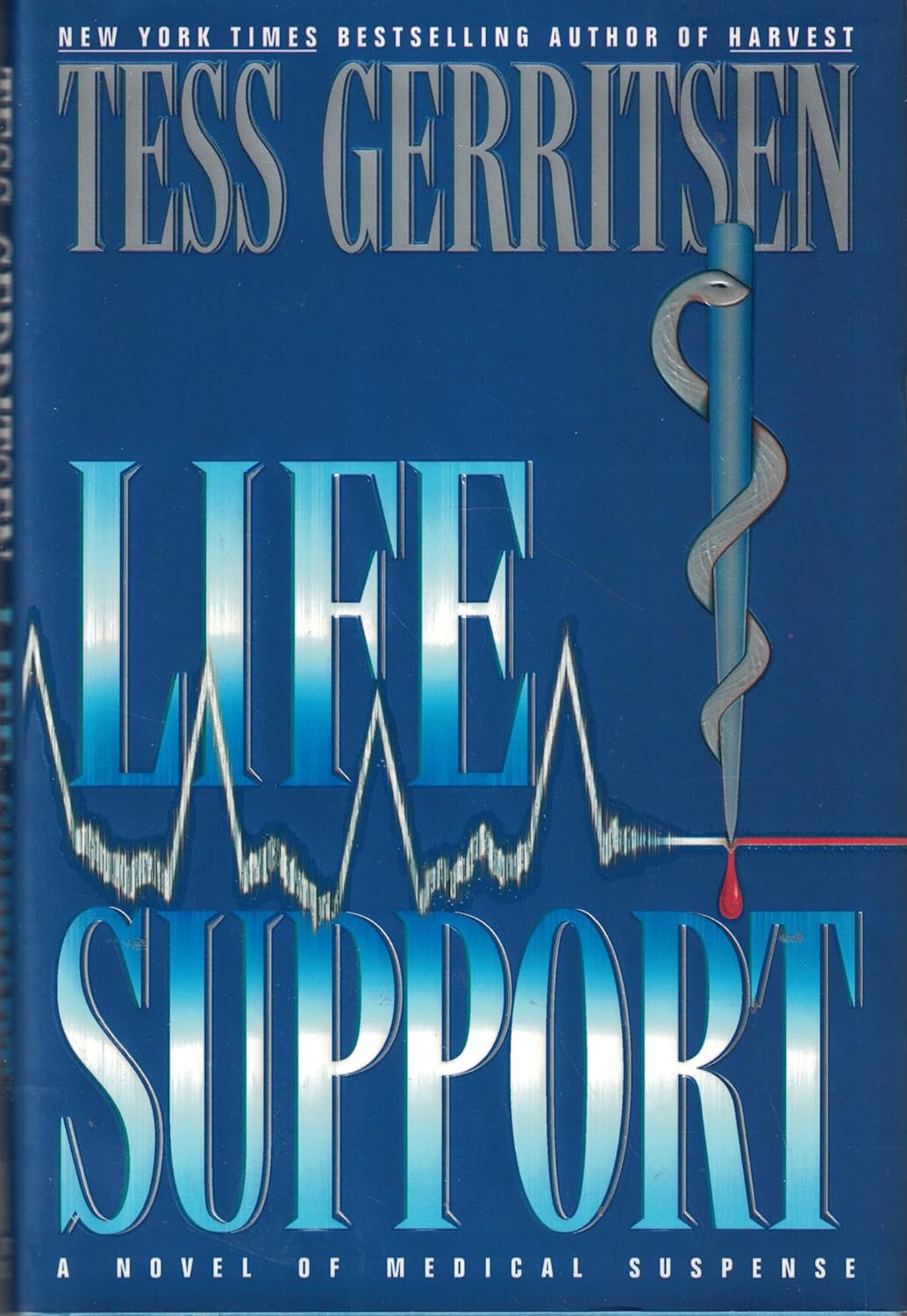
Tess Gerritsen continues her medical thrillers with Life Support, first released in September 1997. As she did in the first of her medical thrillers, she tackles a controversial area of medicine, this time dealing with research into human life extension despite the dangers uncovered along the way. Gerritsen has a way of weaving a compelling story while drawing the reader deeply into disparate details that seem unconnected until much later in the story. She relies heavily on her background as a physician to give the reader a deep understanding of the medicine involved, carefully blurring the lines of what is currently possible. Along the way, Gerritsen also delves into medical research in a way that will likely give readers pause when it comes to exactly what goes into a given research project, from the medicine involved to a quick primer on some curious aspects of genetic engineering.
As she often does in her stories, Gerritsen begins with an unusual situation, an elderly surgeon performing a routine surgery. During the surgery, he has a psychotic break and causes the surgery to end very badly for both himself and the patient. She then jumps to two separate seemingly unrelated situations, the first where a teenage prostitute is put through something only partially revealed in Chapter 2, and the other back in a hospital ER where readers finally meet Dr. Toby Harper in Chapter 3. Toby is the protagonist in this story. She’s an established ER doc just shy of 40, so she’s still relatively young compared to many of her colleagues. She’s exceedingly bright, too much so for her own good at times, but when something doesn’t sit right, she’s not one to ignore it. She’s tenacious and often ruffles feathers when it comes to righting wrongs. She shows that she’s the kind of doctor you’d want if you were in need. She’s also carrying a heavy personal load caring for her mother who is suffering from Alzheimer’s. Although her sister Vicki lives nearby, she’s entrenched in her own family and doesn’t have time to help with their mother all that much. Despite her lack of involvement, Vicki has opinions on everything that Toby is doing wrong. Balancing work and home is a challenge for Toby though she has some help, for a while. Although careful by nature, Toby later learns to be much more circumspect when it comes to hiring outside help.
A surprise work birthday celebration for Toby gets cut short because of a case brought in by the police – an elderly, confused, naked man found wandering the street. As Toby finishes examining the man, his adult son arrives and starts behaving somewhat belligerently. After Toby orders some routine scans to dig a little deeper into the patient’s confusion, the ER gets much busier and grave shift chaos ensues. In the process, Toby has two extremely unfortunate and seemingly unrelated incidents occur. She physically loses the elderly man who somehow, inexplicably ends up leaving the ER on his own, while a critical patient dies after heroic measures are taken to try to save her.
While patients sometimes die, doctors can get burned by the politics of a situation when they overwhelm common sense, and Toby lands in the middle of a turf battle where the odds are stacked against her. Although she couldn’t possibly understand the significance of the elderly man’s symptoms at the time, Toby begins a personal investigation that’s ill-advised because of the danger to her and those around her. This is where the medical mystery takes off, and Gerritsen is exceptionally good at weaving a complicated mystery/thriller that engulfs the reader.
Gerritsen carefully works the science and medicine into the story through her characters’ eyes and actions. Readers become familiar with interesting aspects of medical research, diagnostics, and how hospital and corporate politics can unnecessarily complicate things. Through an evolving story of both greed and opportunism, Gerritsen also points to some of the significant dangers of our for-profit healthcare system. Research is crucial to advance our understanding of the science of course, but only when it’s conducted ethically and openly. The competitive aspect of research can color the results, and greed combined with a complete lack of ethical considerations can create motivations that should never be part of such research, particularly because real lives are stake.
So where does this story lead? In this case the plot leads to multiple betrayals, hidden motives, fascinating extensions of the current state of medical science, and it opens readers’ eyes to very plausible ethical considerations in medical research. In Gerritsen’s stories, it’s not always clear who will survive and who won’t, but her resolutions are generally satisfying and bring together the many disparate plot threads dropped from the start. Still, it’s generally a good idea not to get too attached to any particular character. It’s also a good idea to keep the old adage in mind that if something seems too good to be true, it probably is.
Gerritsen has written numerous standalone novels across multiple subgenres of suspense. Of those, five are explicitly medical thrillers. Those include Harvest (1996), Life Support (1997), Bloodstream (1998), Gravity (1999), and The Bone Garden (2007), so she jumped into the Rizzoli & Isles series after Gravity and much of that series included the same kind of medical detail that became a bit of a Gerritsen trademark from her earlier medical thrillers.
References:
Harvest, by Tess Gerritsen
Life Support, by Tess Gerritsen
https://www.tessgerritsen.com/
https://www.bookseriesinorder.com/tess-gerritsen/

 A Good Reed Review