 By Ande Jacobson
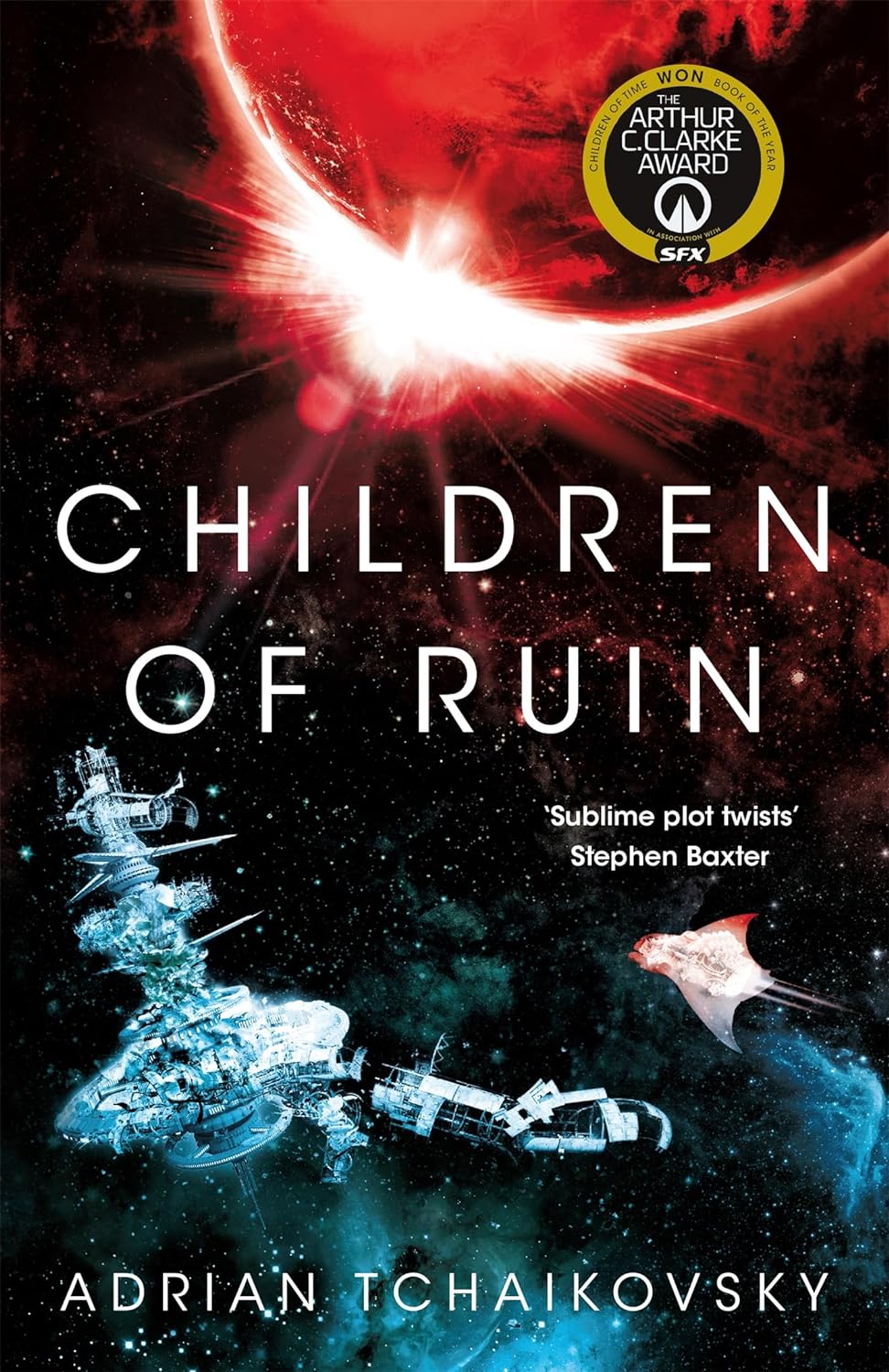
Adrian Tchaikovsky’s series that began with Children of Time, continues with Children of Ruin, originally released in May 2019. Many of the characters from the first book are back, at least in reference, and their descendants do them proud by continuing the adventure. The Humans (with a capital H) and the Portiids now have a strong working relationship on the planet known as Kern’s World, although direct communication is still a bit challenging given the differences in their thought and expressive processes. Capital H Humans are humans who have embraced a mutually beneficial relationship with the Portiids (i.e., large jumping spiders with an advanced intellect and civilization seeded and accelerated by humans of the distant past). Kern’s World from the first book is a planet that was terraformed and seeded with a virus to accelerate the intellectual development of monkeys. Alas, there were no monkeys, but a particular species of jumping spider evolved with the virus to establish a robust civilization on the planet. The planet was named Kern’s World after Avrana Kern, an ancient terraformer/scientist who over the centuries had uploaded her consciousness into an AI and enjoys a type of immortality. Initially, Kern was seen as some kind of god by the Portiids, but eventually when she made herself visible to the Portiids, she became something of an adviser. The first book is discussed in greater detail in ‘Children of Time’ expands minds.
In the second installment in the trilogy, Tchaikovsky runs a parallel storyline alternating sections between the distant past and what is now the present, along the way introducing some new life forms while evolving the existing ones.
In the past, a ship of terraformers and colonizers from Earth have entered a new planetary system and find two candidate planets. One appears desolate, but they discover much to their chagrin that there is some life there which makes it unsuitable for terraforming. An eccentric terraformer, Disra Senkovi, names the planet Nod. Senkovi is brilliant but is a bit of an outcast among the crew. On the ship, he’s much more interested in his collection of octopuses he studies and treats both as experimental subjects and as his pets. The mission commander, Yusuf Baltiel, takes a small team of scientists headed by Dr. Erma Lante to investigate Nod’s inhabitants. They find an inhospitable, desolate world with sparse life so foreign and an environment so hostile that there’s nothing for humans to live on. The air, while not immediately toxic to humans, isn’t sustainable for long term human exposure, and the lifeforms, both plant and animal, offer no nutrients. They also encounter an infective agent that one of the planet’s inhabitants injects into one of the team, their engineer Gav Lortisse. Over a short span of time, they discover that this thing is effectively an intelligent slime mold colony of sorts capable of inhabiting and colonizing a human. Needless to say, it doesn’t end well for the landing team.
The other planet is a dead water world, a planet that Senkovi names Damascus. Although his crew is lost along the way, he and his pets proceed to Damascus to attempt to make a go of it. Senkovi had used a virus on the octopuses to enhance their intellectual development. Even before their enhancements, they were dangerously curious and quite resourceful creatures. While he and his pets can’t exactly talk in the way two humans might, he is able to get them to understand technology far better than he realizes.
This is where Tchaikovsky uses his zoological background to inject some aspects of how octopuses actually behave on our present day Earth, particularly with respect to each other. Unlike humankind, octopuses have a much more distributed nervous system such that their arms operate independently as if they have separate brains from the one in the animal’s mantle, or crown as Tchaikovsky refers to it. He refers to their reach as their independent arms which “discover” the world around them. It’s as if the brain in the mantle is the animal’s primary CPU, and the brains, or more accurately, the pieces of the nervous system present in their arms are independent subprocessors that communicate with the main CPU sharing information, but they don’t take orders from it.
In the story, in the past, the octopuses are still mostly antisocial with one another, interacting only when absolutely necessary. Their interactions are very physical, sometimes violently so to the point of occasionally ripping each other’s arms off to get at whatever has drawn their interest.
The other timeline in the story is a distant future setup at the end of the first book in the series where the Humans and Portiids are working closely together, and the octopuses have not only fully colonized Damascus, but they’ve effectively been expelled by the slime mold. They are more social with one another than in the past, but still very physical, their communication accomplished by changes in their skins and physical contact. There’s is a very visual and emotional language. They have retreated to various space stations and ships as the slime mold has become a menace to all who approach it. Because the octopuses are aquatic creatures, their stations and ships have a unique design that allows them to remain in a mobile aquatic environment. Nod and Damascus are both off limits because of the entrenched slime mold. The thing is that the slime mold entity just seeks adventure, and the humans it encountered on Nod made it (or more accurately them) aware that there was far more beyond Nod. Where they came from originally if they existed before their presence on Nod, Tchaikovsky doesn’t divulge.
Meanwhile, the octopuses know that the humans of past Millennia had brought the invader to Damascus and don’t want further contact with outsiders that might make their current situation even worse. When a small ship of Humans and Portiids from Kern’s World approaches, the octopuses are hostile. They attack the ship and eventually kidnap two key members of the crew from Kern’s World. From there a large portion of the present is built around the captive Human and Portiid attempting to communicate with the octopuses. It’s fascinating how their communication attempts develop given the technological advances they have made through the centuries. What comes into focus is that the octopus society isn’t entirely in agreement. The scientific faction wants to explore the forbidden regions to study, and they see their new captives as a possible bridge toward that end.
As he did at the end of the first book, Tchaikovsky again sets up the next installment at the end of Children of Ruin. Unfortunately, this time that resolution seems a little too pat. The conflicts that have raged throughout the book are resolved in a way that allows for a vibrant continuation of the saga, but it isn’t entirely believable even from within that distant future time, although getting into the third book, it becomes obvious exactly why it had to be that way.
In all of the communication attempts between the octopuses and the Human/Portiid collection from Kern’s World and the early attempts to communicate with the slime mold colony, there are parallels to various difficulties in communication among disparate people here on our present day Earth. The fundamental flaws within human society are present across species in the Children of Time saga, and each new species encountered becomes a new challenge, at first hostile until proven otherwise. The process of moving from hostility to something else is the crux of the stories, although it takes many Millennia in some cases.
Despite the long timelines, Tchaikovsky’s view of the universe in this series is a hopeful one overall. Barriers between species can be brought down through hard work and cooperation, and the benefits far outweigh the initial risks.
References:
Children of Ruin, by Adrian Tchaikovsky
‘Children of Time’ expands minds
Children of Time, by Adrian Tchaikovsky
Adrian Tchaikovsky’s books in order: a complete guide
‘The Soul of an Octopus’ opens up a whole new world

 A Good Reed Review
[…] The interlocutor is named Miranda after a Human who effectively donated her body and mind to help the Nod colony go on an adventure to explore the universe outside of their previous experience. She did so willingly fully understanding that the colony would assume her form and incorporate her memories along with those the colony had previously encountered continually building their knowledge base, but ever the scientist, she was game for this adventure. For the bulk of the story, the original Miranda was long gone, and though the colony from Nod called itself Miranda, it was a composite of numerous species and only looked like Miranda, though many of her characteristics showed through. For additional series background and descriptions of how the Humans evolved and established partnerships with the portiids, octopuses, and the interlocutor, see: ‘Children of Time’ expands minds and ‘Children of Ruin’ continues the journey. […]
LikeLike