 By Ande Jacobson
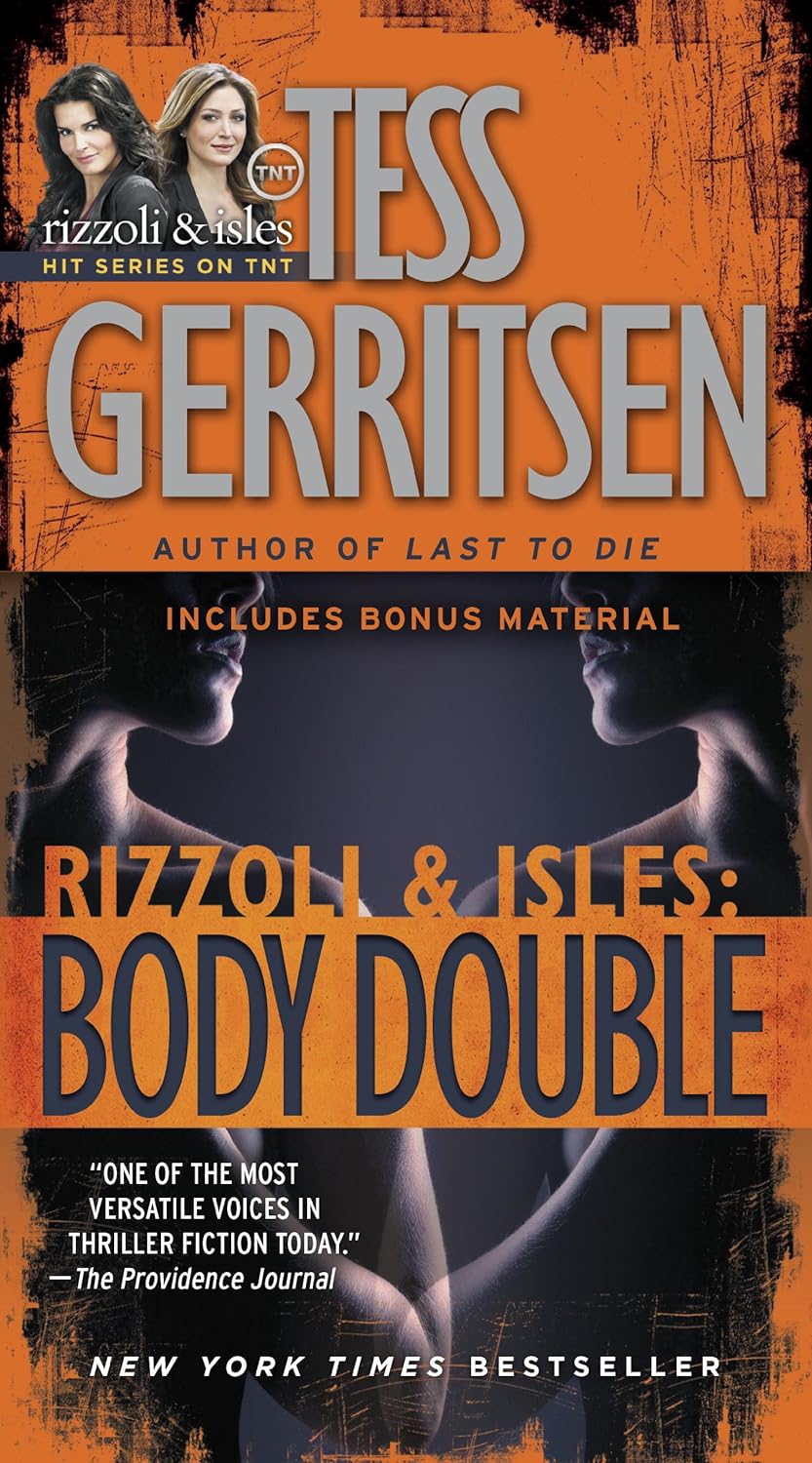
Tess Gerritsen’s fourth Rizzoli & Isles book, Body Double, came out in 2004. Like each previous book, we learn more of the main characters’ back story, this time that of Maura Isles. Readers already knew some of the basics from previous books including the fact that she was adopted, her history before moving to Boston, the fact that she was married, but they didn’t know much about how and why she’d been adopted or anything at all about her birth mother. This book changes all of that in a vivid and sometimes terrifying way. The story’s prologue starts out sweet, in the past, but it quickly turns into a nightmare that seems disconnected from the present until the pieces start coming together. In the present, there’s a murder of course, but this time there’s also a fair amount of misdirection from the start.
The prologue introduces Elijah Lank and Alice Rose, both high school students. They’ll come back later in the story some 20+ years later, but their childhood contact is more than a little disturbing.
Jumping forward to the present, Maura starts the story in Paris, in a cavernous, underground museum of death. The setting seems apropos for a medical examiner who spends most of her time examining the dead for a living. She was in Paris for a conference, but she had some time to do a little exploration as well. The problem occurred when she came home from her trip to find a large police presence in front of her house examining the victim of a murder. The team thinks that it’s Maura who’s been killed in front of her house one night until Maura shows up in the midst of the chaos. The victim is a dead ringer for her, and that spawns questions that can only be answered after a complicated investigation. The first question of course is if the victim and Maura are related. They appear to be twins. One quick spoiler, they actually were, but the story of how they came to be, why Maura’s twin was killed, and much more is revealed through a series of complicated and fascinating twists.
So begins the investigation into Maura’s past by way of her twin. Along the way, they encounter a police detective from Newton named Rick Ballard and a woman named Amalthea Lank. Rick had been a friend of Maura’s twin, Anna Jessop, the victim of the shooting in front of Maura’s house the night she returned from Paris. Amalthea is reputed to have committed some brutal murders and resides in a psychiatric facility seemingly completely out of touch with the real world, although appearances can be deceptive.
There’s another seemingly unrelated crime in progress for much of the book as well, the abduction of Mattie Purvis, the long-suffering wife of Dwayne Purvis. Mattie is nine months pregnant. Dwayne is a BMW salesman who’s all flash and image and no substance. Mattie encounters a madman who lurks in the shadows, and her story is a gruesome one before it gets any better.
Gerritsen winds all of these elements together into a fast-moving murder mystery that’s part family drama, part horror story, and part medical primer. Her medical background continues to add texture to the medical examiner and crime scene sequences, and while she wasn’t reputed to be a psychiatrist, she weaves an intriguing psychological tale. It’s easy to believe that her perpetrators are psychologically damaged or they wouldn’t have committed their crimes so blithely. As always, she gets into the killer’s head, making clear to readers what they are thinking.
In this book, the mystery isn’t so much who committed the crimes, but why they did so. How is such a person formed? Gerritsen supplies a plausible answer, and in the process of doing so makes clear that everyone has the potential to commit horrible acts if given the right circumstances. She also delves into the question of whether nature or nurture has the greater influence on us all.
In the story, Maura spends a good deal of time considering the nature vs. nurture influences once she learns of not only her twin, but unravels why she was killed, who her birth family was, and most importantly, more about what drew her to her current career. On the one hand, it could be considered rather ghoulish to spend one’s time immersed in the land of the dead, even if doing so for noble reasons. Maura has been far more comfortable with the dead than the living for a long time. As a medical examiner, she’s seen horrific victims, and calmly, clinically dissected them to learn how they expired. Her work is invaluable to the investigations she supports and has helped the police to solve countless crimes preventing more victims from succumbing to those killers’ evil intentions. Still, learning that she shares genetics with some of those perpetrating unthinkable evil and coming face-to-face with her closest progenitor unsettles her for a time.
As Maura observes once the case has been solved and her familial questions have been answered:
“We are all descended from monsters.”
The question is whether we can temper our darker instincts and channel them into productive lives as Maura has done or allow those drives to direct our actions. In the end, it’s really a question of impulse control. We all sometimes feel the urge to do things that would horrify us, and most of the time we don’t act on them. But for some, that impulse can be overwhelming. What determines how we’ll react? Some people are drawn to the evil even if they don’t commit the crimes themselves. Dr. Joyce O’Donnell’s research brings her into close, on-going contact with the macabre, and she seems to thrive on it. Joyce unsettles Maura, but not because of her work. Joyce is the one who challenges Maura and asks the questions about her own motives for her life choices. In that, how different are they really?
References:
The Surgeon, by Tess Gerritsen
The Apprentice, by Tess Gerritsen
The Sinner, by Tess Gerritsen
Body Double, by Tess Gerritsen
https://www.tessgerritsen.com/
https://www.starttv.com/lists/the-differences-between-the-rizzoli-isles-books-and-tv-show
A Good Reed Review also gratefully accepts donations via PayPal to help defray the costs of maintaining this site without creating paywalls.

 A Good Reed Review