 By Ande Jacobson
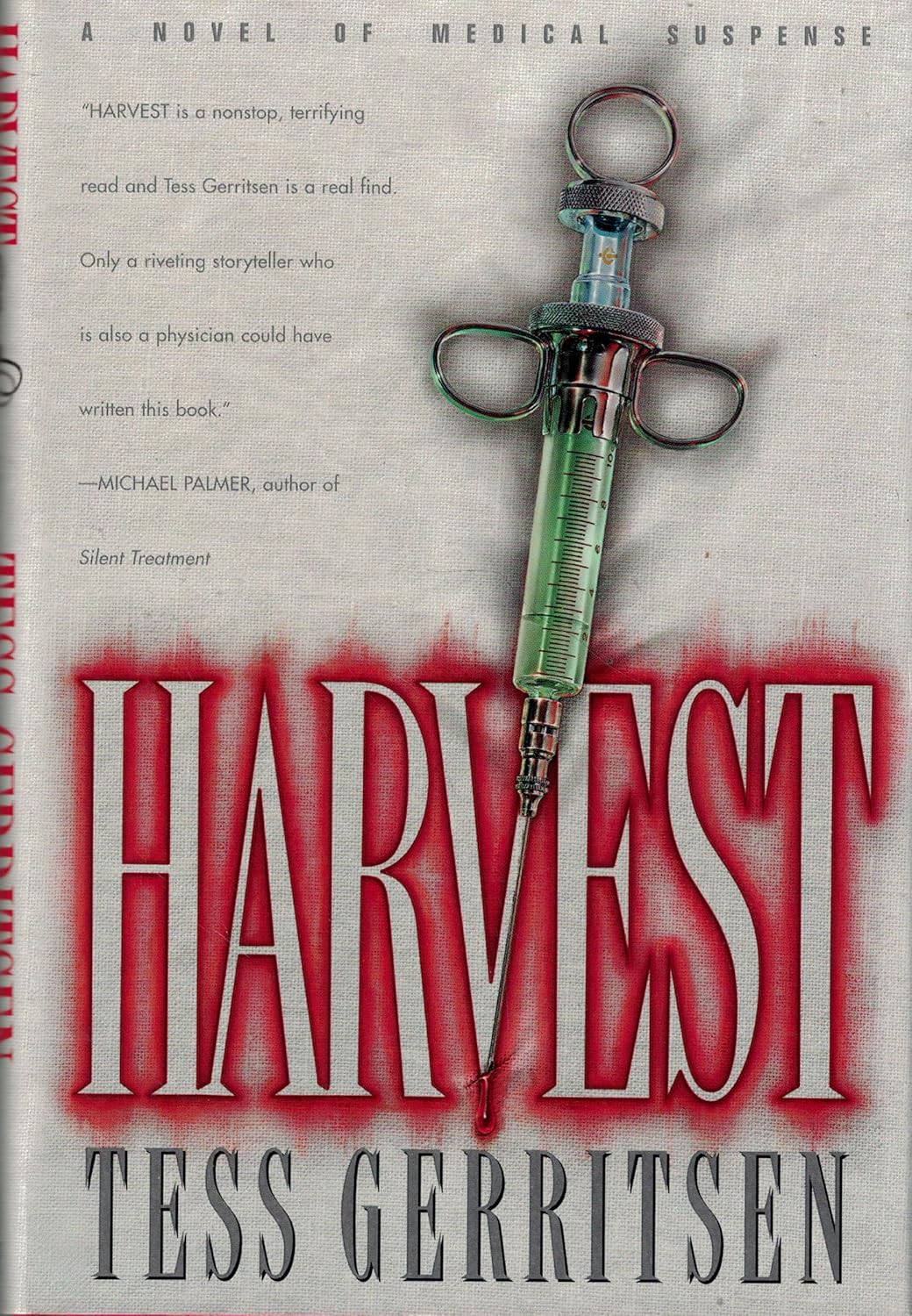
Before Tess Gerritsen began writing her Rizzoli & Isles series, she wrote a number of medical thrillers. The first of these was Harvest, released in September 1996. Her experience as a physician leant itself to tell compelling stories surrounding medical situations, and it also raised her awareness of various societal crises based on manipulation of the healthcare system. Harvest combines a riveting thriller with a very real crisis situation surrounding organ transplants. In particular, the mystery in this story explores how the morbidly wealthy and the very greedy can sometimes work together to circumvent the need-based processes in place. In the real world, organ transplants are lifesaving. They can take a person from death’s door to restored health, but they come at a cost. For most organs, particularly things like hearts and lungs, they come available only when an organ donor dies. While a directed donation can be made in some cases, the general system in place to provide these precious organs is based on patient need. The more severe the need, the higher a patient’s priority on the recipient list. Their financial and social status is not taken into account, only their medical need is relevant. Unfortunately, there’s a rather robust black market that some very wealthy individuals turn to in order to jump the line. The market consists of profiteers who garner the services of some less than reputable physicians to harvest organs from donors that are sometimes “created” to supply these precious organs to those willing to pay. Sadly, some with the resources available would be willing to pay almost any price to save their loved ones denying those in greater need of their very lives. Of course, evaluating medical need can also be tricky, particularly when so few organs are available meaning that whoever doesn’t get a given organ may not live long enough for another compatible organ to come available the normal way.
Gerritsen adroitly explores multiple sides of this contentious situation in Harvest. A group of Russian boys placed under the care of a non-relative is first introduced. They are young, and it’s not immediately obvious exactly how they relate to the story, although their situation is dire – they steal and turn tricks to survive, but the worst is yet to come. Through Yakov, one of the younger boys in the group, readers learn what their lives are like and how their lives are changed fairly early on. Yakov is different than the others though. Despite his young age, he’s developed some skills that serve him well. He’s also far more self-reliant than seems possible, and he becomes instrumental much later in the story.
Across the ocean, after a young mother suffers a serious accident and becomes a patient, Dr. Abby DiMatteo is introduced. She’s a promising young surgical resident. From all appearances, she has everything going for her. She’s in her second year of residency at a renowned teaching hospital with a major transplant center. She’s dating a slightly older surgeon on the transplant team, is well-respected by her peers and the director of her residency program, and she is looking forward to a promising surgical career once she finishes her grueling training. The training is getting to her though, at times making her question her confidence and choice of career. She’s unaware of exactly how much her program director respects her given his gruff exterior, but that respect and even somewhat paternal nature comes to bear much later in the story.
Along the way, Abby is courted by the transplant team just as she starts noticing some things that don’t seen right to her. She tries her best to do right by her patients, but when one suddenly dies unexpectedly, she’s being accused of things she didn’t do. She makes some enemies along the way, and before long, she’s no longer sure who she can trust. She knows that something nefarious is happening around her, and she is at odds with how to prove it. She just doesn’t have any concrete evidence that she can report. Then there’s the question of where to report her suspicions. She wants to go to the police, but they already view her with suspicion based on the unexpected death of one of her patients.
Over time, Abby manages to gain a couple of allies. One is the former chief resident who had been forced out by the hospital for noticing many of the same issues Abby has encountered. The two of them begin their own investigation, and they uncover several inconsistencies. Another ally is a police detective who agrees that something didn’t sit right with him in the investigation surrounding Abby’s patient’s death. It takes much longer for Abby and her allies to piece things together to uncover a criminal operation threatening not only Abby, but the hospital at large. Who is part of the conspiracy then becomes the mystery at hand, and it leads to some rather unexpected corners of Abby’s and her allies’ lives.
As is her style, Gerritsen includes a lot of medical details along the way through the various treatments, codes, and surgeries that occur through the story. Readers learn about how the United Network for Organ Sharing (or UNOS) works, including how the national organization coordinates with various regional groups. Readers also learn how an organ donation is not supposed to happen. Gerritsen develops her complex characters, showing their relationships, thoughts, dreams, and actions in vivid detail. As with any good mystery, there are several unexpected turns along the way, and the action builds to a breathtaking climax. When the resolution comes though, it seems slightly anticlimactic, and the ending is somewhat abrupt. Readers are left wanting to know what happens next to those they’ve come to care about as Gerritsen leaves a good bit to the imagination of the interested reader. While there is a certain amount of gore inherent in the description of medical procedures, Gerritsen doesn’t dwell on it gratuitously in this book. Her focus is on the story. One interesting aspect is that with the book being written in 1996, while still modern in many ways, some of the technological advances that have become so much more widespread in the intervening years are noticeably absent.
Gerritsen has written numerous standalone novels across multiple subgenres of suspense. Of those, five are explicitly medical thrillers. Those include Harvest (1996), Life Support (1997), Bloodstream (1998), Gravity (1999), and The Bone Garden (2007), so she jumped into the Rizzoli & Isles series after Gravity and much of that series included the same kind of medical detail that became a bit of a Gerritsen trademark from her earlier medical thrillers.
References:
Harvest, by Tess Gerritsen
https://www.tessgerritsen.com/
https://www.bookseriesinorder.com/tess-gerritsen/

 A Good Reed Review