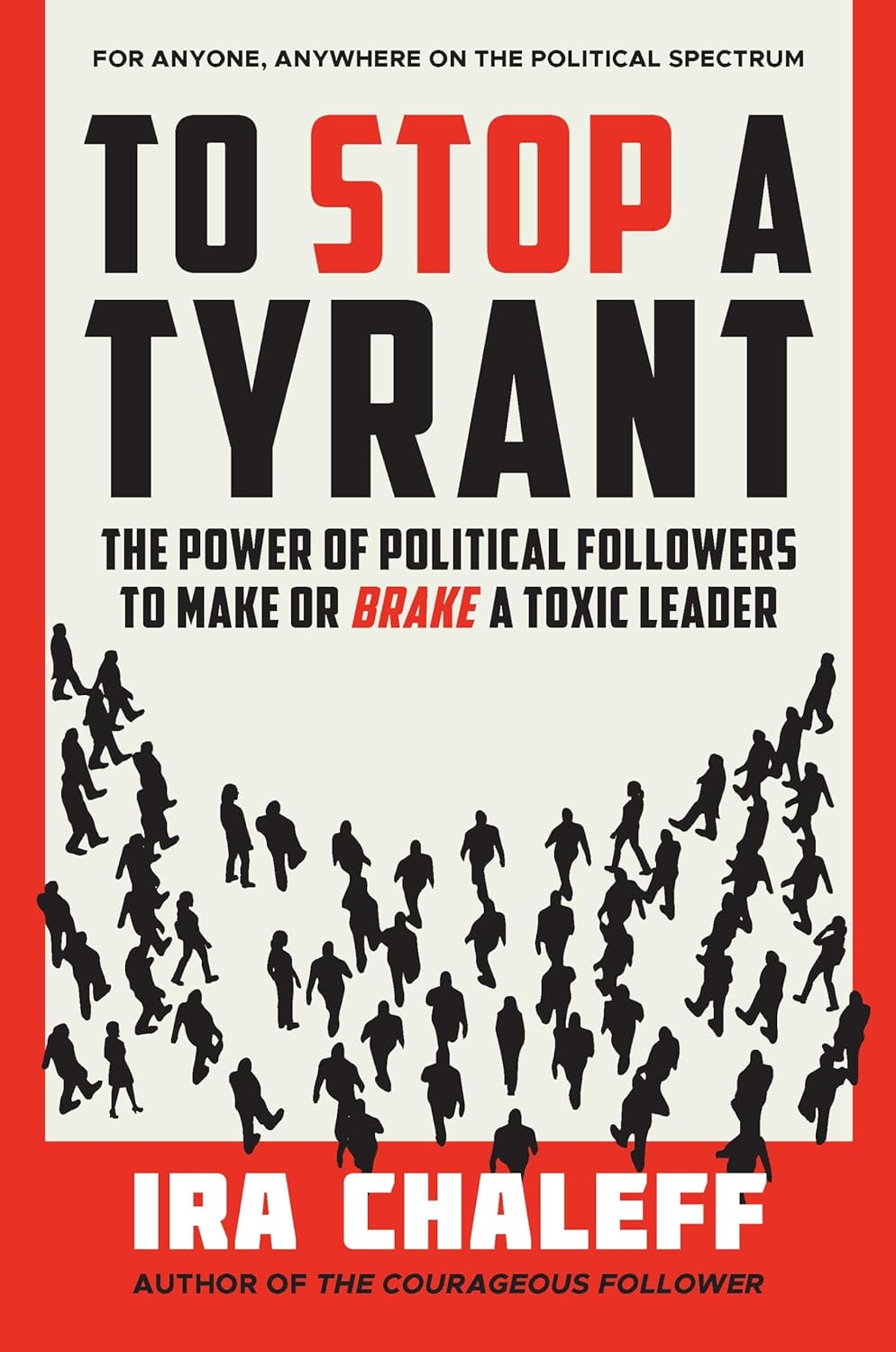
 By Ande Jacobson
Ira Chaleff’s To Stop a Tyrant is both timely and timeless. Although he completed writing the book in March 2024, and it was released a few months later in early September just two months before a major U.S. presidential election with democracy on the line, there is no mention of this crucial election despite everything in the book being directly applicable. Chaleff chose not to discuss the election brewing in his midst in part because so much was changing very quickly at the time of his writing, and also because he wanted this book to transcend any current crises or partisanship. He uses numerous examples not only from his own personal experience but also from throughout human history, especially from the last 100 years up through fairly current times. From the more current perspective at the time of his writing, he covers the evolution from activist to prototyrant to dictator of both Victor Orbán of Hungary and Vladimir Putin of Russia to illustrate many of his points while also including some mention of the same phenomena during ancient Roman times to show that none of this is new.
The ascendancy of a tyrant doesn’t happen overnight. There are numerous signs and windows of opportunity to prevent such a rise, but that can only happen if enough courageous followers take action to intervene. Chaleff shows how important followership is in all political systems by introducing readers to the term and the responsibilities that it encompasses. One important point is that everyone within a given sphere of political influence is involved in and affected by the political process whether they choose to participate actively in it or not, and in fact, dissociating from the political process is a choice, albeit a potentially dangerous one that could greatly help a person with authoritarian tendencies to succeed.
A tyrant cannot be a tyrant if they don’t have supporters, i.e., followers, as they move to take over a country, and those followers can range from avid to apathetic. Note that a tyrant or dictator can come from the right or the left of the political spectrum. All that is required is that such a person embrace authoritarian means and methods. Chaleff carefully illustrates how a prototyrant, which is essentially a tyrant wannabe, makes specific moves to consolidate power and remove any systemic guardrails that might slow their progress. Through his illustrations, the reader learns where and when the windows of opportunity exist to prevent that transformation.
So what exactly is a tyrant? Chaleff shares the Merriam-Webster Dictionary definition as:
(1a): an absolute ruler unrestrained by law or constitution
(1b): a usurper of sovereignty
(2a): a ruler who exercises absolute power oppressively or brutally
(2b): one resembling an oppressive ruler in the harsh use of authority or power
He specifies that the book focuses on the definition through (2a) while admitting that the lessons he shares could apply in a broader sense to (2b) even though that is beyond the scope of this book.
Building on this definition and discussing at length what constitutes toxic leadership that poses a danger to a country, it becomes clear that a prototyrant applies to someone whose goal is to become a tyrant but who hasn’t yet achieved that level of power. It is before and during the prototyrant phase that they can be stopped with careful action by those around them.
Chaleff adroitly defines the various circles of followership that encompass an entire nation. The circles are defined from those closest to the leader outward as follows:
- Confidants – The inner circle with the closest contact with the leader. These are the people the leader trusts most, and they are the ones who see the leader unguarded. They are often family members, close friends, and supportive advisors. Their power is in the trust the leader has in them, though that also makes them most vulnerable to retaliation.
- Elites – Near inner circle. This circle contains leading media personalities, politicians, financial leaders and other influencers who have some access to the inner circle but aren’t permanent members. Their power is in their visibility and ability to influence others, including the major financial backers.
- Bureaucrats – Middle circle. These are the career civil servants who keep the government running. Their power is in the wheels of government itself including having the ability to stop a dangerous policy from being enacted. Their risk is to their livelihood and personal security.
- Activists – Near outer circle. These are the cause leaders. They create coalitions among the populace, and they raise awareness. They don’t generally have inner access. Their power is their visibility and ability to engage and organize segments of the general population.
- Populace – Outer circle. This circle includes general population including the voting public. Their power is the sheer number of members of this group, and yet even an individual can effect change.
Chaleff draws on Alain de Sales’ work noting that within all of these circles of followers (and a person may inhabit more than one circle at a time, or they may move between circles at various times), there are some common behaviors that followers exhibit when a prototyrant or tyrant is evident including:
- Conformists who go along with whatever is happening around them working hard not to be noticed.
- Colluders who actively help a prototyrant or tyrant rule over the country.
- Courageous followers who take action to stop a prototyrant or remove a tyrant who is causing harm.
There have been prototyrants, dictators, and tyrants throughout history, and Chaleff details the common means they all use to assume control. The signs aren’t subtle. They are generally very visible, such as:
- A leader intentionally creating division within the populace and scapegoating a vulnerable group.
- A leader vilifying those who disagree with them, including the press when there is coverage that the leader doesn’t like.
- A leader weakening the foundations of the rule of law and claiming that they are the only authority.
- A leader attacking his perceived political enemies through extrajudicial means, often with the full force of the government’s resources.
For followers, it often comes down to a choice between self-preservation and the greater good once they recognize a prototyrant in their midst. Courageous followership often requires self-sacrifice, but the alternative is no guarantee of safety.
When talking about the outer circle of followership, Chaleff makes a point of discussing the potential dangers inherent in political rallies. They have been used from time immemorial, and they can be a powerful way to draw people in, or to desensitize the masses and normalize a prototyrant’s nefarious efforts. It’s important to not just react on autopilot and to think about what is happening around us, especially when we are in a crowd. Sometimes courageous followership in this context can be something as simple as not going along with the crowd by not joining in the chants or not standing with the masses. In many ways it’s rather like bucking the trend to give a standing ovation at the theater if you don’t think that a performance merits it even if those around you are all on their feet. It takes courage to stand out from the crowd in that way.
Chaleff ends with a handy table succinctly summarizing the core lessons from his book as they pertain to the five circles of followership. He stresses that this is only to jog one’s memory to help recall the deeper lessons he provides. Full understanding requires some study and time to fully absorb the complex relationships between leaders and followers. The categories he lists in the table are in themselves instructive:
- Available Information
- Incentives to Follow
- Vulnerabilities
- Risks
- Communication Channels
- Courage Needed
- Power to Influence
The net of it all is that it’s crucial to engage in our nation’s political system at all levels no matter in which country we reside. Our lives and livelihoods depend on us understanding the issues and the people who are in positions of authority. By virtue of living in a society, we have a responsibility to do our part to ensure our political leaders serve us rather than utilizing us to serve their whims. There is an urgency to courageous followership, particularly in times of change.
Reference:
To Stop a Tyrant, by Ira Chaleff

 A Good Reed Review
[…] References: https://www.project2025.org/policy/ Project 2025 really for free (downloaded early this year) 2024 Democratic Party Platform https://kamalaharris.com/issues/ https://kamalaharris.com/project2025/ https://agoodreedreview.com/2024/09/24/book-to-stop-a-tyrant/ […]
LikeLike