 By Ande Jacobson
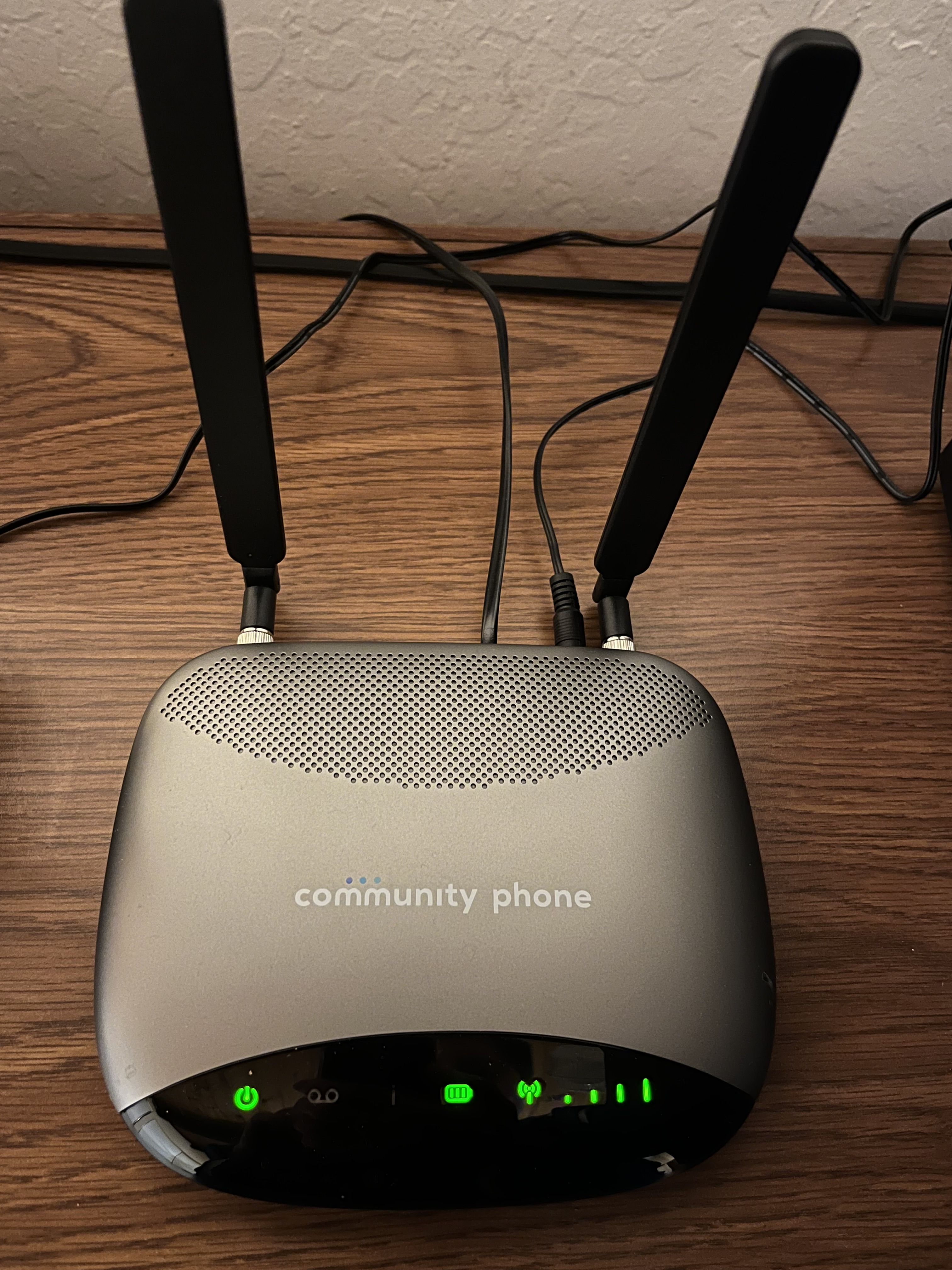
In late April, I wrote a piece about Community Phone talking about its benefits as a landline alternative. In short, Community Phone provides a landline-like alternative to customers that doesn’t require internet connectivity and can work for up to 12 hours without power using two major nationwide cellular networks. Although they use cellular networks, their service isn’t a mobile service. It’s fixed to the service address, and the network used is whichever of the two is stronger at that location. Their base is a strong receiver that connects to a traditional landline/analog phone. Their service provides excellent call quality at that location. It’s not quite the same as copper of course, but it is better than VoIP services that require active internet service. The concept is good.
That said, I need to revise my initial recommendation a bit by first saying that I have recently downgraded my plan to their standard service. While their premium service has some excellent additional features, the system running that level of service is not yet stable. In the six months or so that I had Community Phone’s premium service, many of the advanced features had not been available most of the time, and even some of the standard features running on their advanced system had not been reliable. The price depends on where your service is located, but in general, the premium service is about $10 more per month than the standard service. For both levels of service, there is a discount for paying annually rather than monthly that equates to one month free per year at the monthly rate.
The features are broken down as follows:
Standard landline plans include:
- Landline service with unlimited nationwide calling
- Customizable System Voicemail
- 3-way calling
- Access to our user portal and mobile app
- Access to discounted cell plans for Community Phone’s landline customers
- No contract
Premium landline plans include:
- Everything on the standard plan
- Spam call protection (i.e., robo-blocking or a whitelist which are mutually exclusive for this service)
- SimRing – Calls to your landline can ring on other phones
- Voicemail transcriptions visible in email or in the mobile app
- No contract
Since I’ve downgraded my service, the only feature outage has been the mobile app which is currently undergoing some significant revisions, but I’ve been able to use all other features reliably so far. I don’t have my mobile cellular service through Community Phone. There was no reason to switch from my existing mobile provider when I switched my landline over to Community Phone. Also, there is an advantage for me to continue to keep my existing mobile provider as it is on a different network from the one Community Phone uses at my location. That gives me additional backup capability in case of an outage.
To be fair, when the system is working, the call quality is excellent with both the premium service and the standard service. Also, Community Phone’s technical support is very responsive, and the technicians are readily available to work with customers any time there’s an issue, but for me, reliability is paramount. Over the six months I had the premium service, I had numerous issues including:
- System voicemail not working at all.
- Robo-blocking being routinely turned off.
- The mobile app not working at all so calls weren’t logged and voicemail wasn’t accessible through the app. Even when the mobile app was working, the call logging was incomplete.
- At times, no outside line was available even when there was no power outage or known issues.
- Calls dropped after 30 minutes which really doesn’t work well for calls with long hold periods.
- My number was inexplicably forwarded to an unknown number by their system after a software upgrade at one point.
That last issue was resolved within a day or two after my notifying Community Phone about the problem which I only discovered when a friend notified me through other means that my home phone seemed not to be working. Until that particular issue was resolved, I could call out, but I couldn’t receive any calls on that line, and it never went to my voicemail. The other issues had been ongoing intermittently though, so I finally decided to downgrade given one of the techs along the way had mentioned that their standard service was provided by a more robust system.
As mentioned, Community Phone’s “landline” service isn’t a true landline even though a landline phone is used with the base/receiver. While customers cannot just spontaneously take their base someplace else and have it work, they can transfer their service to another location much the way one would transfer any household utility service. In that way, it is like a traditional landline. Unlike a traditional landline though, Community Phone’s service is not authorized for certain types of monitoring services such as those that closely track the location of parolees. It does work with 911 as it is tied to the service address in that case.
All that said, my reasons for switching to Community Phone still apply. My previous landline service had become somewhat unreliable with poor call quality, and my previous carrier continues to work toward not providing traditional landline service in my area. At present, Community Phone’s advanced system does not meet their advertised reliability claims. Hopefully they’ll eventually work out the bugs, but for now if you decide to try Community Phone, stick with the standard/basic landline plan.
Reference:
Community Phone – www.communityphone.org
A Good Reed Review also gratefully accepts donations via PayPal to help defray the costs of maintaining this site without creating paywalls.

 A Good Reed Review
[…] Editor’s Note: An update to this article was written after several months of service with Community Phone. See: https://agoodreedreview.com/2024/09/26/update-to-a-landline-alternative/ […]
LikeLike