 By Ande Jacobson
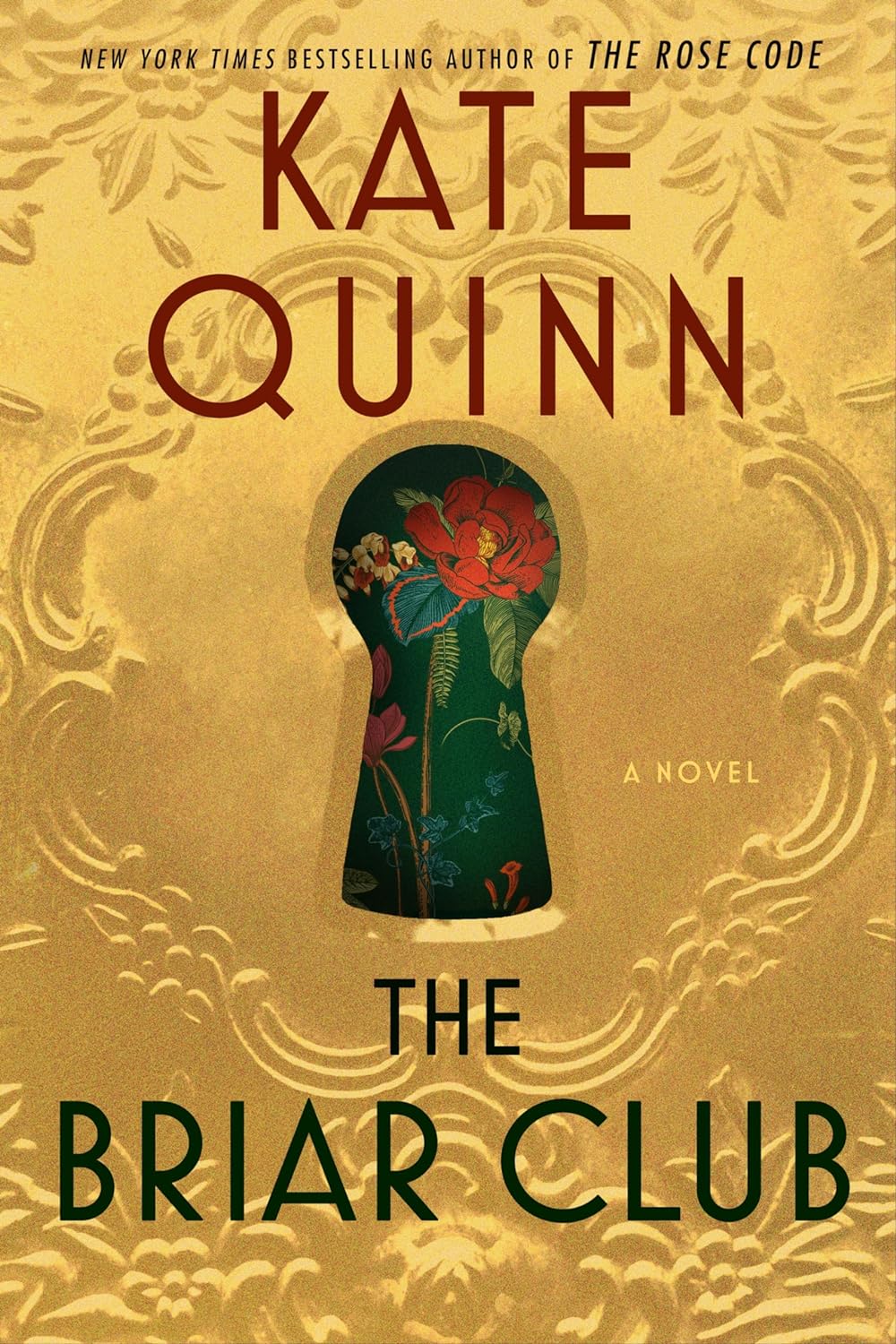
Kate Quinn’s latest book, The Briar Club, while historical fiction in the broad strokes, leans into fantasy a bit with an interesting central character – a sentient house! Briarwood House, so named because it’s at the corner of Briar and Wood streets in Washington, D.C., is a boarding house for single women. It’s owned and run by Mrs. Nilsson, a crusty woman with two children, Pete – her teenage son, and Lina – her young daughter. The story of how and when Mrs. Nilsson’s husband left seeps out slowly as the plot develops. Before that though, the prologue jump starts the story with a murder, and most of the rest of the book is a series of flashbacks just a few years before as the various boarders are introduced. Interludes where the house reports on the current situation pop up in between, and once all the pieces are in place, readers are treated to a wonderful resolution of the mystery at hand. Quinn’s masterful weaving of each boarder’s backstory is riveting. The sentient house is a charming way to meld all of the stories together in this work that takes place in the 1950s during a rather tumultuous time in U.S. history. The Korean War is a factor as are the Cold War and Joe McCarthy’s witch hunts.
The various boarders include:
- Grace March – the most mysterious of the boarders, and the one who brings them all together to support one another.
- Nora Walsh – the youngest boarder at just 20 who has a lot of potential while still finding her way in the world and working at the National Archives.
- Felicity Orton – goes by Fliss, an English expat and former nurse with an infant daughter named Angela who is allowed to stay because her husband (a doctor) is stationed overseas with the US Military serving in the Korean War.
- Claire Hallett – a secretary for a U.S. Senator, but she has some secrets too.
- Arlene Hupp – the one everyone tries to avoid who works for the HUAC and is the “hall monitor” of the group attempting to root out communists everywhere.
- Reka Muller – an elderly Hungarian refugee from WWII whose husband died a few years before, and she too has some talents and secrets from her past.
- Bea Verretti – the one with an interesting past as an athlete as a female baseball player from the All-American Girls Professional Baseball League (AAGPBL) who has big dreams for making a name for herself in a man’s world.
Through flashbacks, readers learn that The Briar Club formed shortly after Grace took a room at Briarwood House. She had a knack for bringing people together, and before long they had a Thursday night dinner scheduled, which was no small feat given the meager facilities they used. Each resident had a refrigerator and a hot plate that served as their only kitchen appliances. The house of course had a regular kitchen, but Mrs. Nilsson (or Doilies as Grace referred to her behind her back) didn’t allow boarders use of her kitchen for the most part. As an aside, Grace had cute nicknames for all of the residents based on their actions or from whence they came. Upon her arrival, she bestows the nickname “Hammer’in Pete” on Pete who takes a shine to her right away.
Quinn’s story covers a lot of ground as she delves deeply into each boarder’s background. Some unexpected details are uncovered for each of them, all helping to explain the murder that readers encounter at the outset. Quinn also paints a visceral picture of the times. In the early 1950s, women had few opportunities, especially single women. The misogyny and strict gender roles of American society of that time come through, although Quinn’s colorful characters stand out in numerous ways, mostly good, except for Arlene who embodies all that was wrong with McCarthyism. But even her backstory contains a few surprises that give readers a chance to empathize with her, at least a little. Quinn also tackles the start of the Civil Rights movement in earnest. The blatant racism that was prevalent then is taken to task, and while our current times are regressing socially, they aren’t quite back to where things were in the 1950s, yet. Hopefully they never will be.
Quinn reveals each of the women’s personal lives slowly, and there is a lot to admire about them all in various ways. Their mutual admiration for one another (sometimes grudgingly) also comes through. The story is hopeful in many ways, offering the possibilities of brighter futures after the tumult of the world wars and regional conflicts mentioned. And the house itself also has hope.
Much of the historical detail scattered throughout the story is accurate although there is a glaring error that isn’t a momentary oversight or poetic license. In a couple of the deep dives, Lockheed Martin is mentioned, but at that time while Skunk Works certainly existed as did other covert facilities vital to the military’s efforts to stave off communism, Lockheed Martin did not. Lockheed did, and Skunk Works was part of Lockheed at the time. The Glenn L. Martin Company (which later became Martin Marietta when it merged with American-Marietta Corporation in 1961) also existed at that time, but Lockheed and Martin Marietta didn’t merge to become Lockheed Martin until 1995, well after the story’s timeline. As a former Lockheed Martin engineer, that stands out.
Quinn’s chapters this time are much longer than they usually are and almost read as connected short stories in some ways. They are named after the central character of the chapter, separated by interstitial breaks that let the house “talk.”
All in all, this is a story well worth reading. It provides some perspective on that time in history and on how various events affected regular people. We know today where society went from there, and while the characters in the story are mostly fictional, they are also loose composites of some people who actually existed combined with several works of fiction. They are familiar in some ways.
Readers shouldn’t skip ahead to the Historical Note which serves as Quinn’s author’s note at the end as that would reveal the big twist in the story, and it’s a doozy. While not spoiling the surprise, one thing that it’s safe to share is that this book came about as Quinn’s pandemic work inspired by the intersection of several different sources during that long, isolated time. Although inspired during the recent pandemic, the book wasn’t published until the summer of 2024.
References:
The Briar Club, by Kate Quinn
The Huntress, by Kate Quinn
Diamond Eye, by Kate Quinn
The Rose Code, by Kate Quinn
https://www.katequinnauthor.com/book-table/
A Good Reed Review also gratefully accepts donations via PayPal to help defray the costs of maintaining this site without creating paywalls.

 A Good Reed Review