 By Ande Jacobson
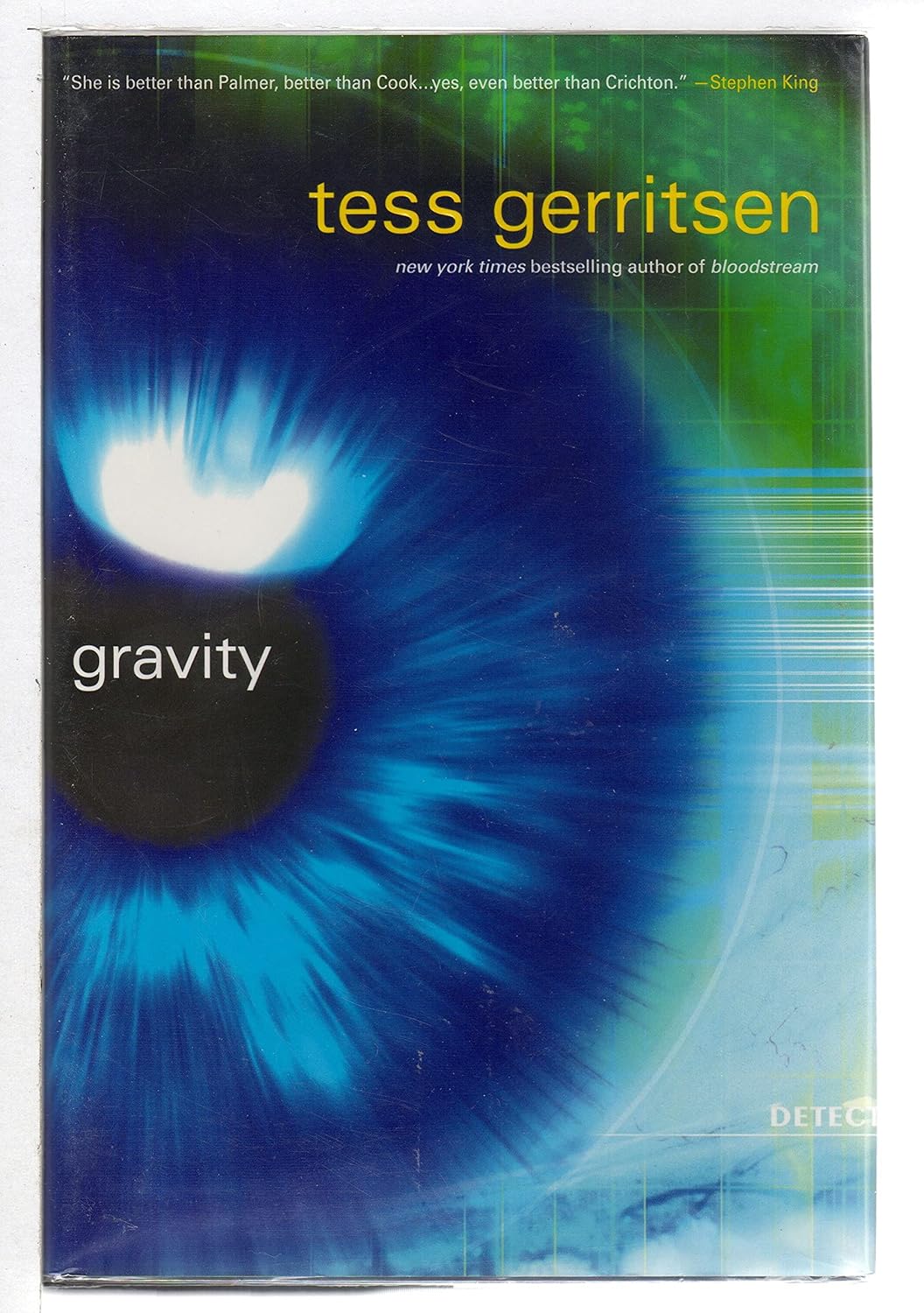
Tess Gerritsen continues her medical thrillers with Gravity, first released in September 1999. This time, she explores the unknown both on earth and in space. As she often does, she starts the book with a seemingly disconnected event, a deep sea researcher encountering an unknown life form on the ocean floor. It’s known that the fauna in the deep waters is not seen anywhere else on Earth, and many of the creatures living and even thriving there have unusual properties such as being able to live in super-heated, poisonous waters near volcanic vents. Gerritsen has done her homework on this one melding deep sea biology with space biology in a riveting story of what happens when life forms are thrust into alien environments. One of the biggest dangers to humans living in space is encountering a pathogen that threatens their existence, and this is a story of such an occurrence aboard the International Space Station (ISS).
The experiments done aboard the station aid in expanding humankind’s knowledge of space and of how various life forms are affected by that environment. One thing that is fairly common about the station is experimenting with various cultures because of how the weightless environment affects culture growth. Instead of being hampered by gravity and growing in two dimensions, they can grow in all three taking on completely different structures than they might on Earth allowing examination of the cultures in ways not possible in Earth’s gravitational environment.
Gerritsen spends some time providing the backstories for a wide variety of characters she introduces including astronauts, doctors (as part of the astronaut corps), numerous ground support personnel at NASA and in private industry, and of course other government officials. We get hints of some of the commercial space industry to come in this one as Gerritsen’s story was written slightly ahead of the emergence of those commercial ventures. She also gives readers an inside look at significant portions of astronaut training. By the time the real adventure starts, readers care about the crews involved making the crisis when it hits all the more terrifying. This time the mystery is a medical one stemming not from malice or criminal behavior but from an experimental accident that the principle researcher didn’t foresee. In the closed environment of ISS, contamination is a very real concern, and contagion can be devastating.
Practical experiments are carried out on ISS proposed and provided by scientists from all over the world. That part is real. There’s a lot that can be learned from space that has real world application here on Earth. For instance, the early days of extended stays aboard MIR and Skylab taught scientists a lot about the physiology of osteoporosis. Astronauts living for extended periods in a weightless environment developed a form of weightlessness induced osteoporosis even when they worked hard to try to load their bones through heavy exercise using resistance rather than gravity while in space. The big difference observed between weightlessness induced osteoporosis and its age-related counterpart on Earth was that the weightlessness version was reversible once the astronauts returned to Earth, though it took a little time for them to recover. The initial thought was that if scientists could find a way to prevent osteoporosis in space, they could apply the same metabolic principles here on Earth to help the millions of osteoporosis patients. That research has continued, and recent studies aboard ISS are showing a new treatment that might have promise without the side effects associated with current osteoporosis treatments on Earth.
The mystery at hand is a doozy. Of course the even bigger challenge is determining where the organism that wreaks havoc aboard the station came from originally, and of course how to stop it. It has characteristics that are found on the edge of biology as it is currently understood, even in space. Never take any clues Gerritsen drops for granted no matter how tangential they may seem. She is good at thinking through some medical situations that are the stuff of nightmares and breakthroughs, and she stays on the edge of plausibility even in her most extreme stories.
While the existence of biological chimeras is real, and is even seen in rare cases in humans, she takes this concept further in a fascinating way. Chimerism is extremely rare in nature, and in humans, it can sometimes occur in the case of fraternal twins in utero where one twin absorbs the other during gestation leaving the remaining twin with two distinct sets of DNA. In this story, there’s a different type of chimerism crossing species, but also incorporating some characteristics seen in parasitoids in nature. The resulting crisis is a frantic race against time and the limits of human knowledge. There are some graphic scenes, but the gore is not gratuitous, and once the foe is known to readers, it’s hard to stop reading until the end.
Gerritsen sold the film rights to the story to New Line with conditions for a film adaptation giving her based-on credit and compensation should an adaptation ever be released. New Line was later acquired by Warner Bros., and Gerritsen never received any credit or compensation when Warner Bros. released a blockbuster film of the same name in 2013. The plot of the film and the book are not identical, but there are significant similarities such that Gerritsen filed a lawsuit against Warner Bros. the year after the film was released alleging breach of contract. The case was dismissed twice by the courts, and Gerritsen eventually withdrew her suit despite her frustration with the situation. She still maintains that the similarities between her book and the film were not a coincidence.
Gerritsen has written numerous standalone novels across multiple subgenres of suspense. Of those, five are explicitly medical thrillers. Those include Harvest (1996), Life Support (1997), Bloodstream (1998), Gravity (1999), and The Bone Garden (2007), so she jumped into the Rizzoli & Isles series after Gravity and much of that series included the same kind of medical detail that became a bit of a Gerritsen trademark from her earlier medical thrillers.
References:
Harvest, by Tess Gerritsen
Life Support, by Tess Gerritsen
Bloodstream, by Tess Gerritsen
Gravity, by Tess Gerritsen
https://www.tessgerritsen.com/
https://www.bookseriesinorder.com/tess-gerritsen/
https://authorsguild.org/news/gerritsen-drops-gravity-film-rights-lawsuit/
A Good Reed Review also gratefully accepts donations via PayPal to help defray the costs of maintaining this site without creating paywalls.

 A Good Reed Review