By Ande Jacobson
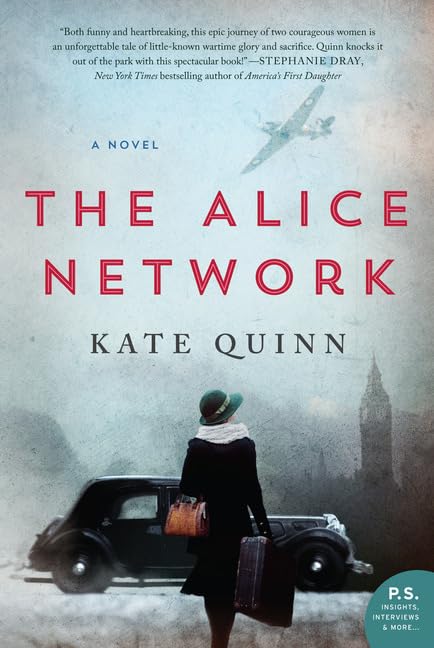
Kate Quinn’s The Alice Network is a masterful look at the heroic efforts by a female spy ring during WWI and beyond. While a work of historical fiction, she weaves in a lot of history following two timelines. The first is WWI and the efforts by the women of The Alice Network, a real underground network of British spies operating in foreign territory gathering huge amounts of crucial information that ultimately helped win the war. The parallel timeline in the “present” is just after the end of WWII. The story follows Charlotte (Charlie) St. Claire on her quest to find her missing cousin. On her travels, she connects with Evelyn Gardiner, a cranky, eccentric old woman with gnarled hands and a mysterious past, and her driver and protector, Finn Kilgore. The trio make their way through Europe first to help Charlie with her quest, but also to satisfy an old score of Eve’s.
While the three primary characters are fictional creations, most of the people they meet and interact with are historical figures of one sort or another. And although Eve is fictional, there are a few aspects of her that come from Quinn’s real life which she details in her Author’s Note at the end. For instance, Eve has a stammer, the effects of which Quinn draws on from someone close to her.
The chapters alternate between Charlie’s and Eve’s perspectives, starting with Charlie’s in the present as she tries to deal with her “little problem.” Charlie is a 19-year-old college sophomore, a math whiz, but she has a big problem, particularly in 1947. She’s unwed and pregnant, and her parents are scandal averse and wealthy, so they’ve arranged to have the problem taken care of in Switzerland. The thing is that Charlie isn’t really interested in that and instead wants to search for her French cousin Rose who has been missing for several years. She has a plan to seek out information related to her cousin while she’s in Europe with her mother, but she needs to ditch her mother first, which she does handily in the first chapter.
Charlie and her mother are in Southampton, and that’s close enough to a lead that Charlie has uncovered. She just needs to make a little side trip to London to meet up with her potential source, Evelyn Gardiner. That turns the tale into a true adventure story with deep dives into Eve’s past as well as Finn’s. Along the way, readers learn of The Alice Network and its leader, Louise de Bettignies, AKA Alice Dubois, a real person though given the nickname Lili by Quinn. Lili was a remarkable woman with undying courage and leadership, and through Eve’s background we learn of Lili’s exploits and her ultimate fate. There are numerous colorful characters throughout:
- Louise de Bettignies – code named Alice Dubois/Lili, the on the ground leader of The Alice Network.
- Captain Cecil Aylmer Cameron – the military head of the spy network with a keen eye for talent.
- Leonie van Houtte – de Bettgnies‘ number 2. Quinn changed her code name to Violette Lameron instead of her real one, Charlotte Lameron because she’d already created a Charlotte (Charlie) in the story.
- Antoine le Four – the network’s forger, and a minor character in the book.
- Aurélie le Four – Antoine’s younger sister who was in the network.
- René Bordelon – a fictional profiteer with a surprising connection to our main trio. Although he was fictional, people like him abounded and caused the network no end of problems.
Quinn takes great pains to draw the reader a graphic picture of what France and England looked like both in WWI and just after WWII. The occupied portion of France was brutal, and those who survived had a lifetime of nightmares following the events. There was no way to live through either of those major conflicts and not carry significant scars. While WWII was a fight against fascism (something present day Americans really should have studied more thoroughly), WWI wasn’t exactly that, although its destabilization of Europe as a whole precipitated many of the actions that followed and motivated the explosion of fascism sparking WWII. In both conflicts, underground resistance networks worked hard to attempt to thwart the worst of the atrocities.
Quinn draws the reader in with complex, multifaceted characters who have serious flaws and also tremendous courage and integrity. Her main trio bonds tightly through the story, supporting one another despite their surprisingly rocky start. Both timelines are far in the past at this point, yet many of the personal concerns are just as poignant and pertinent today, especially given the political turmoil of the current moment. A young, unmarried, pregnant woman in a red state would face the same concerns Charlie does in 1947.
As the story progresses, readers genuinely care about Charlie, Eve, and Finn, even though Eve is anything but likeable at the outset. Through the deep dives into her past, readers gain not only an understanding of why she behaves the way she does and how her hands were damaged, but also grow to admire her even if they don’t necessarily agree with all of her actions. Even Finn has some skeletons that come out through the story, but he and Charlie are kindred spirits. Both are underestimated by some, yet Eve couldn’t have two more devoted and loyal friends than the two of them.
As is common in a Quinn novel, the story builds to quite a climactic moment, and all of the threads are brought together in a believable if slightly improbable resolution. She continues the story after tying up the main plot points giving the reader a comfortable look into the characters’ futures and an opportunity to revisit them should she later choose to do so.
At the end, between Quinn’s Author’s Note and an extensive P.S. section that includes additional research material and letters from the historical figures in the story, readers gain an even greater appreciation for the heroic efforts of The Alice Network through WWI and beyond.
References:
The Alice Network, by Kate Quinn
The Briar Club, by Kate Quinn
The Huntress, by Kate Quinn
Diamond Eye, by Kate Quinn
The Rose Code, by Kate Quinn
https://www.katequinnauthor.com/book-table/

 A Good Reed Review
I’m really enjoying it, and I’m a big fan of war time stories especially WW2 In fact I’m combining reading a hardcopy I actually even bought new, with the Audible version via the library. It’s working really well doing that. Haven’t tried a mix of the two before.
LikeLike
I’ve never listened to an audiobook. I tend to read a lot of books on Kindle though as that works really well for reading while using my elliptical.
LikeLike
I grew up listening to Afternoon Theatre on Radio 4 so listening to a book comes easily for me. Plus I can listen when I’m too tired to read. Give it a whirl Ande. They’re free through the library.
LikeLike
No, listening to a book isn’t the same as reading it for me. If I ever get to a point where I physically can’t read I might consider it, but otherwise, I prefer the cognitive exercise of reading. I listen to other things, just not books unless I am reading them aloud for some reason.
LikeLike