 By Ande Jacobson
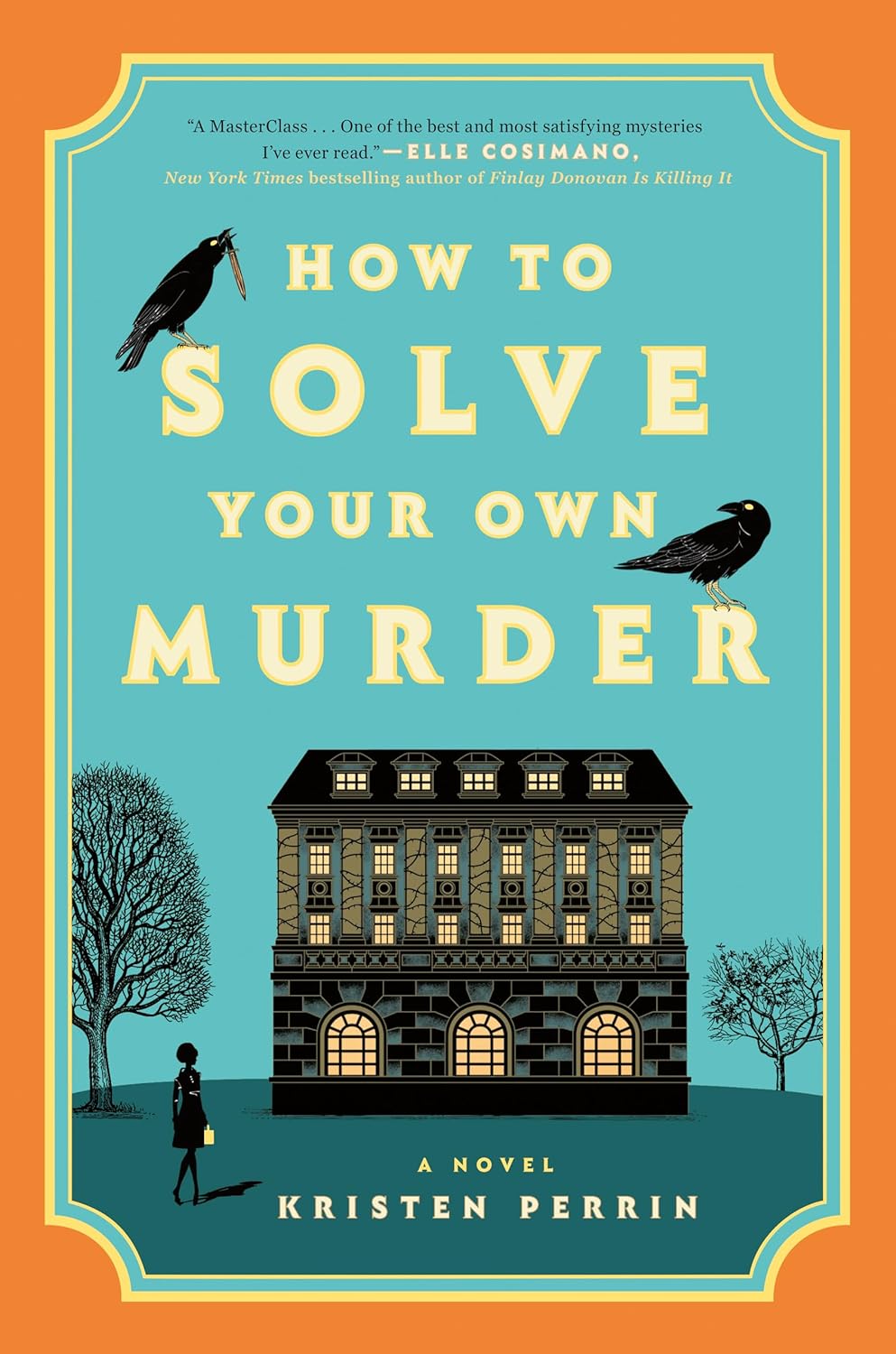
Imagine being a teenager and getting your fortune read. Now imagine that fortune is dark, a portent of what you believe might be your demise. What would you do? Frances Adams faced just that situation in Kristen Perrin’s novel, How to Solve Your Own Murder, first released in March 2024. It became an instant best seller and has continued to delight readers worldwide. Frances and her friends Rose Forrester and Emily Sparrow visit a fortune teller at the Castle Knoll Country Fair in 1965, an event that shapes the rest of Frances’ life. The three were longtime childhood friends, and while they suffered some of the usual teenage competition for boys and attention, they were often inseparable. Of course there’s far more to their friendship than readers suspect, much of which becomes clear as the story progresses.
The fateful fortune in question reads as follows:
“Your future contains dry bones. Your slow demise begins right when you hold the queen in the palm of one hand. Beware the bird, for it will betray you. And from that, there’s no coming back. But daughters are the key to justice, find the right one and keep her close. All signs point toward your murder.”
Perrin runs a dual storyline in this one, one from the mid 1960s, and one in the present two generations hence. Frances’ great niece, Annabelle Adams (Annie), is central to the present-day timeline as she becomes involved when she receives a communication from Frances’ solicitor requiring her presence at a meeting with her great-aunt. Annie has never met Frances though her mother has told her stories about her eccentric Aunt Frances over the years, but most of that never really made sense. So off Annie goes to Castle Knoll to meet with her great-aunt, and several others it seems. Saxon and Elva Gravesdown, Oliver Gordon, are also summoned to this meeting with Frances and her solicitor, Walter Gordon. When Annie arrives at Walter’s office, she finds out that her great-aunt has car trouble, and the entire meeting has shifted to her estate, Gravesdown Manor. Perrin gives readers quite the tour of the English country-side and the village of Castle Knoll in bringing them along to the estate. Once they all arrive, they enter the estate and find Frances dead on the floor, and so begins the mystery of her death, or is it murder? Perhaps that fortune from years ago was onto something after all.
The first order of business after the paramedics and police are summoned is to get things in order for the reading of the will. When that happens, the game truly is afoot as Frances has set some interesting terms in her will. Upon her death, Annie and Saxon are to attempt to solve what Frances believes is to be her murder, but she puts a clock on it of one week. If the police solve the case before either Annie or Saxon, they forfeit everything, and the estate would be sold off. If either of them solves the case in the allotted time, they inherit the works and the other gets nothing. As the executer, Walter Gordon is to be the arbiter of the case and has the final say of who solves the crime.
Perrin weaves the parallel timelines throughout the novel, bouncing between past and present to give readers the relevant history of who Frances was along with her circle of friends from 1960s England. Perrin, while not native to England, emigrated there to read for her PhD and stayed. She was originally from the United States, but having much more than a passing familiarity with the quaint towns and villages dotting the English countryside, she writes with panache to bring that world to life for her readers.
Everyone in Castle Knoll has a story to tell, whether it’s the detective working the case, Rowan Crane; the estate’s gardener, Archie Foyle; the paramedics who respond to the call, Magda and Joe; the doctor who treats Annie when she suffers an unexpected accident, Dr. Esi Owusu; or Archie’s granddaughter, Beth Foyle. The people from the past have a way of becoming central to the case as well, even when they’re long gone. Saxon’s uncle, Lord Rutherford “Ford” Gravedown, has a key role to play as Frances’ husband and Saxon’s guardian during his formative years. Readers are treated to Saxon’s history as a precocious yet odd boy growing into a man of some stature in the present. Some of his boyhood traits come back to haunt him as the case progresses.
Annie’s mother, Laura, also has an unexpected past, one that Annie uncovers through her investigation. As all the pieces start to coalesce, the story accelerates and builds to an unexpected crisis point ultimately resolving in a satisfying turn.
How to Solve Your Own Murder is book one of a two-book series. The second book in the series is How to Seal Your Own Fate, due out in late April 2025. It appears that many of the characters from book 1 will return, and again Annie will be thrust into the role of investigator for an event that occurred decades ago. As in the first book, this too involves her Great Aunt Frances as a young woman. Readers who’ve read How to Solve Your Own Murder will be familiar with the principals and will be fortunate to be treated to a deeper dive into the secrets of Castle Knoll’s past.
The quaint little village is anything but serene despite all appearances to the contrary. The Gravesdown family is again at the center of the action in what might be the village’s best kept secret. Maybe there’s more to Saxon’s peculiarities as a child than initially divulged.
It’s encouraging that readers can again visit Castle Knoll and learn more of its history. Although Annie may have bitten off more than she expected in all of this, she’s developing some significant skills as a reluctant investigator all because she answered the request to come to Castle Knoll at the behest of her Great Aunt. Who knew that being the “right daughter” carried so much responsibility? Then again, as a budding writer, this can only help her cultivate her craft once she catches her breath.
References:
How to Solve Your Own Murder by Kristen Perrin
How to Seal Your Own Fate by Kristen Perrin

 A Good Reed Review