 By Ande Jacobson
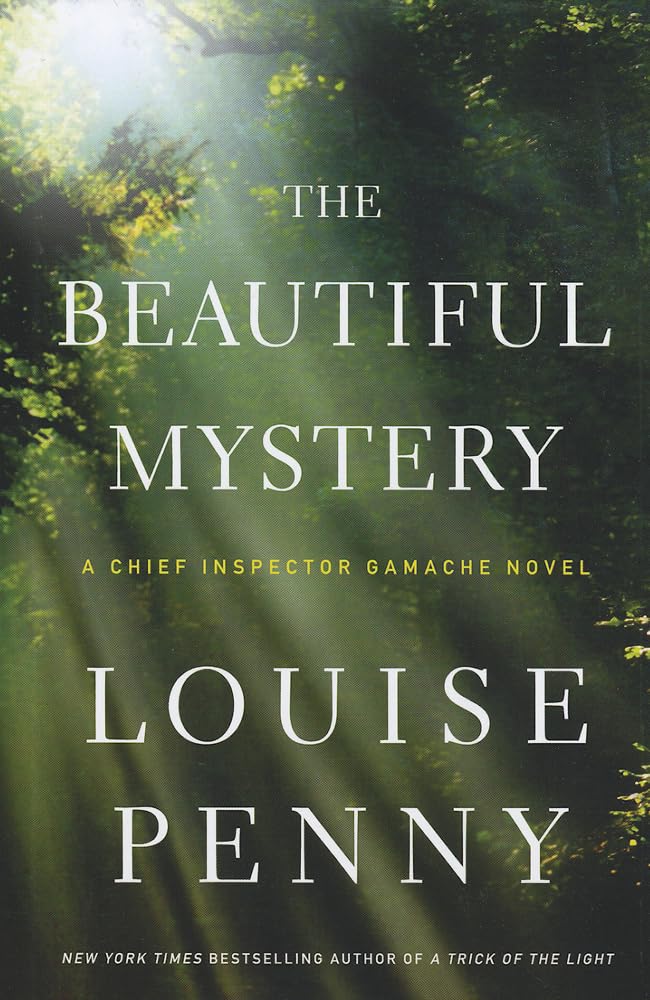
The Beautiful Mystery is the eighth full-length mystery novel in Louise Penny’s Chief Inspector Armand Gamache (of the Sûreté du Québec) series, and was first released in 2012. This book is different than most of those before it in the series in that the story doesn’t take place in Three Pines. Evidently the murder capital of Québec took a break, and Armand and his second in command, Jean-Guy Beauvoir, head to the wilderness to a remote monastery forgotten by the church and by society until recently. The Gilbertine order, named for Gilbert of Sempringham, was thought to be extinguished or disbanded during the Inquisition, but instead they merely fled Europe for a remote part of Canada where they built the last remaining monastery to continue their brotherhood. The monastery, named Saint-Gilbert-Entre-Les-Loups, garners Armand’s attention when a monk is found dead, presumably murdered, in the abbot’s garden one morning after Lauds. So begins the adventure.
The deceased monk was the prior and choirmaster who was an expert on Gregorian Chants and specifically Plainchant in which all of the services of this tiny order are sung. The Gilbertines are a silent order except for the beautiful music they create with their voices. The monastery is self-sufficient outside of a few supplies, and intentionally isolated on the shore of a remote bay that borders a deep woods. None are normally admitted to the monastery outside of the monks who live and worship there. They are a small community numbering only 24. When one monk dies, the abbot ventures into the world to find a replacement who is a pious man who will serve their order, and most importantly, their choir well. They each have other skills beyond their extraordinary singing voices. One is a doctor. One is an engineer/architect. Others are craftsmen of various sorts. Some are gardeners or versed in animal husbandry, important given they grow their own food and raise their own animals.
When Armand and Jean-Guy are brought to the monastery, the boatman is sure they’ll be turned away as every other visitor has been in recent years. The monastery gained notoriety when, through the urging of their choirmaster, the order released an unnamed, uncredited CD of their chants. Surprisingly, it became a world-wide sensation. Since that release, they’d been found and visited by numerous people trying to get a look at the monks who created the mesmerizing music, but to a person, those visitors had been turned away until Armand and Jean-Guy arrive to investigate the murder. They’d been summoned by the abbot. The one thing that is clear is that the murderer had to be one of the monks, but which one, and more importantly, why? What would motivate someone dedicated to this order to commit a mortal sin and kill one of his brothers?
Penny did extensive research for this book giving readers the feel and texture of the monastery and of the life the monks lead which is so different from living in the outside world. During the investigation, Armand discovers that while he and his team (very limited in number this time) search for evidence and facts, the monks operate on a different plane where the spiritual rather than earthly reality guides them. There are times when reality asserts itself, such as with the physical operation of the monastery, but their thoughts and pursuits tend to be more ethereal and spiritual. In addition to Armand and Jean-Guy, there is an officer from the local constabulary from the nearest village accompanying them. He’s there briefly and takes charge of the body bringing it back to the crime lab for forensic examination while Armand and Jean-Guy stay at the monastery to further investigate.
Having outsiders inside the monastery walls is a disruption. The order is normally a silent one, save for the chants and very limited discussion at specified times. The abbot temporarily suspends the vow of silence so that the monks can cooperate with the police in the investigation. What follows from that is a series of interesting discussions that are at first more than a little stilted. These men are not used to speaking freely, so they tend toward rather abrupt answers at first. As they start to get used to Armand and Jean-Guy, they loosen up, and Armand, always the active listener, learns a lot not only from the answers the monks give him, but from observing their interactions with one another. It becomes clear that all is not necessarily peaceful there. While not a full-on civil war, there is a pretty obvious schism among the monks, some favoring the abbot, with others favoring the now deceased prior in their philosophies. Armand and Jean-Guy uncover the source of the conflict, and in a way, it’s a conflict between embracing modernity versus avoiding it. The abbot is a traditionalist. He doesn’t want the order to become a public spectacle, and for a variety of reasons that become clear through the investigation, he pushes hard to maintain their traditional society even if that might mean their eventual demise. The prior on the other hand wants to embrace modernity in a sense by creating another recording. The first recording garnered not just popular attention, but it also brought in much needed funds to help maintain the monastery, but not enough to stave off an impending disaster.
There are many fascinating aspects to this mystery. The music is central to it, and the music’s effect on each man is palpable. More than any other order, the music in this order is central to their spirituality. As more than one monk points out in various ways, it brings them closer to God.
There are also some complications including a visit by a Dominican monk who shows up after dark one night begging to be let in. He’s from an office at the Vatican, though it is later revealed that his office is the successor to the Inquisition that has been searching for the Gilbertines ever since they fled Europe centuries earlier. He plays a significant, though unexpected role in solving the crime.
Penny also revisits an internal fight between Armand and his direct supervisor, Sylvain Francoeur when he arrives, uninvited, and noses into the investigation. Jean-Guy’s recovery is still tenuous from previous maladies, and Sylvain pounces on that to drive a wedge between him and Armand. How that plays out through the investigation is tense, and surprising.
The mystery is eventually solved. In fact multiple mysteries are brought to heel in the course of the investigation, two stemming back centuries along with solving the question of who and why the prior was murdered. Music has great power over humankind, and the sacred place it holds in the church is in a way a testament to that fact. Through Penny’s prose, readers can almost hear the monks chanting in the old, remote monastery on the shore bordering the woods. And they can almost taste the delectable blueberry chocolates from the monks’ chocolaterie. The Gilbertines eat well and enjoy more than a few delicacies borne of their hard work.
References:
The Beautiful Mystery, by Louise Penny
https://www.gamacheseries.com/books/the-brutal-telling/
https://agoodreedreview.com/2023/03/27/book-still-life/
https://agoodreedreview.com/2023/05/19/a-most-ungraceful-exit/
https://agoodreedreview.com/2023/06/16/book-the-cruelest-month/
https://agoodreedreview.com/2023/07/14/book-a-rule-against-murder/
https://agoodreedreview.com/2025/01/27/book-the-brutal-telling/
https://agoodreedreview.com/2025/03/07/book-bury-your-dead/
https://agoodreedreview.com/2025/03/24/book-a-trick-of-the-light/

 A Good Reed Review
[…] References: How the Light Gets In, by Louise Penny https://www.gamacheseries.com/books/the-brutal-telling/ https://agoodreedreview.com/2023/03/27/book-still-life/ https://agoodreedreview.com/2023/05/19/a-most-ungraceful-exit/ https://agoodreedreview.com/2023/06/16/book-the-cruelest-month/ https://agoodreedreview.com/2023/07/14/book-a-rule-against-murder/ https://agoodreedreview.com/2025/01/27/book-the-brutal-telling/ https://agoodreedreview.com/2025/03/07/book-bury-your-dead/ https://agoodreedreview.com/2025/03/24/book-a-trick-of-the-light/ https://agoodreedreview.com/2025/04/23/book-the-beautiful-mystery/ […]
LikeLike
[…] https://agoodreedreview.com/2025/03/24/book-a-trick-of-the-light/ https://agoodreedreview.com/2025/04/23/book-the-beautiful-mystery/ […]
LikeLike
[…] https://agoodreedreview.com/2025/03/24/book-a-trick-of-the-light/ https://agoodreedreview.com/2025/04/23/book-the-beautiful-mystery/ https://agoodreedreview.com/2025/05/02/book-how-the-light-gets-in/ […]
LikeLike
[…] https://agoodreedreview.com/2025/03/24/book-a-trick-of-the-light/ https://agoodreedreview.com/2025/04/23/book-the-beautiful-mystery/ https://agoodreedreview.com/2025/05/02/book-how-the-light-gets-in/ […]
LikeLike
[…] https://agoodreedreview.com/2025/03/24/book-a-trick-of-the-light/ https://agoodreedreview.com/2025/04/23/book-the-beautiful-mystery/ https://agoodreedreview.com/2025/05/02/book-how-the-light-gets-in/ […]
LikeLike
[…] https://agoodreedreview.com/2025/03/24/book-a-trick-of-the-light/ https://agoodreedreview.com/2025/04/23/book-the-beautiful-mystery/ https://agoodreedreview.com/2025/05/02/book-how-the-light-gets-in/ […]
LikeLike
[…] https://agoodreedreview.com/2025/03/24/book-a-trick-of-the-light/ https://agoodreedreview.com/2025/04/23/book-the-beautiful-mystery/ https://agoodreedreview.com/2025/05/02/book-how-the-light-gets-in/ […]
LikeLike
[…] https://agoodreedreview.com/2025/03/24/book-a-trick-of-the-light/ https://agoodreedreview.com/2025/04/23/book-the-beautiful-mystery/ https://agoodreedreview.com/2025/05/02/book-how-the-light-gets-in/ […]
LikeLike
[…] https://agoodreedreview.com/2025/03/24/book-a-trick-of-the-light/ https://agoodreedreview.com/2025/04/23/book-the-beautiful-mystery/ https://agoodreedreview.com/2025/05/02/book-how-the-light-gets-in/ […]
LikeLike
[…] https://agoodreedreview.com/2025/03/24/book-a-trick-of-the-light/ https://agoodreedreview.com/2025/04/23/book-the-beautiful-mystery/ https://agoodreedreview.com/2025/05/02/book-how-the-light-gets-in/ […]
LikeLike
[…] https://agoodreedreview.com/2025/03/24/book-a-trick-of-the-light/ https://agoodreedreview.com/2025/04/23/book-the-beautiful-mystery/ https://agoodreedreview.com/2025/05/02/book-how-the-light-gets-in/ […]
LikeLike
[…] https://agoodreedreview.com/2025/03/24/book-a-trick-of-the-light/ https://agoodreedreview.com/2025/04/23/book-the-beautiful-mystery/ https://agoodreedreview.com/2025/05/02/book-how-the-light-gets-in/ […]
LikeLike