 By Ande Jacobson
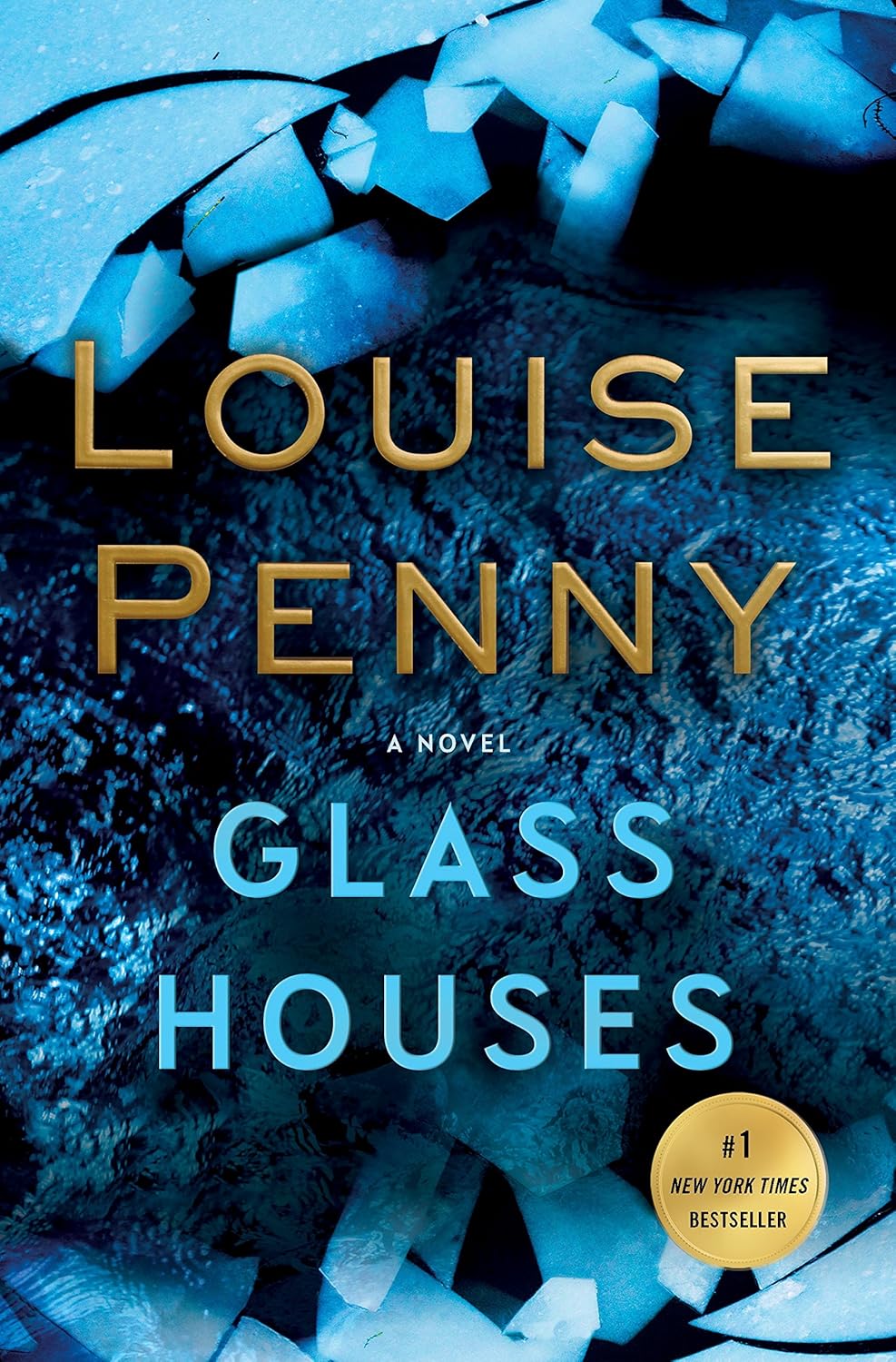
Glass Houses, is the thirteenth mystery novel in Louise Penny’s Gamache series. As in the previous book, this one picks up where its predecessor left off, this time with Armand Gamache taking the position of Chief Superintendent of the Sûreté du Québec. Having cleaned out the service and the academy of the former deep-seated corruption, he now faces the reality that the service is fighting what seems an unwinnable battle against the drug trade. Canada had become the entry point for drugs flowing from Europe, Asia, and parts beyond so proficiently that there isn’t an obvious way to stop them. Those drugs then blanket both Canada and the U.S. causing death and destruction in their wake. Given this dire situation, Armand, with his second-in-command and son-in-law Jean-Guy Beauvoir, create a committee of the most trusted heads of Sûreté departments including Chief Inspector Isabelle Lacoste, the agent who rose to replace Armand when he retired earlier, and Superintendent Madeleine Toussaint among others to address this in a way that promises serious consequences whether or not they are successful. Armand also enlists the chief prosecutor for the province, Barry Zalmanowitz, in his complex plan. At the same time, Armand is a key prosecution witness in a contentious murder trial. The presiding judge, Judge Maureen Corriveau, suspects something is amiss in the trial early on, but it takes time for the depth of the scheme to fully come to light. Part of Armand’s plan necessitated him making it seem like the Sûreté was completely inept to give those they were pursuing a false sense of security. The danger of course puts many innocents in grave danger. At what point are sacrifices for the greater good too great?
Back in Three Pines, another story develops surrounding several newcomers to the village. A group of college buddies meet for an annual reunion of sorts, and two new arrivals join the staff of the boulangerie and the bistro respectively. Unbeknownst to any of the village regulars, there’s a hidden connection between all of the newcomers that plays a serious role in the trial running concurrently with Armand’s complex plan.
As has happened in a few of the recent installments, Penny runs a dual timeline interweaving the trial, Armand’s long term plan to deal with the out of control drug trade that’s infiltrated the country, and the events that lead up to the trial at hand. She also includes some interesting history that she extends into the realm of fiction.
Penny introduces readers to the concept of the Spanish “cobrador del frac,” an odd type of debt collector who uses public shaming to coerce debtors to pay up. The real life cobrador del frac follows the debtor around wearing a black frock coat and top hat, often carrying a briefcase. The mere presence of the cobrador puts a target on the debtor’s back, even though the cobrador never actually talks to the debtor or physically threatens them. They merely make it publicly visible that the debtor is in fact trying to escape their obligation shaming them into ultimately paying their financial debt. Such pursuit is remarkably effective in most cases. In Glass Houses, Penny extends the concept of a cobrador beyond the generally accepted scope and brings one to life in Three Pines, standing on the village green, targeting somebody, though who and for what reason is a mystery in itself. Penny’s creation isn’t limited to financial debt. The cobrador Penny conjures in this story isn’t wearing the costume of a cobrador del frac either. Instead they appear all in black more like death himself (without the scythe), and the disquiet that creates in the village is palpable. Penny’s cobrador stands on the village green staring at someone for days making the entire village uncomfortable until things come to an impressive confrontation.
Many plead with Armand to do something, but the figure is just standing there, not even approaching anyone. Being a public space, there’s nothing legally that Armand can do, and he points that out. There is quite a mystery surrounding this cobrador. The mystery intensifies when a murder victim is later discovered in the cobrador’s garb linking this flashback with the trial, but then there had to be a murder for the overarching trial to make any sense. Penny’s interweaving of the current events in the trial and the past village events are sometimes just a tad disorienting.
More of Armand’s inner thoughts and turmoil come to light as he takes some actions that at first seem out of character for him. Once the reasons for his actions come to light, it’s clear that this is still the same Armand Gamache that readers have come to care about. He is human. He is fallible. He is determined. He is skillful and persuasive. And he is desperate to help.
The resolution of the mysteries is satisfying eventually, but not without quite the journey into uncomfortable territory. Still, there are a few strings that remain hanging that linger into the next book in the sequence, particularly where Armand is concerned. While these strings create the foundation for the next story, but they don’t detract from the resolution of the story at hand. Armand risks everything to execute his plan for the greater good, as do others who sign on to help. To say there were a few mishaps along the way would be a bit of an understatement, though had Armand pursued a different course, he’d have had no chance of success. This way, while not guaranteed, he has some hope.
These later stories in the series are multilayered. Many of those involved aren’t all good or bad, and it’s that nuance and balance that makes them interesting. Seeing Armand’s inner turmoil over some of his decisions gives the story even more weight. As a character, Armand maintains a certain level of hope that people can change for the better. Sometimes that faith in humanity is warranted and rewarded. Sometimes it blinds him to dangerous possibilities as Jean-Guy is quick to point out. Even so, Armand doesn’t necessarily trust or like everyone he’s enlisted, but he recognizes that even those with whom he shares no rapport can sometimes be helpful and even dedicated allies. He’s good at building cooperative coalitions, even when it’s excruciatingly uncomfortable to do so.
This story is a little on the dark side, but it’s not without some less intense or even humorous moments. After all, the village regulars are all present as well, and they are integral to the plot. As has been the case along the way, they too grow from the experience.
References:
Glass Houses, by Louise Penny
https://www.gamacheseries.com/book/
https://agoodreedreview.com/2023/03/27/book-still-life/
https://agoodreedreview.com/2023/05/19/a-most-ungraceful-exit/
https://agoodreedreview.com/2023/06/16/book-the-cruelest-month/
https://agoodreedreview.com/2023/07/14/book-a-rule-against-murder/
https://agoodreedreview.com/2025/01/27/book-the-brutal-telling/
https://agoodreedreview.com/2025/03/07/book-bury-your-dead/
https://agoodreedreview.com/2025/03/24/book-a-trick-of-the-light/
https://agoodreedreview.com/2025/04/23/book-the-beautiful-mystery/
https://agoodreedreview.com/2025/05/02/book-how-the-light-gets-in/
https://agoodreedreview.com/2025/05/23/book-the-long-way-home/
https://agoodreedreview.com/2025/06/07/book-the-nature-of-the-beast/
https://agoodreedreview.com/2025/06/24/book-a-great-reckoning/
A Good Reed Review also gratefully accepts donations via PayPal to help defray the costs of maintaining this site without creating paywalls.

 A Good Reed Review
[…] A review […]
LikeLike