 By Ande Jacobson
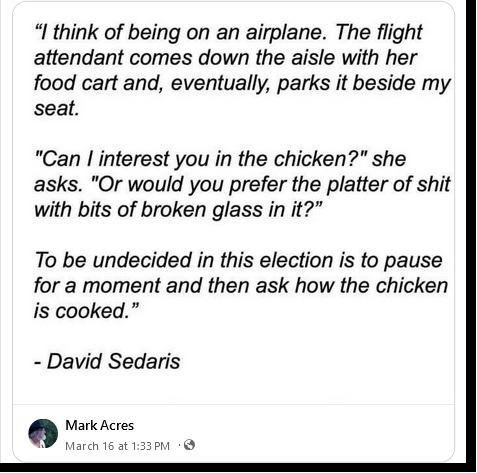
I recently shared what I thought was a cogent, albeit satirical take on the choice before us this November. It was a David Sedaris quote posted by Mark Acres. A friend shared Acres’ post on their timeline, and I shared it to mine.
Several friends commented on the post. Most were either close to retirement or in retirement save for one who posted a somewhat provocative take based on his own demographic – a very smart, engaged, well-educated younger voter who is scared and angry about the future of our country, idealistic, and concerned that he is not seeing the Democratic Party reaching out to younger voters in a way that shows they are listening to their concerns. This sparked a heated exchange between several commenters including me. The older generation was trying to explain the lessons we’ve all learned through hard-earned experience and why a protest vote in this particular election could be very dangerous. To be fair, my younger friend lives in a very blue area of a very blue state, so his vote if he chooses to use it as a protest probably won’t do much damage, but the general concept is one that got me thinking back to my young, idealistic college days and the hard lesson I learned in the first presidential election in which I was eligible to vote.
In 1980, Jimmy Carter ran for reelection against Ronald Reagan. It was clear at the outset that Reagan was trouble. He had already shown his stripes as the Governor of California years before when he made some changes that caused serious problems that the state is still struggling with today. I definitely didn’t want to see Reagan become president of the nation and impose his cruel economic policies on the country as a whole. While I thought that Carter meant well, he was struggling with bad press, and policies that faced strong opposition from the growing moderate and conservative movements. Like many other young, idealistic college students at the time, I ended up voting for John Anderson who, after having lost the GOP primary, ran in the general election as an independent. He was billed as a liberal alternative to Reagan’s hard-right policies. Anderson stood for many of the things I thought were important, though in the end while he garnered millions of votes, he didn’t win a single state, but more than that, he siphoned off most of his votes from Carter rather than Reagan.
The hard lesson learned from that election was that in our two-party system, like it or not, in presidential elections, a third party or independent candidate will pull from the major party candidate they are most like and help the other major party candidate win. Of course, in 1980, I didn’t consider my vote a protest vote. I really thought that Anderson could win at the time not yet recognizing that impossibility in our modern political climate. A third party or independent candidate might win a regional or congressional election, but they cannot win a national presidential contest.
In 1992, Ross Perot played the role of spoiler costing George H.W. Bush a second term and giving Bill Clinton a decisive victory. I personally didn’t mind this result, but it’s still instructive to the pattern.
In 2000, Ralph Nader cost Al Gore the election and while the Supreme Court ultimately decided that contest, had Nader not been a candidate, it likely wouldn’t have been that close. Gore won the popular vote that year, but not the Electoral College once the Supreme Court stepped in an put their thumb on the scale.
In 2016, while Hillary Clinton won the popular vote by a sizable margin, third party candidates propelled by protest votes siphoned off enough of her votes to cost her the Electoral College win and gave us Donald Trump. We know what happened from there.
Now in 2024, while the presumptive major party nominees are Democratic Party candidate Joe Biden running for reelection and GOP candidate Donald Trump, this isn’t a normal presidential contest. In 2020 when Joe Biden defeated Donald Trump in both the popular vote and the Electoral College, Trump wouldn’t concede and still hasn’t publicly accepted those results. For the first time in our nation’s history, Trump refused to support the peaceful transfer of power to his successor. Trump has since been indicted in multiple jurisdictions on 88 criminal charges, and he’s also lost multiple civil cases adding up to about a half a billion in judgements against him so far. The first criminal trial is currently scheduled to begin in mid-April 2024.
While the party platforms are normally created at the conventions for the general election, and in 2020, the GOP didn’t bother with a platform, the records and policies of the two major candidates couldn’t be more different.
The Biden/Harris administration has an impressive record for their first term so far, in spite of razor thin Congressional majorities the first two years and a hostile and dysfunctional House lead by MAGA extremists since January 2023. Theirs is a multicultural administration that reflects the country as a whole.
In contrast, the GOP has their Project 2025 playbook, a step-by-step guide to creating a white nationalist, theocratic autocracy in place of U.S. democracy. It is a guide to further widening the divide between the vast majority of people, and a very small, rich, white, male elite who wants to run everything.
For political norms, if a sitting president chooses to run for reelection, that’s normally the end of the discussion for the party holding the White House. President Biden has chosen this path, and the DNC is supporting his reelection campaign, although officially he’ll be selected at the DNC’s summer convention to launch the general campaign. Biden has been an incredibly effective president despite the hostility he’s faced in our hyper-polarized country. He hasn’t accomplished everything he set out to do, but he has accomplished a great deal of it, and he does the work. He’s not flashy. He’s not begging for headlines, but through his experience and acumen he and his administration have accomplished much of their agenda through tough but fair negotiation, and he’s provided world leadership in the face serious threats to U.S. security and democracy worldwide. Few could have brought together the international coalition he and his team did to support Ukraine, a must for world stability. He’s also come a long way in repairing our nation’s international reputation after the damage done by the previous administration. Still, world leaders are very aware that could change if Trump were to regain the White House.
So what does this have to do with the contentious debate on a Facebook post? It’s a symptom of a larger problem and points to another difficult lesson. My young friend claims that the DNC’s messaging is deaf to the concerns of his cohort when younger voters and workers are the future of the country. They have economic challenges that older generations haven’t fully faced. Housing, education, healthcare, and transportation concerns all weigh heavily on younger people early in their careers. Many may never be able to work off the debts they’ve accumulated by their mid-twenties for things that most in older generations have had for a far more reasonable cost.
Climate change is only getting worse, and the brunt of the changes caused by the billions of people on the planet will be felt most heavily by the younger generations.
The Biden administration has started to repair some of the damage of the last 40+ years of GOP economic policies. They’ve also started to address some of the structural problems facing the nation through the bipartisan infrastructure law, but none of this can be cured in a single administration, particularly with a hostile Congress in the mix. The lesson here is that compromise and cooperation are key to getting anything done. We’ll never get everything we want, but in exercising our vote, we have to look at the issues with clear eyes. We have to understand not only who has a chance of winning, but who is in the best position to accomplish a more favorable overall result on the issues we care about. Between Trump and Biden, that choice for most should be self-evident.
A protest vote, while it might feel good in the moment, really isn’t a solution here. A protest vote against Biden because he hasn’t done everything somebody might want will only help Trump win. The same goes for casting a protest vote for a GOP Senatorial candidate because the Democratic candidate isn’t one’s first choice. The Congressional balance matters. If we want to make forward progress given the extremism of today’s GOP, we need Democratic majorities across the board.
If we value democracy and forward progress to help the vast majority of people, Biden and Democratic candidates for Congress are the clear choices here.
References:
https://www.whitehouse.gov/therecord/
https://www.project2025.org/playbook/
https://agoodreedreview.com/2023/08/25/wear-a-raincoat/
https://agoodreedreview.com/2024/02/13/book-a-firehose-of-falsehood-2/
https://www.history.com/news/third-party-candidates-election-influence-facts
Heather Cox Richardson’s Letters from an American
Jay Kuo’s The Status Kuo
Joyce Vance’s Civil Discourse
Katelyn Jetelina’s Your Local Epidemiologist
https://terikanefield.com/
Teri Kanefield’s blog series on disinformation:
A Good Reed Review also gratefully accepts donations via PayPal to help defray the costs of maintaining this site without creating paywalls.

 By Ande Jacobson






 A Good Reed Review