Adrian Tchaikovsky’s series that began with Children of Time, concludes with Children of Memory, released in November 2022. Again many of the characters (or their descendants from previous books) are back. This time, an instance of the AI known as Avrana Kern is built into yet another interstellar ship. She and all of her other instances are what remain of the ancient human terraformer/scientist who jump-started the advancement of numerous species on diverse worlds, though not all intelligent life was directly the result of her intervention. The ship this time is called the Skipper, and its crew is comprised of a Human (with a capital H), a few portiids (a type of intellectually advanced jumping spider), an enhanced octopus, an interlocutor or observer who has taken Human form but is in reality a colony of intelligent entities from the planet Nod, and two new arrivals. Continue reading
Book Review
‘Children of Ruin’ continues the journey
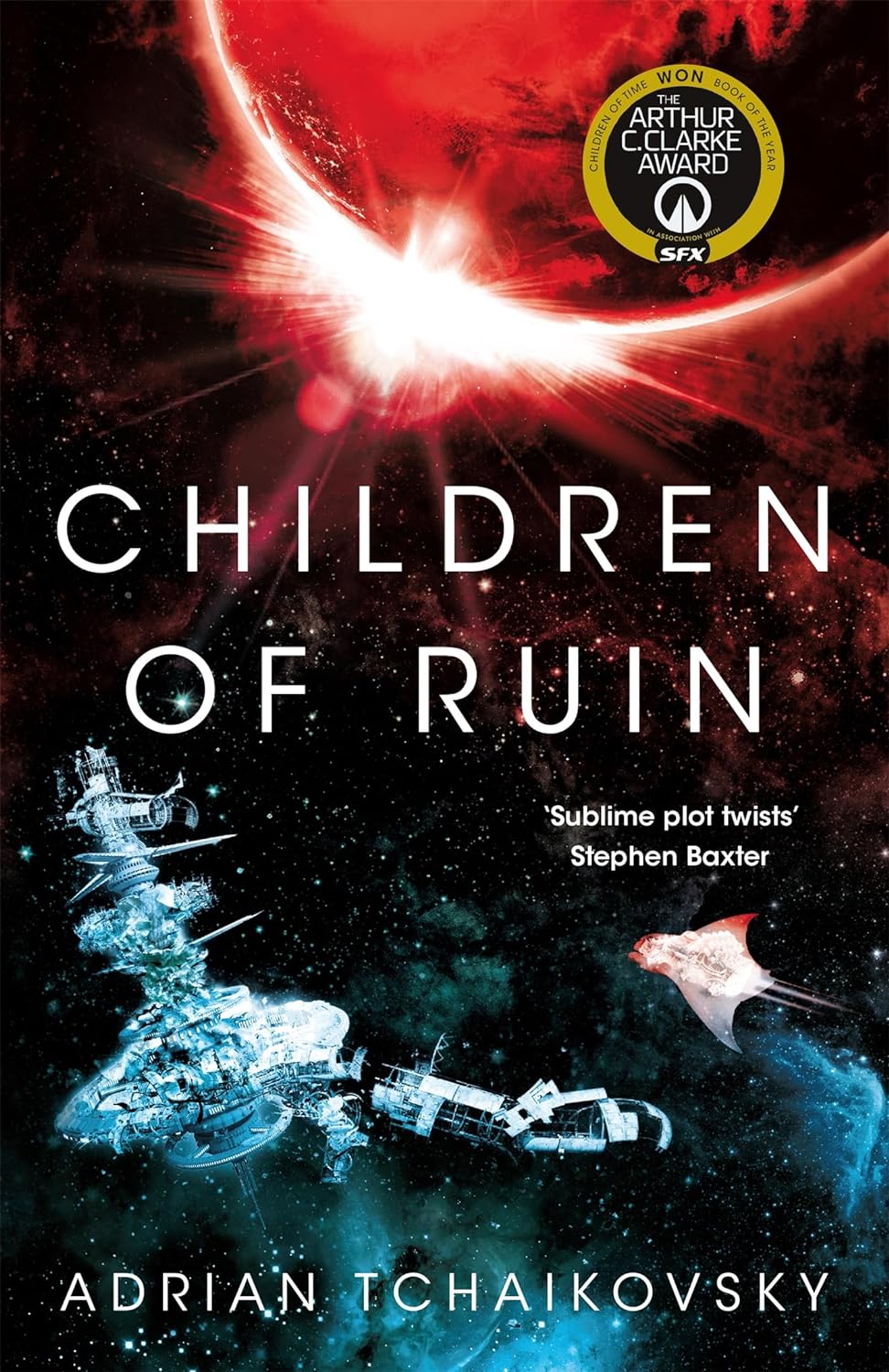
Adrian Tchaikovsky’s series that began with Children of Time, continues with Children of Ruin, originally released in May 2019. Many of the characters from the first book are back, at least in reference, and their descendants do them proud by continuing the adventure. The Humans (with a capital H) and the Portiids now have a strong working relationship on the planet known as Kern’s World, although direct communication is still a bit challenging given the differences in their thought and expressive processes. Capital H Humans are humans who have embraced a mutually beneficial relationship with the Portiids (i.e., large jumping spiders with an advanced intellect and civilization seeded and accelerated by humans of the distant past). Kern’s World from the first book is a planet that was terraformed and seeded with a virus to accelerate the intellectual development of monkeys. Alas, there were no monkeys, but a particular species of jumping spider evolved with the virus to establish a robust civilization on the planet. The planet was named Kern’s World after Avrana Kern, an ancient terraformer/scientist who over the centuries had uploaded her consciousness into an AI and enjoys a type of immortality. Initially, Kern was seen as some kind of god by the Portiids, but eventually when she made herself visible to the Portiids, she became something of an adviser. The first book is discussed in greater detail in ‘Children of Time’ expands minds.
In the second installment in the trilogy, Tchaikovsky runs a parallel storyline alternating sections between the distant past and what is now the present, along the way introducing some new life forms while evolving the existing ones. Continue reading
‘Democracy Awakening’ puts it all in perspective
Heather Cox Richardson’s newest book, Democracy Awakening: Notes on the State of America, was released on 26 September 2023 and is a must read to understand how we got to where we are, the dangers we face, how Americans have strengthened our democracy in times of yore, and finally, how we can again counter the authoritarian threat and reclaim our democracy from those who would abolish it forever. For those who regularly read Professor Richardson’s nightly newsletter, Letters from an American, there isn’t a lot of new material in this book. What is new is how Richardson has condensed the journey and the solution into this tight volume. This isn’t a big book. In fact, it’s a collection of 30 essays of six to eight pages apiece. Bounding these essays are a Forward introducing the material and discussing how the book came about and a Conclusion at the end tying together the pieces of how we could go about recovering and strengthening our democracy going forward. Richardson is honest that she can’t say it’s a sure thing, but the vast majority of Americans want our democracy to survive. The question is whether the overwhelming majority of people will pull together to make it so. Only time will tell. Continue reading
‘Children of Time’ expands minds
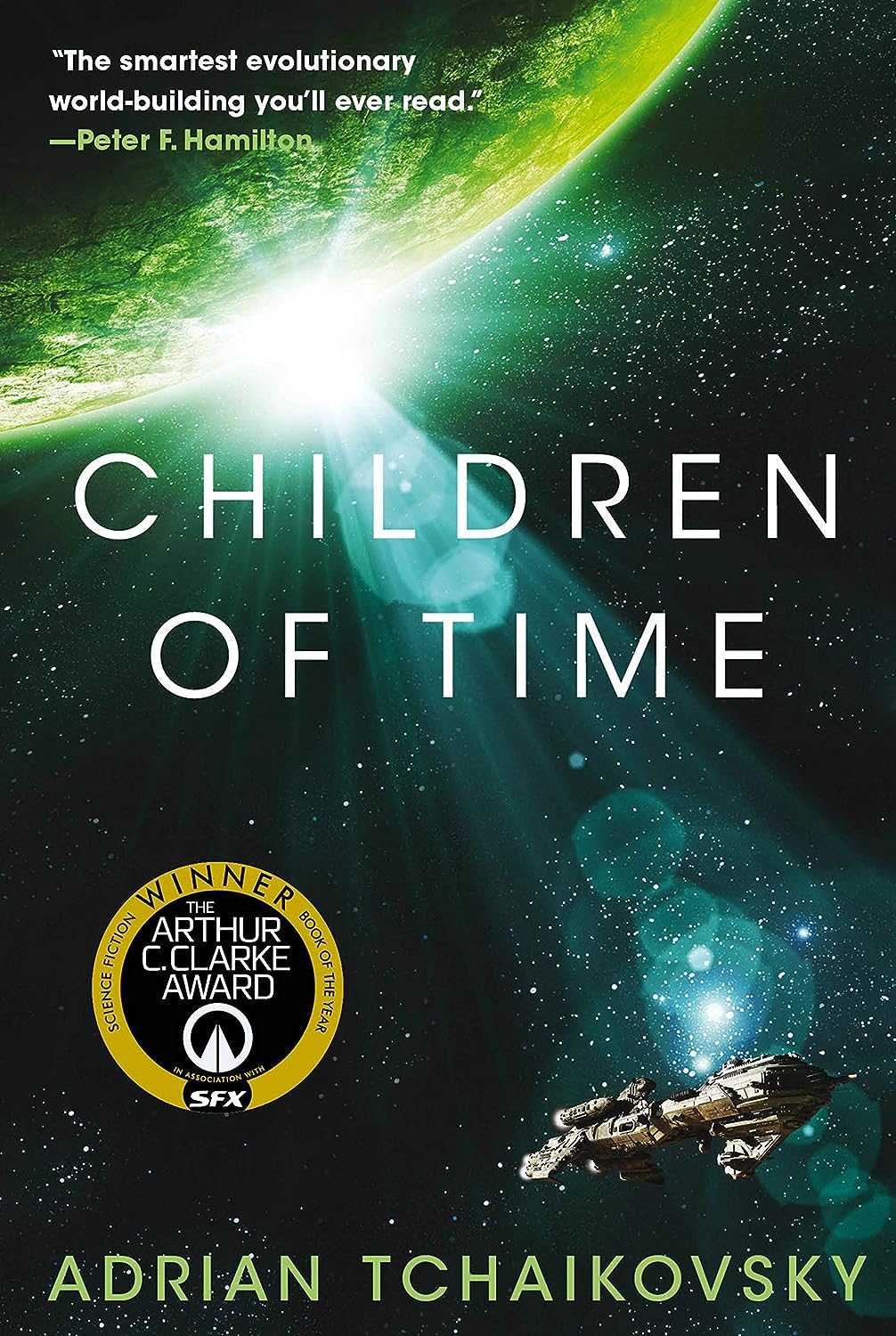
Adrian Tchaikovsky’s Children of Time trilogy begins with a bang. Or perhaps I should say the first book, Children of Time, originally released in June 2015 spins a mind expanding tale. The premise is one that draws deeply on Tchaikovsky’s roots as a zoologist (with a combination psychology/zoology pedigree). It is thought-provoking science fiction at its finest introducing a world where humans are not the dominant species. Although sparked by human interference, the green planet known as Kern’s World is home to a wide-ranging arachnid and insect population that has developed beyond the wildest human imagination. Marine life as well has surpassed what we know today on Earth. It wasn’t always this way, but humankind had run out of options. In the far future, humankind had finally destroyed the Earth. In their final days they sent out ark ships in hopes that the species could find a new home through advanced terraforming experiments intended to seed potential worlds with the ecosystems necessary to support human life. Alas, the best of the intentions are often usurped by unexpected events. Continue reading
Wear a raincoat!
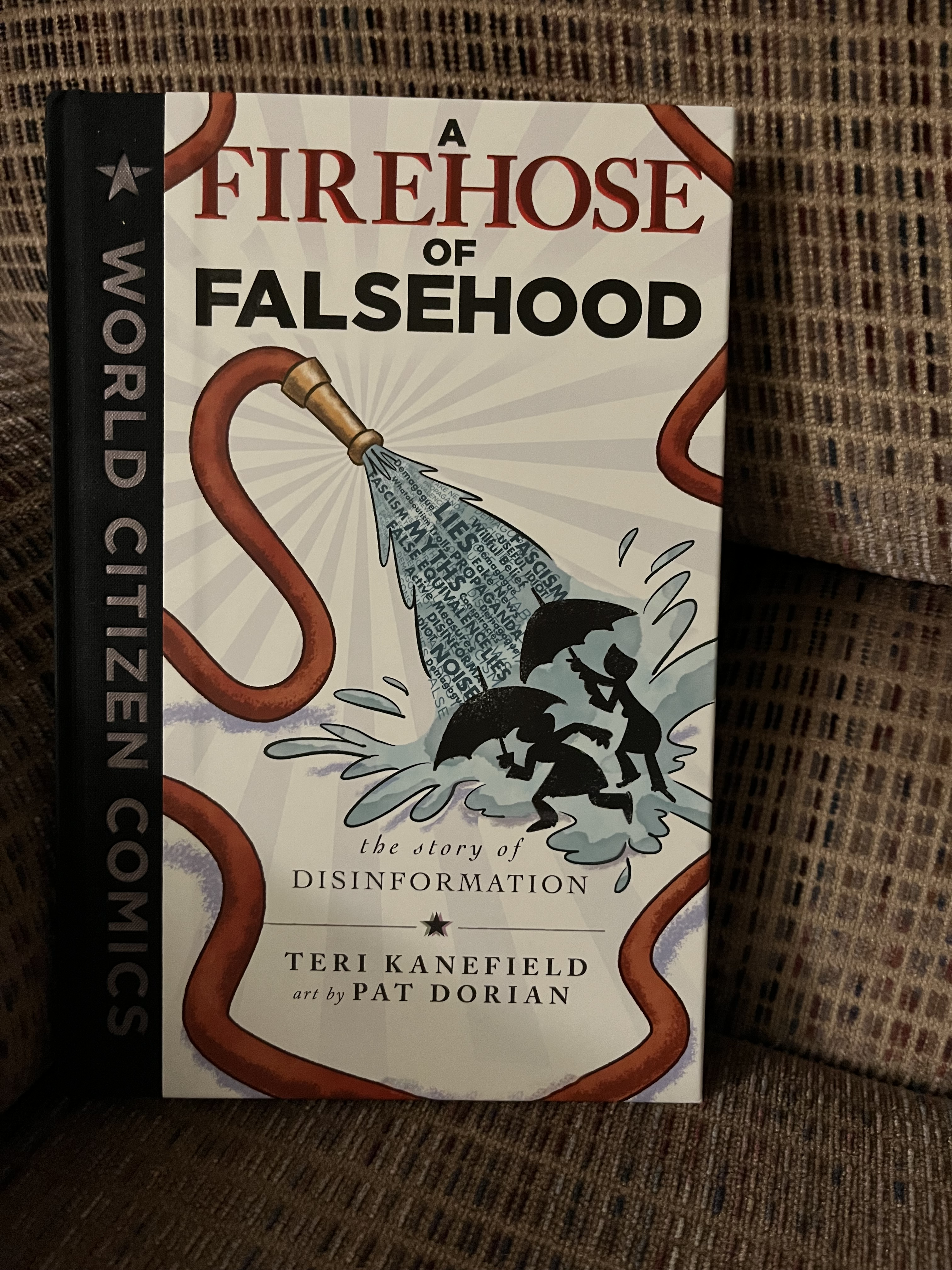
I recently received a review copy of an upcoming book by Teri Kanefield and illustrator Pat Dorian that’s coming out in February 2024, and it’s a good one. Their new book entitled, A Firehose of Falsehood: The Story of Disinformation, is a graphic novel providing an extremely well-sourced history and use of disinformation and the damage it can do. Many of the scenes depicted are fictionalized accounts to illustrate aspects of how disinformation grew into the powerful, malevolent tool it has become. It’s not new and in fact has its origins in ancient times. The ways in which disinformation is deployed have evolved with our technology to the point where it’s become so ubiquitous, it’s often hard for people to recognize. In the end, the only real protection we have is to wear a figurative raincoat to protect ourselves from its onslaught and be ever vigilant in verifying the information we consume through reputable sources. That raincoat consists of awareness, education, and care. It takes effort, but the alternative is bleak. This upcoming book is considered a crossover YA/Adult work, and as I was reading, it sparked a bit of Rocky and Bullwinkle nostalgia in the sense that it seemed to hit on multiple levels. Continue reading
‘The Trespasser’ is a gripping murder mystery
Tana French is an American-Irish author who writes gripping mysteries. Her Dublin Murder Squad Mysteries series is taut and guaranteed to keep her readers up at night flipping pages to see what happens next. While Tana French aficionados sometimes recommend reading the series in order to fully appreciate the tempo of the squad, it’s not necessary. Although some characters are occasionally seen in multiple books, the books themselves don’t lose any of their appeal or tension if read standalone in any order. Continue reading
The Morrows and a murder
A Rule Against Murder is the fourth Chief Inspector Armand Gamache (of the Sûreté du Quebec) story by Canadian author Louise Penny first released in 2009. In Canada, the title was originally The Murder Stone which gives more away about the mystery from the outset. This time Armand and Reine-Marie are enjoying an anniversary trip to the luxurious Manoir Bellechasse, an inn in a lovely forested location not far from Three Pines. They had planned to enjoy the scenery and each other’s uninterrupted company in the peaceful old-world setting. The only other guests are the Finneys – a large, wealthy, multigenerational family there for their own celebration of sorts. Early on Irene Finney, the matriarch of the Finney family, and her adult children get the entirely wrong idea about the Gamaches thinking that Armand is a lowly shopkeeper, and Reine-Marie is a cleaning women when they misinterpret something that the Gamaches say in casual conversation. The Finneys are awaiting the wayward sibling and his wife, who surprisingly turn out to be Peter and Clara Morrow from Three Pines. Peter and Clara arrive the night before a statue of Irene’s first husband, Charles Morrow, is to be unveiled. It turns out that Bert Finney is Irene’s second husband, but her children (Thomas, Julia, Peter, and Marianna) are all Morrows. Continue reading
Can somebody be literally scared to death?
The Cruelest Month is the third Chief Inspector Armand Gamache (of the Sûreté du Quebec) story by Canadian author Louise Penny. Penny has kept a pace of one or two Gamache mysteries a year since she started the series, and this one was first released in 2008. As usual, the murder requires some setup through the first quarter of the book, and when it comes it hits hard.
Easter is fast approaching, and Three Pines has a visitor – a psychic named Jeanne Chauvet with a surprising history. She’s staying at the B&B where all visitors tend to stay, and Gabri is beside himself with excitement. He convinces Jeanne to lead a séance at the B&B on Good Friday, an activity she ostensibly hadn’t planned on as she had other plans for her time in the village. Still, Gabri is her host at the B&B, so she eventually acquiesces and holds an informal ceremony that night after most of the villagers had spent the afternoon hiding wooden eggs for the upcoming Easter egg hunt. There’s a story behind the wooden eggs that’s nicely covered in the book. For now, suffice it to say that Three Pines has some interesting creative traditions. Continue reading
The Camel Club’s final case
Hell’s Corner, released in 2010, is the fifth and final book in David Baldacci’s Camel Club series. As mentioned in a prior essay, the Camel Club is a ragtag team of eccentrics who are attuned to and intent on exposing and correcting our government’s missteps. John Carr, AKA Oliver Stone, leads the group and is a former government-trained assassin from a highly secret (and fictional) branch of the CIA.
At the outset of the story, Stone is pulled back into the government fold, though not as a Triple Six assassin since that division no longer exists. He has other skills that they desperately need, so the president makes him an offer he that cannot refuse. Stone has been living off the grid for the last thirty years or so, constantly looking over his shoulder because even his own government has been after him. After his recent retaliatory actions to remove his two biggest threats it actually has a valid reason to pursue and eliminate him. The president recognizes his value despite Stone’s sometimes rogue behavior, so he offers him the opportunity to work on a high stakes case. If successful, the president promises that he’ll allow Stone to live out the rest of his life in peace. Stone agrees and is due to embark on a grueling training course after which he’ll be put back in the field on a case he really isn’t expected to survive. Continue reading
A most ungraceful exit
A Fatal Grace is the second of Louise Penny’s Chief Inspector Gamache stories. It was first released in Canada as Dead Cold in 2006. Although it takes several chapters before the primary murder of interest occurs, Armand Gamache ends up back in Three Pines again. For a small village outside of Montreal, Three Pines might rival Cabot Cove in Maine for the most murders per capita, and this is only one of the murders being investigated by the famed Chief Inspector this time. He has two investigations going on. The primary case occurs on Boxing Day in Three Pines and involves his full team. The secondary case is one involving the murder of a homeless woman in Montreal that occurred a few days earlier though most of his team is unaware of the Montreal murder. He keeps that case close to the vest as it is a recent one that he’s investigating on the side for a friend with the Montreal Metropolitan Police. Gamache is a Chief Inspector with the state police – the Sûreté du Quebec, and he and his wife (Reine-Marie) have a Boxing Day tradition of combing through the cold cases brought by Marc Brault of the city’s force while Brault does the same with some of Gamache’s more stubborn cases. Why such a recent murder would be a cold case intrigues Gamache. As for the trade, new sets of eyes could sometimes break the logjam. Continue reading