Remember it’s ‘WE THE PEOPLE’

By Ande Jacobson

As I sit huddled at home as many of us have for almost eight months now, I see the world outside my windows, and I interact virtually with friends and family via phone, via text, and via Zoom (and boy do I look forward to those Zoom sessions). I never thought I would be living through a worldwide pandemic, and yet here we all are. In the US as I write this, we are also only a few days from the end of being able to cast our ballots in the most important election in almost a century. In response to this election, rather than sitting back and waiting, I am heavily engaged in some necessary volunteer work for the Biden campaign as I mentioned in my recent essay, Taking Action! As I read reports of daily happenings, these words are looming large:

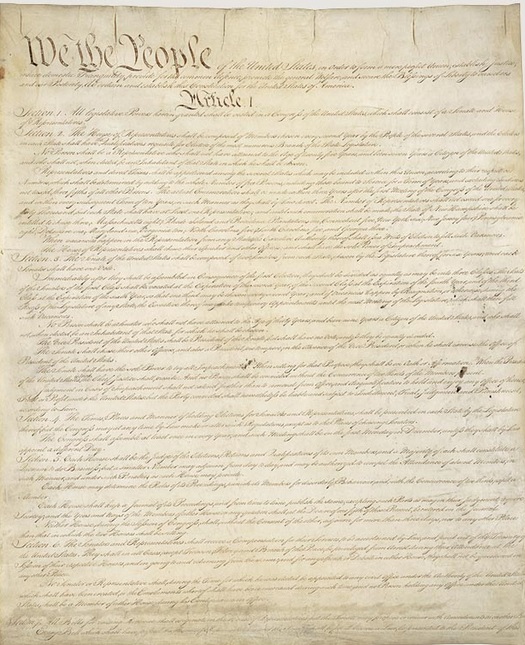
WE THE PEOPLE of the United States, in Order to form a more perfect Union, establish Justice, insure domestic Tranquility, provide for the common defence, promote the general Welfare, and secure the Blessings of Liberty to ourselves and our Posterity, do ordain and establish this Constitution for the United States of America

Continue reading

Taking Action!

By Ande Jacobson

Stories. We all relate through stories. We use them from the time we’re small to help us learn language and other skills we need to function as members of society. We use them in our families to ensure that we don’t forget those who came before us. We use them in school as students and teachers to illustrate new concepts and explore the vast world around us. We use them at work to convey information. We use them for entertainment to draw out emotions. We use them throughout society to help understand where we are, and how we got here. We use them in politics to persuade and move people to take action. Continue reading

Trouble – when the story matters more than reality

By Ande Jacobson

In theater or in literature, an author’s vivid imagination can be a wondrous thing. A writer can spin a captivating tale limited only by the bounds of their imagination and their ability to capture their vision in words. If told well, such a story can be divorced from reality yet still provide compelling entertainment for its audience. In this context it’s not only acceptable, it’s desirable, and viewers or readers can find escape through immersion in such a story. It can be enjoyable to suspend disbelief enough to imagine what might be, and it can even inspire people to positive action to improve a situation in reality. Science fiction has long posited potential advances, both good and bad, that are sometimes achieved at a later time. The communicators used in Star Trek in the 1960s were intriguing. They allowed people to communicate over long distances from wherever they were with a tiny device seemingly by magic. Decades later, they came to life in the real world as flip phones as a phase in the evolution of mobile technology. Granted, there were significant differences in range, clarity, and required infrastructure, but the similarities were striking given various designs inspired by the fictional story. Since then, mobile technology has advanced in the form of smart phones and devices, delighting consumers and titillating the minds of creative engineers to continue to push even further. Continue reading

Eclipsing Reality

By Ande Jacobson

Years ago, although I lived and worked on the west coast, I spent a good deal of time near Washington, D.C. on some temporary work assignments. On these extended trips with my technical team, I had some time to explore the various museums and monuments on the weekends after some very long work weeks. Little did I know that one such outing would blossom into a vivid lesson on how easily people can be swayed by exaggeration or even completely false information presented as fact, eclipsing reality in dramatic fashion. Continue reading

The magic of the written word

By Ande Jacobson

Writing can be a powerful tool. Written words have the power to induce strong emotions. They give us a way to record history, events, and ideas. They can entertain and inspire. In telling a story, a writer is often trying to elicit a strong response in their readers. As a reader, it can be quite enjoyable to lose one’s self in a well-told story that runs us through a variety of emotional responses.

With the ubiquity of text messaging, the internet, email, and social media, many of us are thrust into the role of writer as well as reader on a daily basis. We share ideas and concerns as we connect with friends and foes, often making new friends along the way. We debate, we cajole, we support, and we entertain through our written exchanges. And sadly, we can sometimes push people we care about away. Continue reading

My magical, musical journey: Part 4 – my return to organized music

By Ande Jacobson

As I mentioned at the end of Part 3, something was sorely missing during the dark years when I wasn’t involved in any organized ensembles. I still played my instruments at home and whenever I would drop by my mother’s house to visit. At some point during every visit, I would play a little ragtime or Chopin on her piano. She really didn’t want me to get my own piano because she was afraid that I would visit less often if I could play comfortably at home. Also, she really enjoyed it when I would bring my clarinet with me and play along with her for a bit. Still, between my own personal practice, the occasional simple duet with mom, and attending professional productions from time to time, I still had a pretty big hole in my life. Work was going well, and I eventually married a very dear friend. The marriage didn’t last, but it would turn out to be a very pivotal point in my life, especially musically. Continue reading

My magical, musical journey: Part 3 – the college years

By Ande Jacobson

This piece of the journey picks up where part 2 left off. When I started college, I was torn. I loved music with every fiber of my being, but I also very much loved science and math. I wanted to become a doctor, but I still considered majoring in music for a very brief moment. I knew that to get into medical school, one only had to fulfill the required coursework and take the Medical College Admission Test (MCAT), but they could major in anything they liked. Still, I loved math and science, so I decided that I would major in the sciences, but still pursue my music somehow. Long story short, I never got into medical school. In fact I never even applied. Along the way, I switched from majoring in biochemistry to electrical engineering (still heavily in the math / science realm), and I pursued my music as well, just not as a major or even a minor. I also made one very firm decision before I got to the campus to start my first term. I never wanted to march again. Continue reading

The performing arts during a pandemic

By Ande Jacobson

With the country in the throes of an ever expanding pandemic, all non-essential group activities have been suspended. This is of course a necessary measure to help slow the spread of a serious health threat. Numerous businesses are affected, and many won’t recover with such a sustained stoppage of commerce. Not unlike sporting events, this is also a particularly devastating blow to the live performing arts where audiences normally gather to enjoy the efforts of artists presenting theatre, music, and dance right in front of them. Audiences cannot gather in person at this point, and realistically with social distancing, performers can’t perform in their normal fashion either since that would put them in close proximity to one another. In an attempt to keep the arts alive, even in these difficult times, this situation has sparked a widespread and creative use of technology. Continue reading

The leapling’s struggle

By Ande Jacobson

29 February only occurs in years divisible by 4, and for centennial years, only in those divisible by 400. This little oddity has been written about in verse in that famous poem that has become a favorite mnemonic for remembering how many days each month contains:

Thirty days hath September,
April, June, and November;
All the rest have thirty-one,
Excepting February alone,
And that has twenty-eight days clear
And twenty-nine in each leap year.


29 February also figures prominently in musical theater in that Gilbert and Sullivan favorite, The Pirates of Penzance. In the G&S story, the hero, Frederick, through an unfortunate accident had been apprenticed to a pirate in his youth. He was slated to be released from his servitude on his 21st birthday. Alas, the lad was a leapling (one who was born on 29 February). Because of this unfortunate birth date, he wouldn’t have the 21st occurrence on the right date until he had lived for 84 years. The story of course doesn’t end there, but it takes a few interesting turns along the way.

There are also many more pragmatic issues associated with 29 February in the world of software. Julian Day 060, i.e., the 60th day of the year, occurs on 29 February in leap years, and on 1 March the rest of the time. This can serve to inspire many software tests to make sure that the accounting is correct. Of course the larger problem is at the end of a leap year rolling into the next year since there are 366 days rather than 365 before rollover should occur. The year 2000, the first centennial year since entering the computer age, was predicted to be the end of every computer system. Software engineers the world over prepared for the rollover into that year, across JD 060, and for the rollover into 2001. The world didn’t end, and although there were a few small hiccups in some systems, there was no worldwide computer shutdown.

Other concerns surround when to credit a birthday for leaplings in non-leap years. Does it fall in February the day before the date should occur, or in March, the day after? There is no real consensus in the leapling community for when to observe one’s birthday when there is no 29th in sight, and solid arguments can be made either way. Fortunately, a standard has evolved where official documents and events depend on one’s birthday to keep it in one’s birth month, at least in the US.

The real struggle for leaplings occurs when they reach what would normally be their eighth birthday as a child. For people born on every other day of the year, there is no confusion. Their birthday rolls around on the same day each year, and they get a year older. When one is young, these events are often cause for great joy as they get closer to being able to achieve various milestones in their lives. When one gets much older, the number of years tends to be less important, until they get to those decade milestone birthdays. But when a child reaches the age of eight, most of the people in their lives insist that no, they are only going to be two, and this can present a difficult obstacle. After all, what eight-year-old wants to be a toddler?

By the time a leapling approaches age 12, they start to enjoy the idea that they are only “3” and yet can do things a toddler could potentially only dream of doing, or more likely couldn’t even comprehend. After that, the game ensues for the rest of their lives.

Still, many milestones will occur on the wrong day, and quite possibly in the wrong month. Decade milestones only fall on 29 February every 20 years, rather than every 10 like they do for everyone else. And 29 February only falls on a Saturday every 28 years.

29 February is unique day. Be kind to the leaplings in your lives.


A Good Reed Review also gratefully accepts donations via PayPal to help defray the costs of maintaining this site without creating paywalls.
Donate with PayPal

My magical musical journey: Part 2 – high school acceleration

By Ande Jacobson

This piece of the journey picks up where part 1 left off, the summer before my freshman year of high school. Leaving junior high behind, there was a lot ahead, and that summer was an eventful one. Normally, the incoming freshman class didn’t start band rehearsals until school commenced in the fall, but this particular summer was different. The band had been invited to participate in a massive summer parade as part of the Lions Club International conference in San Francisco, so there was no time to lose. The high school’s band was an award winning organization known throughout the western region as a top notch marching band. Their strength wasn’t in the drum corps style of marching or field shows. They thrived on military-style street marching competitions where everything, including standing inspections of the uniforms, hair length, musical interpretation, and marching precision was scored. My class, as incoming freshman, had a lot to learn in short order. Continue reading