 By Ande Jacobson
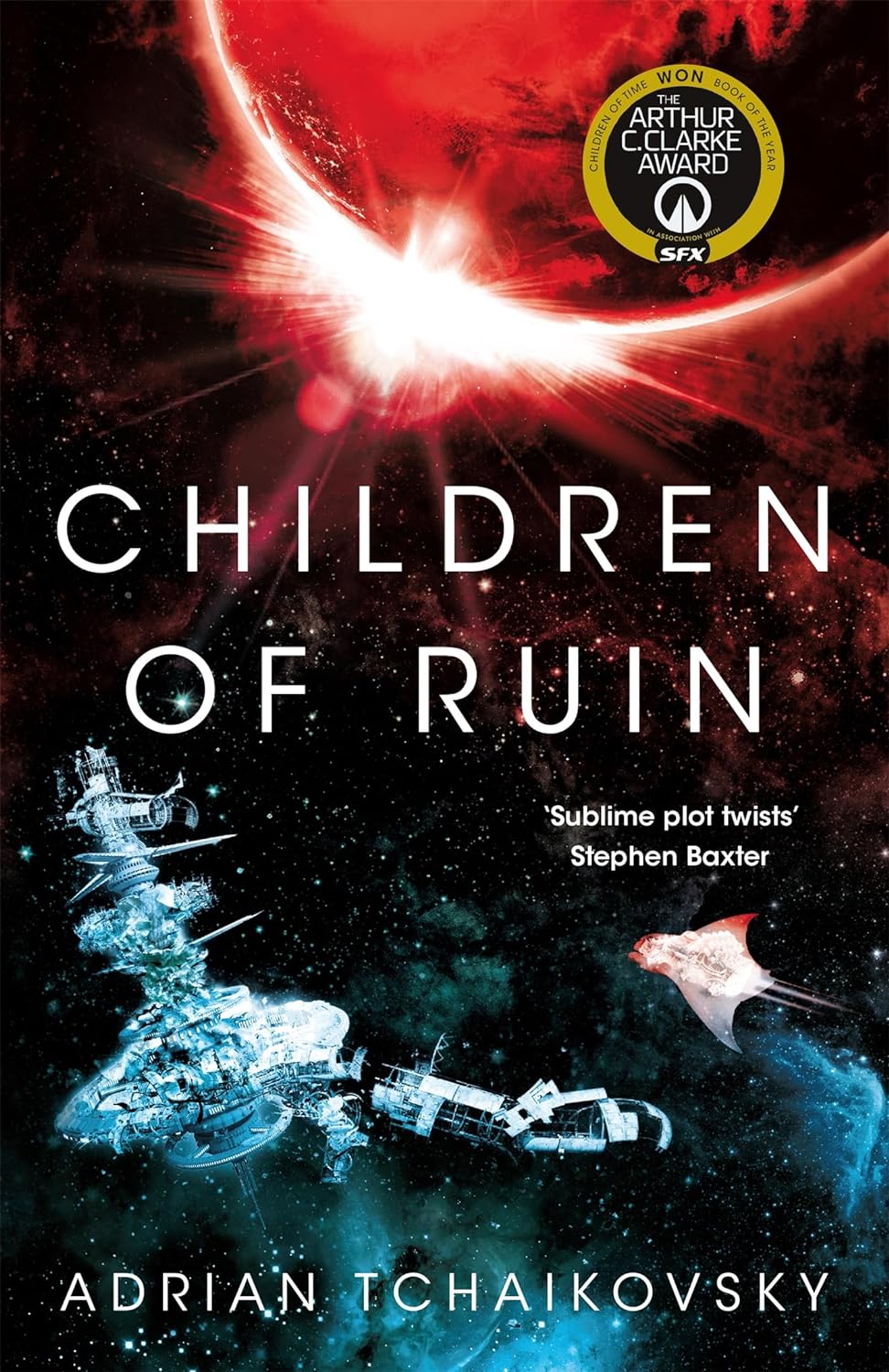
Adrian Tchaikovsky’s series that began with Children of Time, continues with Children of Ruin, originally released in May 2019. Many of the characters from the first book are back, at least in reference, and their descendants do them proud by continuing the adventure. The Humans (with a capital H) and the Portiids now have a strong working relationship on the planet known as Kern’s World, although direct communication is still a bit challenging given the differences in their thought and expressive processes. Capital H Humans are humans who have embraced a mutually beneficial relationship with the Portiids (i.e., large jumping spiders with an advanced intellect and civilization seeded and accelerated by humans of the distant past). Kern’s World from the first book is a planet that was terraformed and seeded with a virus to accelerate the intellectual development of monkeys. Alas, there were no monkeys, but a particular species of jumping spider evolved with the virus to establish a robust civilization on the planet. The planet was named Kern’s World after Avrana Kern, an ancient terraformer/scientist who over the centuries had uploaded her consciousness into an AI and enjoys a type of immortality. Initially, Kern was seen as some kind of god by the Portiids, but eventually when she made herself visible to the Portiids, she became something of an adviser. The first book is discussed in greater detail in ‘Children of Time’ expands minds.
In the second installment in the trilogy, Tchaikovsky runs a parallel storyline alternating sections between the distant past and what is now the present, along the way introducing some new life forms while evolving the existing ones. Continue reading
 A Good Reed Review