The timely history of the Bill of Rights

By Ande Jacobson

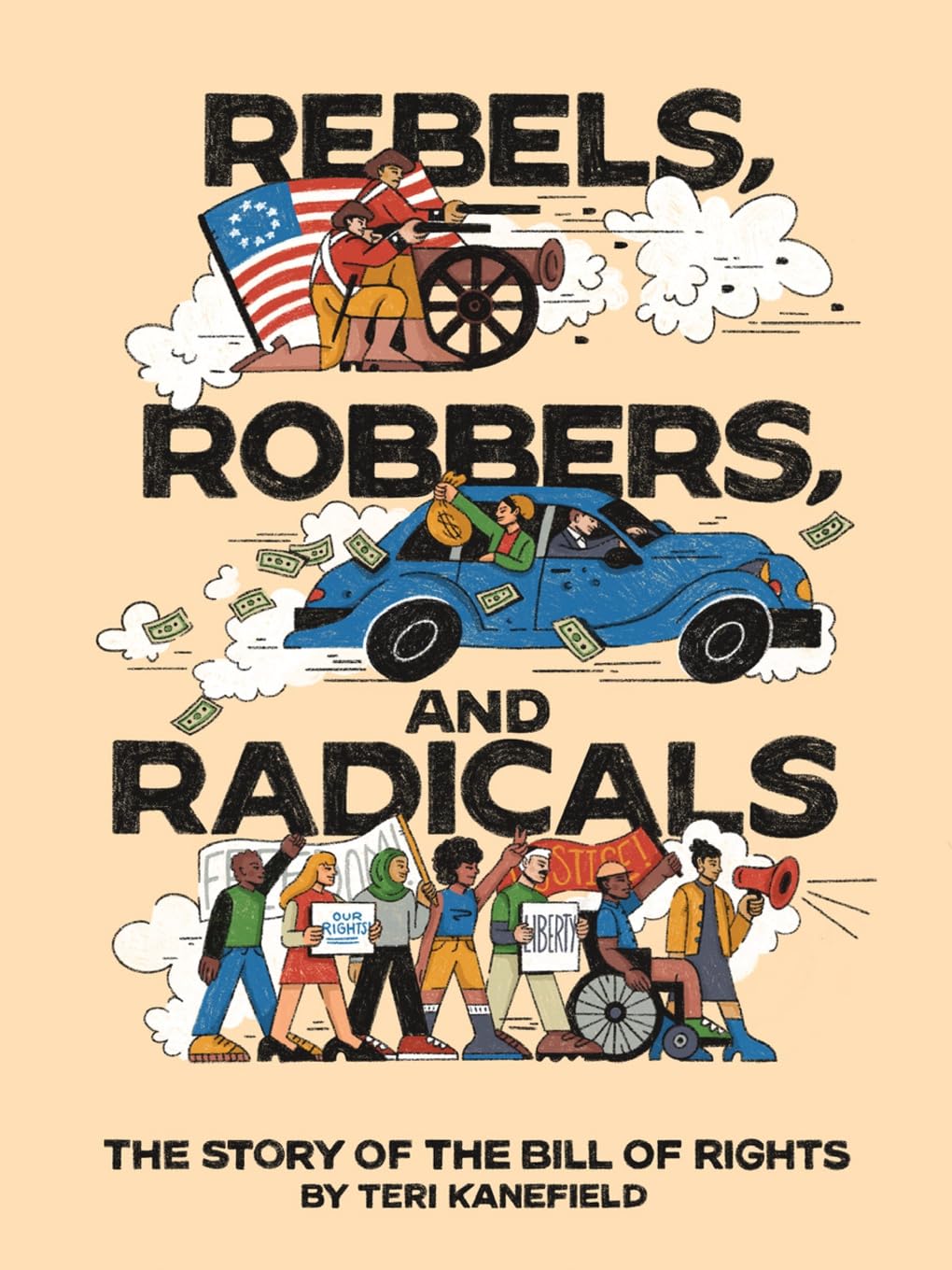
Teri Kanefield’s writing is often quite timely, and her latest book is no exception. At a time when individual rights are in peril, Kanefield’s upcoming book, Rebels, Robbers, and Radicals: The Story of the Bill of Rights, tells the story of not only how the Bill of Rights came to be and why it was needed but also how the interpretation of those rights has changed since their initial ratification. The book is due out on 20 May 2025, and it would be a great addition to everyone’s personal library, especially now. This concise volume, clocking in at a slim 224 pages, tells a story every American should know. The Bill of Rights is the collection of the first ten amendments to the Constitution, and in those amendments lie the foundation of our individual rights under the law. The publisher lists this volume as appropriate for young readers ages 10-14, but in reality this book is also an excellent reference for anyone young or old. It’s written at same level that Kanefield used to write her appellate court briefs. She doesn’t talk down to her readers and seeks to inform them through compelling stories about real people from our history to illustrate the critical aspects of each of these amendments. She also incorporates applicable law, explaining terms where unfamiliarity may hinder understanding. Continue reading

Then and now, how different is it?

By Ande Jacobson

When I was growing up, it was a turbulent time. Being a child of the 60s and 70s, I saw some thrilling scientific advances, as well as numerous disturbing events throughout my childhood. Both the positive and negative had an impact on how I viewed the world, but I always thought that things would continue to get better for society overall.

We had lots of books at home – both of my parents were avid readers of all sorts of material, and they instilled in me a healthy love of learning. We had numerous academic texts (both of my parents were medical professionals, so they had an extensive medical library), and we had our Encyclopedia Britannica along with the Great Books as more general references. We even had the Children’s Stories Great Books collection to round out things from the literary side. We had numerous dictionaries, lots of history books, and shelves overflowing with literary works including both fiction and nonfiction on countless subjects. We also had our library cards for both pleasure and for those times when our research needs exceeded what was available at home. Learning was fun. Continue reading

Remembering the 1989 Loma Prieta Earthquake

SJSU Engineering By John Pozniak from Wikimedia Commons

By Ande Jacobson

34 years ago at the time of this writing on 17 October at 5:04 p.m. (or as I thought of it, at 1740 L), I was in class in grad school at San Jose State University. I was an engineering student working on my master’s degree and was listening to a lecture in my digital data transmissions class. When the shaking started, one student in the back made a beeline for the door jamb while the rest of us dove under the tables. We were in the new wing of the engineering building in a sort of small, tiered lecture hall that seated 30-40 and had long tables with comfy rolling chairs along the tiers. The professor was still lecturing when he noticed us all under the tables and mentioned that he should probably get under a table or something. He was originally from Switzerland, but this was his first earthquake here, so he wasn’t quite as well-versed as the majority of the class in our earthquake protocols. Continue reading

Trouble – when the story matters more than reality

By Ande Jacobson

In theater or in literature, an author’s vivid imagination can be a wondrous thing. A writer can spin a captivating tale limited only by the bounds of their imagination and their ability to capture their vision in words. If told well, such a story can be divorced from reality yet still provide compelling entertainment for its audience. In this context it’s not only acceptable, it’s desirable, and viewers or readers can find escape through immersion in such a story. It can be enjoyable to suspend disbelief enough to imagine what might be, and it can even inspire people to positive action to improve a situation in reality. Science fiction has long posited potential advances, both good and bad, that are sometimes achieved at a later time. The communicators used in Star Trek in the 1960s were intriguing. They allowed people to communicate over long distances from wherever they were with a tiny device seemingly by magic. Decades later, they came to life in the real world as flip phones as a phase in the evolution of mobile technology. Granted, there were significant differences in range, clarity, and required infrastructure, but the similarities were striking given various designs inspired by the fictional story. Since then, mobile technology has advanced in the form of smart phones and devices, delighting consumers and titillating the minds of creative engineers to continue to push even further. Continue reading