 By Ande Jacobson
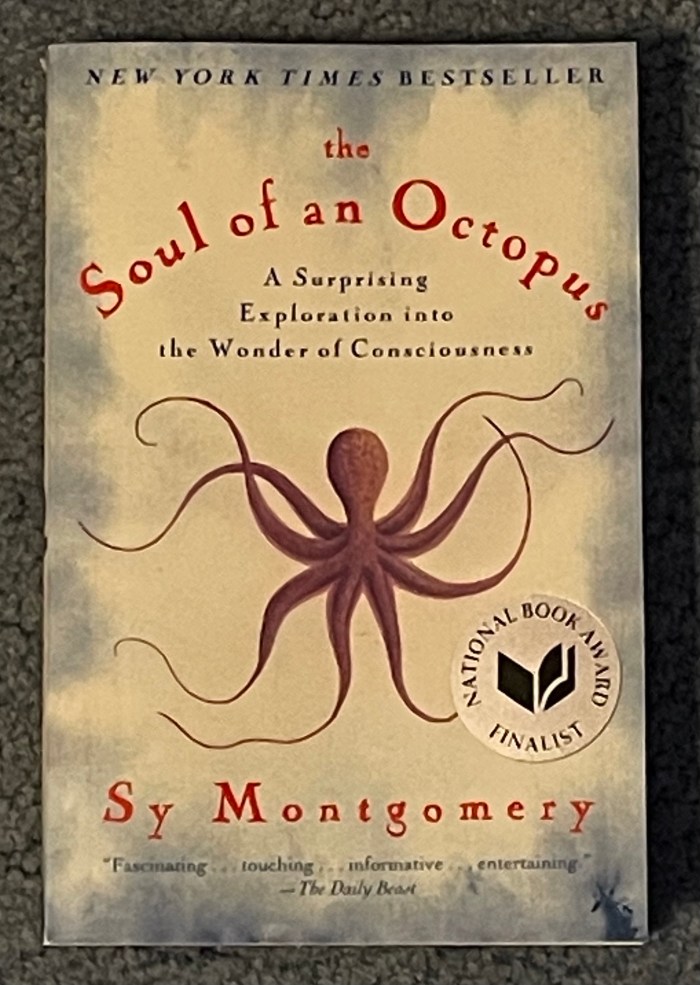
Naturalist, Sy Montgomery, opens up a fascinating world that is foreign to most of us in her 2015, best-selling memoir, The Soul of an Octopus: A Surprising Exploration into the Wonder of Consciousness. She tells her story of how she was introduced to her first octopus at the New England Aquarium in Boston, MA and was hooked. She was taken with their curious nature, their intelligence, their cunning, and their charisma. The book is her personal tribute to all that is the octopus as she educates her readers by dispelling many misconceptions and fears and bringing these extraordinary creatures to life on the page. The first thing she teaches readers is that the scientifically correct plural for octopus, contrary to common belief, is not the Latin “octopi.” The word octopus is derived from the Greek, oktṓpous, so the plural is instead “octopuses” despite what Dictionary.com may imply. She also gives an initial description of the animal thusly:
“Here is an animal with venom like a snake, a beak like a parrot, and ink like an old-fashioned pen. It can weigh as much as a man and stretch as long as a car, yet it can pour its baggy, boneless body through an opening the size of an orange. It can change color and shape. It can taste with its skin.”
Through her years working with the folks at the New England Aquarium, she joined an inner circle of staff and volunteers in getting to know a succession of octopuses. Behind the scenes, she was able to interact directly with these magnificent animals, letting them get to know her as she did them, and when she was with them, she felt time stand still. Each had its own unique personality. Some were game players. Others were downright cuddly in a slimy, octopus kind of way. And all of the octopuses she met there over time become dear friends as she, along with the octopus experts in the inner circle, plunged their arms into freezing water to let each octopus taste them with their suckers and get to know them.
An octopus is effectively a very dexterous snail without a shell, although it is far more capable and wily than a snail. Through many examples, Montgomery shows just how smart these creatures so alien to land dwellers actually are. She notes that as she watches them, they watch her with just as much fascination. Unlike mammals, octopuses have decentralized nervous systems that allow their arms to act independently without direct commands from their brain, a point that Montgomery drives home describing how one particular octopus stole a bucket of fish unnoticed while actively interacting with three people simultaneously. An octopus can also regenerate their arms if they get bitten off by a predator.
The key to determining the sex of a given octopus is to examine the tip of their third right arm. In females, their suckers extend to the tip of all of their arms. In males, the suckers do not extend all the way to the tip of their third right arm, known as the hectocotylized arm. While it would seem an easy task to identify the sex of an octopus, the animals often keep the tips of their arms curled, so it can take some time before the crucial arm tip is visible, even for those handling the octopuses directly. Montgomery provides a detailed look at how octopuses reproduce through her description of the Seattle Aquarium’s Annual Blind Date.
On Valentine’s Day each year, the Seattle Aquarium brings a pair of Giant Pacific Octopuses together to give them an opportunity to mate. The pair doesn’t always get along, but often they do, and the day brings a very large audience to observe. Montgomery documents one such event when she got the opportunity to fly across the country to attend the blind date several years into her study of octopuses.
Most octopus species are loners, only coming together at the end of their lives to mate. A female can lay up to 100,000 eggs, each the size and appearance of a grain of rice. The last undertaking of a female octopus is often laying and meticulously caring for those eggs until just before they hatch. Very few newly hatched octopuses survive to adulthood as the young are left to fend for themselves, their mother dying just before they emerge, and their father nowhere to be found. When they first hatch, they float amidst the plankton until they grow big enough to swim to the bottom of the sea to find a den, evade predators, and to hunt for their own food. If they do survive, octopuses are very short-lived; the Giant Pacific Octopus being the longest lived species lasts only 3-5 years.
Montgomery tells her story of her introduction to, and certification in, scuba diving. She describes her difficult start to her dive lessons and provides a detailed look into the dangers of the sport recounting not only her own experience, but also that of one of the close friends she made in Boston who was injured so badly he could no longer dive at all. She was determined to dive and after being certified, was invited to accompany some research teams on a couple of very eye opening expeditions around the world. Although focused on octopus behavior, she was also exposed to a whole new world in the wilds of the oceans off Mexico and French Polynesia. Oceans cover more than 70% of the planet, and there are far more animal species in the oceans than on land. Many aquatic animals can only be observed through dives, and others live so deep in the ocean that they have never been observed by humans.
It took Montgomery several years to complete her research for this book, and over that time, she came to know a few individual octopuses at the New England Aquarium. Because octopuses will often eat one another, the aquarium can only have one in their main public display tank, and as that octopus ages, they’ll acquire another younger octopus that they keep behind the scenes in a barrel type arrangement until the old octopus dies. Montgomery describes a few of the mishaps they had over the years with their octopuses. Unlike most of the aquatic animals cared for at the aquarium, octopuses are serious escape artists. Between their curiosity, intelligence, and dexterity, it’s a real challenge to create a truly escape-proof tank. They can hide in very small spaces, and if they do get out, they can actually run across the floor for a brief period. They can live outside of water for just under 30 minutes before they suffocate.
The book is a loving adventure story providing an inside look at these incredible creatures and is well worth a read. The writing is a little colloquial at times, and there are a few editorial errors, but the story is compelling and hard to put down.
Reference:
The Soul of an Octopus by Sy Montgomery
A Good Reed Review also gratefully accepts donations via PayPal to help defray the costs of maintaining this site without creating paywalls.

 By Ande Jacobson

 A Good Reed Review