 By Ande Jacobson
I am an observer not of this world, though most of the life forms that inhabit this planet have no knowledge of my existence which is probably a good thing. I’m here to observe and report back whether Earth is receptive to a cultural exchange with our world. So far it’s clear that none of the life forms from this world would yet be able to reach ours on their own although sometimes an early exchange can prove beneficial to all concerned. Sadly, from my observations thus far I’m inclined to recommend against such an exchange at this time. While the life forms on this planet pose no direct threat to us, our presence would greatly complicate the situation for the life forms on this planet and would undoubtedly change the course of their development.
This planet is full of life forms of numerous different modalities. Many, or perhaps even most of the various life forms spend their whole existence doing what they must to continue living until they expire. Shortly after they start their lives, they develop the skills necessary to survive, sometimes using play to hone those skills. For the types of creatures that eat other creatures, it’s interesting watching young animals playing with others of their community to hone their hunting skills. This seems to happen on land and in the seas, though most of this early training tends to be among others of their own kind. In most cases, the young develop relatively quickly. Once they can fend for themselves, or in collaboration with others of their species if that is their norm, they sometimes even establish friendly relationships with life forms different from themselves.
One dominant life form is something colloquially called a human. In many ways, these creatures behave differently than other life forms on their planet. They are curious about the world around them, and they even show interest beyond their own planet. They do far more than just deal with their day to day survival needs as a species, often putting tremendous importance on activities that have no direct bearing on their personal or species survival.
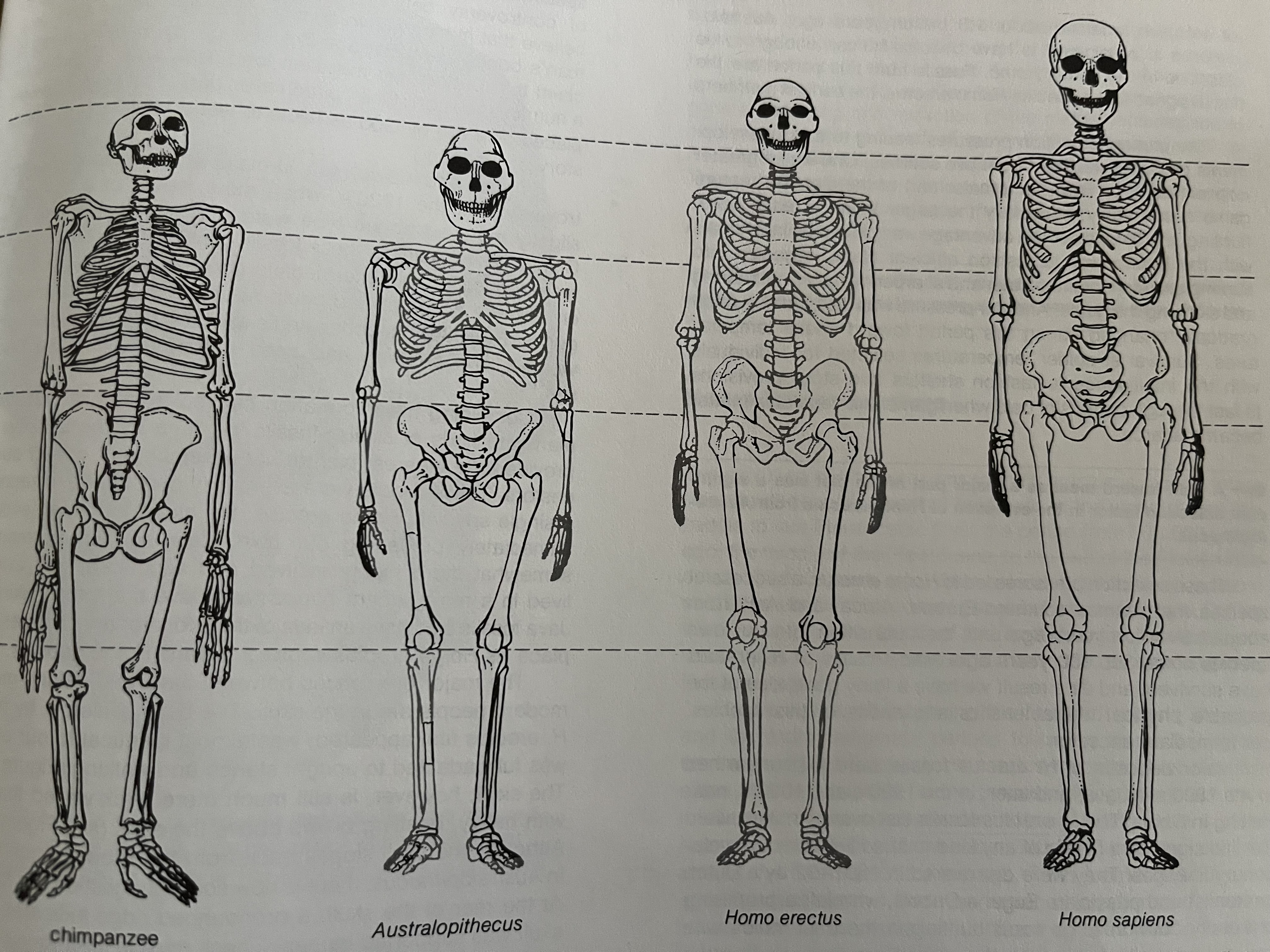
The planet itself is in a constant state of flux. The forms that life takes has changed numerous times since the planet first coalesced, although some of the earliest forms of life are still present. The planet itself has been around for about 4.5 billion years. The first simple life forms emerged about 3.8 billion years ago. While various hominids have been around for about 2.5 million years, the first Homo sapiens arrived some 200,000 years ago, though it wasn’t until about 70,000 years ago that they first developed the ability to employ fiction. In some ways, that could be considered the beginning of the end because with fiction came their ability to lie about things that aren’t really there. At that time there were still multiple human species. It wasn’t until about 13,000 years ago that Homo sapiens became the only kind of human on the planet although it’s not entirely clear why Homo sapiens survived while other types of humans didn’t.
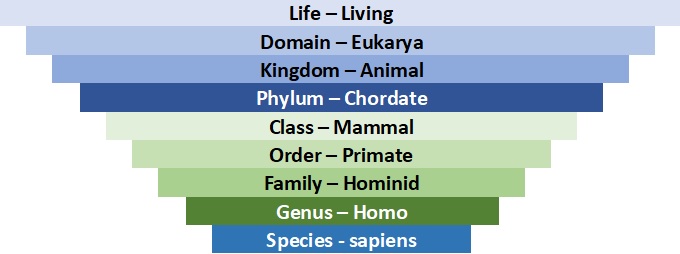
These modern humans have since created a fascinating classification system whereby they categorize all of the life forms that they know about on their world. They only know about a small fraction of the life forms surrounding them, yet they proclaim that they are the experts and owners of all that exists on their planet. They classify living things in an interesting inverted pyramid where organisms get more narrowly defined the further down the hierarchy one descends. They see their kind, i.e. Homo sapiens, defined thusly:
I’m amazed by some of the things that humans have achieved while at the same time recoil at the death and destruction they leave in their wake. They have so much potential, but it’s too often overcome by their short-sightedness and individual avarice and hostility toward one another and all non-human life forms they encounter. This hostility stymies them, preventing them from thriving overall. Worse, their hostility and arrogance often prevent other life forms from thriving as well.
From what I’ve seen, these humans are a communal species, reliant on one another for their survival, yet they practice some inexplicable patterns of exclusion based on trivial differences that are really just normal variations within their species such as dividing one another based on certain aspects of their external appearance. They even categorize differences in behavior or belief between groups of humans as us and them with “us” being good and “them” being bad. All of the humans alive today are part of the same species, but their baffling need to categorize various humans as different pushes them to take some bizarre actions against each other for no apparent reason. I shudder to think of how they would react to me if they knew of my existence given so many of them seem to fear anything different from the narrow category into which they’ve assigned their particular group.
Humans are born in a most miraculous way just like many of the other mammals on this planet. To make a new human requires an intimate pairing and sharing, though only a subset of the species has the ability to grow a new human inside themselves. Taking on such a project is not without some significant risks to the individual growing the new human, sometimes causing them lifelong disease or injury, or worse, even hastening their own death in the process.
Over time, humans have spread copies of themselves all over their world, even into places where all of the planet’s life forms would be better off had humans not encroached. They are extremely successful in making copies of themselves, but this can be a problem as they overextend beyond what their planet can support.
Many of the species on this planet are limited by the resources they need for their survival. Once those resources are depleted, the species that need them diminish or even disappear altogether in some cases. This doesn’t appear to be under conscious control of the individuals.
Unlike many of these other species on their planet, humans have the capability to voluntarily limit their population growth to something manageable within the scope of their available resources. They can even stop their expansion for a time if they so choose. Despite this extraordinary capability, too often, incomprehensibly, they fight over whether the very individuals who have the ability to go through the process to grow new humans inside themselves while putting themselves at great risk in doing so should have any say in whether they endure that process or not. Beyond that, in an exceedingly self-defeating way they set up situations where they force more humans into existence and intentionally overwhelm their resources in a given area.
The offspring humans produce are completely helpless and would not survive without dedicated care. Unlike most of the other animal species I’ve observed, humans stay helpless for a relatively long time, years in fact. They can’t feed themselves or even move effectively for quite some time after their birth.
All humans, like so many other animals on their planet, need shelter. They all need adequate food and water. They have these very basic needs in common, yet many humans have far more of these than they can possibly use, while others struggle to get just enough to survive from one day to the next.
Like many other species, humans are covered by a delicate outer shell that they call skin. Human skin is easily damaged by their sun and by various other external elements and organisms. Like other mammals, they also have some fur or hair, but not enough to protect their skin sufficiently. To protect themselves, they put on a removable outer covering they call clothing. Clothing can be decorative, strictly functional, or both. Some humans make their own clothing while others trade some kind of trinkets in exchange for completed clothing that they don’t have to modify or assemble.
Most humans seem obsessed with making sure to cover themselves with clothing, not just to protect their delicate skin, but to hide parts of themselves from others. Unlike other species, they even punish each other for allowing various parts of themselves to remain uncovered although there doesn’t seem to be agreement across all humans which parts of themselves are allowed to be displayed, and which aren’t. It’s very confusing.
Most humans trade the trinkets they use to acquire their clothing for all of the other things they need or want. They call these trinkets money, and it can come in various forms including cloth or paper, metals, or even something they call electronic transactions using some marvelous inventions called computers that help connect humans with each other. Their money has no intrinsic value. They can’t eat or drink it, wear it, live in it, or ride it, yet humans almost universally strive to acquire as much money as they can. A few humans are extremely successful acquiring this money while most struggle to have enough to trade for the things they need. Interestingly, no matter how much they have they worry about not having enough and obsess over getting more.
Humans have a varied and complex method of communication. When in close proximity, they communicate directly through some kind of spoken or visual language although there seem to be hundreds of different kinds. It is interesting observing humans from different groups coming together because sometimes the different groups use different languages and do not understand one another. Over periods of time they can learn one another’s languages, but that doesn’t help when quick communication is necessary during an early contact between disparate groups of humans. In this, they seem to have more difficulty communicating with one another than other species do. This is one reason to be wary of engaging with humans. I’m certain they would not understand our normal communication methods, so we would have to learn theirs before initiating contact. If we were to encounter them without their being able to understand us, they would likely assume that we were a threat to them.
Humans argue over senseless things like ownership of the world around them. They make claims on the land on which they live. They even appear to own each other for a time. The smaller humans seem to be owned by those who care for them until they get to a certain size and fitness. In some human groups, some members of their collective are owned for their entire lives. In those groups, the same individuals who sometimes have no say in whether they grow new humans inside themselves are often the ones who are owned by those who cannot grow new humans. This is disturbing because the more capable members of those groups are allowed the least independence by the collective. It makes me wonder what the “owners” are afraid of.
Humans also seem to communicate for pleasure or just to hear themselves make noises. Some of the noises they make require the use of various tools external to themselves. They even gather for exhibitions of sound-making in the form of something they call music. These exhibitions are called performances or concerts, and I have to admit that some of them are quite pleasurable. There’s a vast array of music that they can perform and some humans spend a considerable portion of their lives honing their skills to make music.
In addition to music, humans collect their words in various ways. They record them into repositories of different types including stacks of paper and various electronic collections. They also perform these collections of words in various ways in front of audiences either in person or remotely in exhibitions like concerts, but by speaking rather than performing something musical. Some of these exhibitions are simply speeches, i.e., a single human or collection of humans talking to their audience. In other exhibitions, the performers do more than just speak. They enact some kind of scene in something they call a play where they tell a story. They sometimes use elaborate setups and costumes. Costumes are fancy clothing that is part of the story. They also sometimes use various movements as part of their storytelling. These humans are creative in their communications.
They also communicate through static pictures or objects that they call paintings or sculptures. Some are very elaborate and are housed in various public locations. These objects clearly have a strong effect on those who look at them, and in some way this seems to communicate a message that the creator of the work wants to convey. It seems an inefficient means of communication, but on the other hand it can be quite beautiful, which may be the point.
These humans create artificial boundaries based on their need for exclusion. They have these things they call countries. There is no physical reason to separate their population this way since the humans in each of these countries all have the same basic needs, yet there are vast differences in how humans live in some countries compared to others. Because of these differences, the humans sometimes claim that the people from their particular country are exceptional compared to humans in other countries. Nothing could be further from the truth. The humans in any given country are not exceptional in and of themselves. Some of them are just luckier than others. Some are lucky to be born into a family of means with lots of resources nearby. Some are lucky to not be living in the middle of a war. Others are unlucky and through no fault of their own are born into situations that stop them from thriving.
Humans set up rules of conduct in their various communities, and then some number of individuals in those communities break the rules to see how much they can get away with. In some of their communities, they have complicated processes for handling those who break the rules. Interestingly, just as the rules vary from place to place, so too do the methods for handling rule breakers. The one thing that is similar is that the rule breakers tend to hurt others in some way.
That’s another thing that makes no sense. While some humans are kind and helpful to those around them, others seem to take pleasure in hurting those around them and in the process end up hurting themselves in the long run.
Another thing that many humans do is seek some kind of relationship with what they call a god or a higher power that they somehow think endowed them with meaning beyond all of the other animals on the planet. While they cannot directly observe their higher powers, they call their study and practice of this belief religion. Across their planet there are thousands of different religions or faith groups. Some are very similar while others differ dramatically, yet not all humans subscribe to such beliefs. For those who do, their fervor also varies. For some it’s the core of their life’s pursuits. For others, it’s more something that they share with friends and family. For still others, it’s something to be avoided at all costs. The one thing that religions seem to have in common is that their officiants use them to control their followers in some way. Sometimes this can be gentle and more of a suggestion on how to behave and interact while for others it’s an absolute edict. Some of these religious pursuits promise eternal existence going far beyond their lifetimes. Others merely provide codes of conduct by which to live their lives. Still others urge or command their followers to push their beliefs and rules on everyone around them whether they are receptive or not.
This last construct tends to create hostile situations that often prompt significant conflicts of the most violent nature. From my vantage point, humans would be far better off if they would shrug off their religious pursuits and focus more on helping each other thrive.
One side-effect of their various religious pursuits is an inexplicable devotion to or focus on members of their species who have died. They carve out large portions of land to hold the bodies of those who are no longer living. That land could be used for myriad other purposes, but instead they isolate it and dedicate it to those who no longer need it. All living things die eventually. When they do, if everything were geared toward a sustainable environment, all organic matter would be recycled to promote plant growth, used as food, etc. It wouldn’t be embalmed, preserved in an unusable state and stored on large expanses of dedicated land not used for anything else.
One of my most baffling observations of humans surrounds something they refer to as meaning. I doubt that humans will ever all agree on what constitutes meaning. For some, meaning is living what they consider a good life which includes comfort and service to others. For others, their focus is on how they’ll be remembered by those who come after them. For still others, meaning constitutes being “better” than everyone else and having more than those around them even if that means doing so through force or coercion.
Many humans are especially sensitive when their basic beliefs are challenged in some way. Such challenges often result in violent conflicts. Given this recurrent theme among this life form, I again reiterate my initial warning. I do not think that humans are ready to meet us and would likely greet us with hostility should they become aware of our existence, though that wouldn’t be true of all life on Earth. Some of the so-called lesser life forms seem more open to engaging with those unlike themselves. Unfortunately, because of the ubiquity of humankind on this planet, meeting other life forms without human interference is unlikely save for the life within the deepest oceans or under the thickest glaciers, at least until humans find a way to infiltrate these areas in greater numbers.
One more thing that is concerning is that humans are pushing hard to spread out into space. They’ve gone to the little satellite world that they call their moon a number of times although they haven’t setup any long term presence there, at least not yet. They’ve learned that their moon has various effects on their planet, particularly with respect to time, tides, and light, so they understand its importance. They also have some small communities orbiting their planet in human-made satellites as well. A couple of the larger countries are trying to send some of their kind to a planet next to them, one they call Mars, but if they manage to find ways to live long term on other worlds, I fear they will bring their dysfunction with them. If they eventually reach a planet that has resources they can use or other life forms, I fear these humans will try to “own” those planets too. This makes them dangerous. The question is whether they’ll be able to create human communities elsewhere before they eliminate themselves from their home planet. For those of us not of this world we hope that humans can settle their differences, quell their fears of others, and open their minds to possibilities, but we aren’t sure that humans are capable of such massive changes.
Still, these humans are fun to watch. The wonder of new humans as they first explore their world is fascinating. They are innocent and open to everything. They are curious and fearless. If only they weren’t tainted by the fears and obsessions of those who came before them. I sometimes wonder if it would be possible to speed up our contact if we could somehow find a human who stayed open to new things without the biases that their societies inflict on them. They are impressionable to their caregivers’ teachings, and even when not intended it seems like dangerous biases are passed along. It happens fast, just as these new humans learn to communicate. It’s endemic to their languages and societies. Humans learn by grouping things and learn by noticing similarities and differences. They categorize everything, and in so doing they put value judgements on everything they identify. Once embedded into their thinking, they can’t seem to look beyond those categorizations. Interacting with other life forms requires one to step outside of themselves. They can’t apply their values to other life forms and have any kind of mutually beneficial contact.
A wise human from their ancient history once suggested that any sufficiently advanced culture would appear to be godlike or magical to a more primitive society. They even suggested that the basis for some of humankind’s core religious beliefs and ancient mythologies could stem from some kind of alien visitors from long ago. While it might surprise these modern humans, this ancient philosopher was correct. There were visitors in ancient times, and they took human form to try to blend in. The problem at that time was that they didn’t blend in quite enough. They didn’t hide their abilities sufficiently, and they became objects of worship. They liked the attention and didn’t recognize the harm they were doing. They were later recalled. We learned from their errors, so when my world sent me, they gave me instructions to stay out of sight of the humans. I am allowed to interact with other species, but only when humans are not present and cannot monitor any such interactions. That’s the tricky part now. Humans have made some extraordinary technological advances since ancient times, and they can monitor far more of what’s happening on their planet than ever before, even when they are not physically present.
I strongly recommend against establishing any formal relationship with humans at this time. The humans are just too dangerous and unpredictable. I suggest either extending my assignment here or sending a new observer to keep watch. If and when the humans can resolve their differences with one another, stop destroying their planet’s resources and life forms, and adopt far less xenophobic policies overall, then maybe we could consider bringing our presence out in the open.
It’s not clear whether we’ll need to wait another 13,000 years before making contact, but it could certainly be a few thousand the way things are going at present, or it could be a few hundred. Alternatively, we might just have to wait until humans disappear through something called a mass extinction event. After such an event, the course of evolution may again shift and the new dominant life form could be more receptive to meeting and sharing with us. Time will tell.
 A Good Reed Review
[…] Short story: Humans are Weird […]
LikeLike