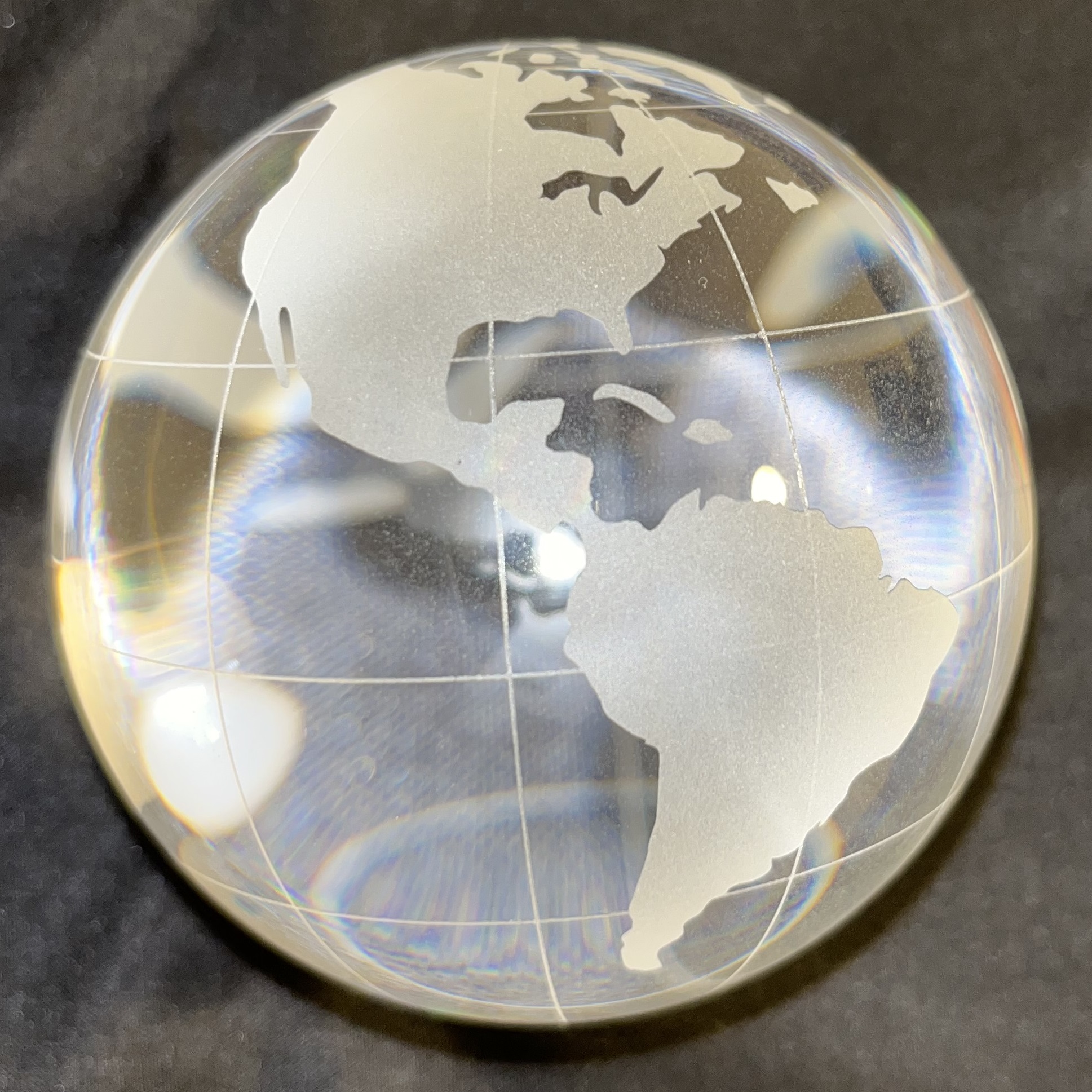
 By Ande Jacobson
Every so often, particularly when things get very chaotic around me, I think about the world I want to live in. In my recent short story, Humans are Weird, I explored how the Earth, and specifically how humankind might appear to an intelligent extraterrestrial species studying us. Humankind is a single species. Over time, largely because of our tribal nature, we’ve developed multifarious cultures that often put us at odds with one another and more importantly at odds with our continued survival as a species. As Yuval Noah Harari discusses in his book, Sapiens: A Brief History of Humankind, we’ve built our societies based on fictional common myths that we all buy into at some level. These myths allow cooperation on a large scale, but they also form the basis for significant exclusion. I see the moves toward exclusion in the news, on social media, even in conversations among my friends as we collectively think about the world around us.
As time has moved forward, it’s become obvious that what we do in one part of the world affects us all at some level no matter where or how we live. The COVID-19 pandemic should have brought that fact into sharp focus for us all. Rather than working together universally to slow or stop the spread of this dangerous disease, large factions fought against sensible, science-based public health initiatives mocking them and solidifying their positions in opposition.
I’ve long wondered if it would ever be possible for humankind to set aside our differences and come together as a species on a planetary level to avoid our looming extinction. After all, we only have one Earth, and it only has a limited amount of space and resources. Once we run out of livable space, clean water, clean air, and means of sufficient food production without harming ourselves (or countless other species), it’s over for us all. Despite a critical need to do so in real life, a path moving toward a global community has been explored in full only in science fiction – both from utopian and dystopian perspectives.
We don’t have to hurt each other. We could set societal norms to mitigate our differences more effectively. In fact, many societal rules are in place specifically to encourage cooperation on a large scale. What if instead of lauding individual achievements, we had social norms that rewarded helping one another thrive?
I sometimes wonder if our very means of communication furthers our divisions. There are thousands of languages across the world making communication with other “tribes” more challenging. In this case, a tribe refers to any group of humans based on some perceived commonality be it national, cultural, or geographical.
Beyond having numerous languages through which we communicate without any one used universally, when we learn language, we do so by sorting everything and everyone based on identifiable differences. We are trained to focus on these differences. It’s not a huge leap to assign values to these differences in various ways driving wedges between us before we realize what’s happening. Do we unintentionally enhance our tribal nature through our communication methods, or does our communication reflect our innate tribal nature that our societal norms attempt to mitigate? In the Star Trek universe, they have universal translators that allow disparate beings to communicate. Today, we now have translators that can be accessed through web browsers and sometimes within various applications directly (e.g., the translate function on various social media platforms and in word processing applications) that do a pretty good job of translating simplistically, but the meanings of idiomatic expressions are often lost in the process. Still, it’s a help that allows more worldwide integration which is a step in a positive direction to increase communication.
The formation of The United Nations was an attempt for nation states to work together on common objectives for the betterment of humankind. After two world wars that wreaked havoc across the globe, the need to cooperate across nations became more urgent to prevent another even more devastating world conflict. The UN was revolutionary when its full charter was completed in 1945. Since then, it has tackled severe world divisions and has provided a forum for open discussion among its member nations. It uses human interpreters who translate speakers’ words in real time to its members to help reduce communication difficulties, although the UN has six official languages (English, French, Spanish, Russian, Arabic, and Chinese) rather than thousands. Unfortunately, even within the UN sharp divisions remain, and national identities are maintained above our planetary status as citizens of the Earth. If the UN cannot overcome our tribal divisions when its members are chartered to find common ground and work together, how can we expect the world’s population to do so on anything close to a global scale?
It’s possible that our species isn’t capable of completely setting aside our manufactured differences, but why? Are we just too individualistic and selfish to look beyond our immediate individual wants to think more globally as a species, or is there some biological imperative working against our interests? Are we truly incapable of seeing what we have in common over the artificial divisions we’ve created?
The more chaotic things become, the more obvious that we really are the same. Sadly, our xenophobia increases the more we are pushed together from disparate regions as cultures clash. This is evident in the worldwide response to climate induced human migration. When resources are scarce, wars often result. Between areas becoming unlivable from extreme climate events and the impacts of armed conflicts, people are fleeing in greater numbers now than ever before, and that’s only going to become even more extreme over time.
It’s sometimes comforting to imagine a world where we’ve successfully come together despite our superficial differences. We are but one out of about 8.7 million species on our planet according to National Geographic. Our continued existence on this planet goes well beyond politics and is a question of biology and maintaining the biodiversity of our world. We’ve interfered with that ever since our species came into existence. Can we hope to become a worldwide force for good, for maintaining healthy environments where the life on this planet can thrive? It’s important to consider not just human life, but the full spectrum of life that shares this world with us. To do that, we have to stop thinking of ourselves as the only species that matters. We have to stop devising new ways to divide the world into us and them. We have to stop trying to control the world around us and instead learn to live in it without destroying it.
That’s a tall order, but our continued survival as a species depends on our coming together across the globe. We need to create a planet-wide federation and see each other as citizens of the Earth rather than so many separate and distinct societies.
References:
Short story: Humans are Weird
Common myths
Climate crisis
Too many people
Less competition, more cooperation
Novel Coronavirus 2019
UN History
We are living with a modern ‘Lord of the Flies’ style threat
The world I want to live in
Too many people
Biodiversity
What is reality?
Translation at the UN
The Animal Kingdom includes us

 A Good Reed Review
[…] written about whether it might be possible to get to a single world order where we would consider everyone to be our kind. If we could collaborate on a global scale to […]
LikeLike