 By Ande Jacobson
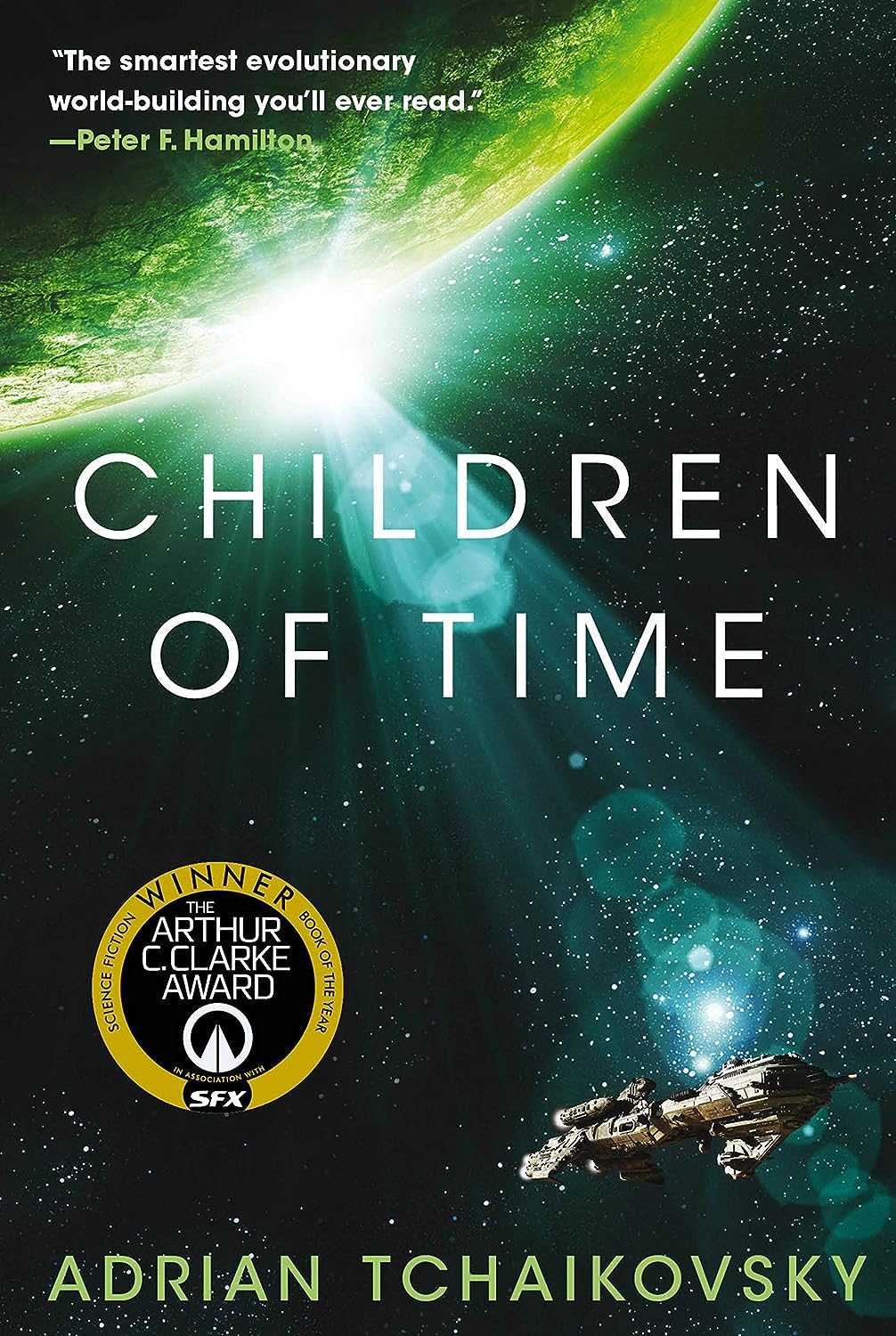
Adrian Tchaikovsky’s Children of Time trilogy begins with a bang. Or perhaps I should say the first book, Children of Time, originally released in June 2015 spins a mind expanding tale. The premise is one that draws deeply on Tchaikovsky’s roots as a zoologist (with a combination psychology/zoology pedigree). It is thought-provoking science fiction at its finest introducing a world where humans are not the dominant species. Although sparked by human interference, the green planet known as Kern’s World is home to a wide-ranging arachnid and insect population that has developed beyond the wildest human imagination. Marine life as well has surpassed what we know today on Earth. It wasn’t always this way, but humankind had run out of options. In the far future, humankind had finally destroyed the Earth. In their final days they sent out ark ships in hopes that the species could find a new home through advanced terraforming experiments intended to seed potential worlds with the ecosystems necessary to support human life. Alas, the best of the intentions are often usurped by unexpected events.
That humankind destroyed our planet in the book isn’t hard to imagine. We’re a good part of the way there right now with all of the environmental and societal crises we face. It’s an open question whether we’ll solve our problems before we run out of time. We aren’t as technologically advanced as the humans in Tchaikovsky’s world yet, but they are imagined far in the future, so achieving that level of sophistication might be possible someday, if we survive long enough as a species.
The book starts slowly chronicling three overlapping storylines through the ages. Tchaikovsky defines the worlds and the societies that set up an unexpected collision of cultures eventually, but first readers need to know where they are in space and time. The story starts on a research vessel, a facility known as the Brin 2. Doctor Avrana Kern runs this space-born facility and the project is a scientific one to terraform a world. Kern wanted to then seed it with monkeys and infect them with a nanovirus that would speed up their evolution to get them to the intellectual level of a new pseudo-human sophistication. Back home, at the beginning of the book, humans on Earth hadn’t yet completely died out, but they were fighting an intense battle between those who wanted to pursue scientific and technological advancement, and the so-called “Non Ultra Natura” terrorists, known as NONs, who wanted to send humankind back to a primitive, pre-technological state. It seems that the anti-science crowd still has a foothold in some views of the future.
The project ship suffers a mutiny, but not before Kern sequesters herself and the nanovirus in a command module that breaks off from the larger ship containing the rest of her team and her monkeys along with the mutineer. A NON had managed to hide among the scientists until the moment he chose to attempt to destroy the ship to stop Kern’s work. Kern’s escape was a narrow one, and she’s all alone with the command system, ELIZA, an AI that maintains the ship’s systems among other things. Kern deploys the nanovirus and then goes into suspended animation having given the ship instructions to wake her if various triggers are tripped. Her little command module serves as a sentry, guarding the planet from intrusion while the nanovirus does its work. Along the way, Kern effectively uploads her memories and consciousness so that the ship’s computer contains her essence and ELIZA’s even after her corporeal being has ceased to exist.
The nanovirus finds a receptive host and starts multiplying on the planet inside the species known as Portia labiata, a species of jumping spider. They start out as solitary hunters, but the nanovirus accelerates their intellectual growth well beyond what we might imagine. It takes hundreds of years, but over the generations, the spiders have a facility unknown to humankind – they can learn and pass on their acquired knowledge, or understandings as the spiders refer to them, to their progeny genetically. Over time, the spiders develop a rich cooperative society, although their old customs are difficult to overcome. Theirs is a matriarchal society where the females are much bigger and bolder than the males and consider themselves much smarter and more capable. Despite their challenges, some individual males distinguish themselves above the rest of their gender. The males never achieve equality though. There are definite parallels to the challenges that women face here on Earth in the real world where brute strength and brawn often suppress those less physically adept despite equivalent levels of intellectual prowess.
Tchaikovsky’s artistry in following the spiders’ advancement is fascinating, combining real life aspects of how spiders function with imaginative science fiction where they develop and maintain a thriving planetary society broken into various competing houses. They are territorial, but they also recognize the need for large scale cooperation against their enemies. Along the way, they develop a symbiotic relationship with some stomatopods that also benefit from the nanovirus and are far more advanced than we currently understand in the real world but they are somewhat technologically limited by their marine environment. Curiously not all species benefit from the nanovirus to the same degree or even at all in some cases. Even among the spiders, only the Portia labiatas achieve such superior intelligence. Over time, the spiders effectively domesticate some lesser insect species such as ants and a particular type of beetle to help them in their hard work and the result is a planet thriving through various relationships, some truly symbiotic, others more akin to indentured servitude. The spiders and other species also develop a spiritual side in the story, something that is clearly a good bit of anthropomorphism possibly in part to ensure that Tchaikovsky’s human readers can better relate to the overall story. Alternatively, with greater intelligence and awareness, fictive constructs become possible. Once that happens, the need to understand can sometimes foment spiritual or supernatural explanations when fact-based solutions are unavailable or not yet understood and imagination thrives.
While all this is happening, an ark ship that has fled Earth is also in play. Its crew and cargo are mostly in suspension for the better part of a millennium when they stumble upon Kern’s World. They have a disagreeable confrontation with the sentry module protecting the planet and have a very difficult time communicating with it. At first they encounter ELIZA and receive a standardized warning to leave, but then they have a mixed contact with Kern, although they aren’t sure whether they are communicating with a fellow human or a machine at the time. Much of the communication with Kern is nonsensical as she isn’t quite sure what form she’s taken having been “awoken” by the ship because of the encounter with the ark ship. As part of their reconnaissance, the humans send a scout ship down to the planet and are dismayed by what they find there. One of the crew is captured by the spiders, never to be heard from again by the humans, and although warned off, Kern finally relents and lets the ark ship rescue the crew of the scout ship before issuing a stern warning and sending them away to settle on a distant moon.
Children of Time is refreshing in that on Kern’s World, although human intervention started the process, humans aren’t in control even when they are present. The spiders are. As such, they communicate very differently than humans would given spiders can’t hear. They have greater visual acuity than humans, and they are also much more sensitive to vibration and chemical changes than we are. This all comes into play in their societal structure. They are scientists, and as a species are extremely curious.
Over time, as they become aware of Kern’s sentry ship, they first consider it a god or a messenger. Once what remains of Kern recognizes that the inhabitants of the planet revere her as some kind of savior, she’s horrified. Avrana Kern had been a pure scientist with no respect nor use for religion or spirituality. To be considered a god is an affront to all she knew. Over time, once she finally realizes that there are no monkeys and the species she’s in communication with are instead spiders, she’s able to develop something of a cooperative relationship with them, and to get them to think of her not as a god but as an advisor and an expert on humankind, a species that they would eventually need to understand and interact with.
The ark ship’s crew having failed to settle long term on the distant moon, comes back to Kern’s world generations later. The ark ship has precious few of the original crew and cargo remaining and is bursting at the seams with later generations in need of a planet on which to land. Their final confrontation with the spiders, which have further advanced and have become space faring in the interceding centuries, is not at all what readers might expect.
It’s fascinating to consider how a civilization so different from humankind could thrive and evolve in this way. Kern’s World is in a kind of ecological balance, something the spiders consider in their actions. They are careful to maintain that balance with their natural world, building upon it rather than conquering it and defacing it.
After the final confrontation concludes, Tchaikovsky carefully sets up the hook for the next book in the series, Children of Ruin. While it’s clear at the end that there is much more to come, the resolution of this initial installment is satisfying. It’s an adventure worth taking, and in many ways, despite being science fiction, makes much of the non-human life on our Earth all the more interesting.
References:
Children of Time, by Adrian Tchaikovsky
Adrian Tchaikovsky’s books in order: a complete guide
A Good Reed Review also gratefully accepts donations via PayPal to help defray the costs of maintaining this site without creating paywalls.

 A Good Reed Review
[…] Adrian Tchaikovsky’s series that began with Children of Time, continues with Children of Ruin, originally released in May 2019. Many of the characters from the first book are back, at least in reference, and their descendants do them proud by continuing the adventure. The Humans (with a capital H) and the Portiids now have a strong working relationship on the planet known as Kern’s World, although direct communication is still a bit challenging given the differences in their thought and expressive processes. Capital H Humans are humans who have embraced a mutually beneficial relationship with the Portiids (i.e., large jumping spiders with an advanced intellect and civilization seeded and accelerated by humans of the distant past). Kern’s World from the first book is a planet that was terraformed and seeded with a virus to accelerate the intellectual development of monkeys. Alas, there were no monkeys, but a particular species of jumping spider evolved with the virus to establish a robust civilization on the planet. The planet was named Kern’s World after Avrana Kern, an ancient terraformer/scientist who over the centuries had uploaded her consciousness into an AI and enjoys a type of immortality. Initially, Kern was seen as some kind of god by the Portiids, but eventually when she made herself visible to the Portiids, she became something of an adviser. The first book is discussed in greater detail in ‘Children of Time’ expands minds. […]
LikeLike
[…] evolved and established partnerships with the portiids, octopuses, and the interlocutor, see: ‘Children of Time’ expands minds and ‘Children of Ruin’ continues the […]
LikeLike