 By Ande Jacobson
Some services that have been around for more than a century have improved over time. Unfortunately, sometimes that improvement stops and regresses the service, and we lose something we didn’t used to think about not being there when we needed it. A good old-fashioned telephone can be one of those things. Growing up, we always had a phone with multiple extensions throughout the house. At first they were clunky rotary phones that weighed a lot more than it seemed like they should, but they worked even when the power went out which happened frequently for a time. It seemed like if the wind blew, we’d lose power. If it rained, we’d lose power. But even when it was dark, our phone worked.
Although they first came about much earlier, touch tone phones weren’t in widespread use until about the time I was in college, but they were a luxury at that time. If a customer wanted to have touch tone service, they had to pay extra, but I wanted one by golly. My second year, I moved out of the dorm after fall quarter and rented a room in a house in town. At the start of my third year I got my own apartment, and I signed up for touch tone phone service. Even though it cost just a little bit more per month, it seemed so new and high tech that I couldn’t resist. The phone company still provided the phones at that time, and I picked a bright red one reminiscent of the bat phone. I was surprised at how much lighter it was than our old rotary phones at home. About that time, you could also start buying your own phones outside of the phone company, but given that theirs were more solidly built and were included with the service, I didn’t see any reason to buy my own, yet. I waited to do that until I started graduate school. I also got an answering machine for my apartment given the odd schedule I kept as an undergraduate. I was hard to reach, so this way I could at least get messages the same day.
The next big boon for me was getting a speaker phone which didn’t happen until sometime after grad school. To be able to have a phone conversation while eating my dinner without having to hold the phone was beneficial on multiple levels. It was healthier not to have to hold the phone in my hand or tweaked between my neck and shoulder. It was also far more productive and timely because I could eat and talk at the same time. This was still at a time when there really weren’t viable alternatives to the good old-fashioned analog landline though, so phones still weren’t yet mobile.
The advent of widespread use of cell phones didn’t come until a few decades later, but that caused a huge jump in staying connected, and added no small measure of safety as well. While I never really adapted to having a cell phone at work because wireless technology wasn’t permitted in the environments I worked in, once I acquired a cell phone, I always had it with me in my car. It wasn’t necessarily turned on, but it was available if I needed to call out. That gave me piece of mind that if I got stuck, I’d be able to call for help.
Now with dramatic increases in population and so much technology being pushed needing a continuous source of electrical power, the load has increased significantly and power outages have become far more frequent than they had been. That creates a problem for devices that require a power source to function or to recharge. Not all areas permit generators to cover outage periods. Also, the advent of voice over IP (VoIP) phone systems requires both power and access to the internet to function, so not only does the user have to have power, so does their internet service provider (ISP). At the same time that companies are pushing various VoIP options, the primary provider of traditional landlines in my region is trying to get away from that network. It’s expensive for them to maintain, and they have far fewer customers on that technology compared with their digital options. The problem is that there are still quite a few people who prefer the reliability and availability of an analog landline, especially in areas where electrical power can be flaky. An analog landline is the telecommunication service that is likely to still be functional after a major earthquake or catastrophic storm. Granted, a satellite phone might also function, but those aren’t in widespread use among the general public and services are cost prohibitive. But after a major catastrophic event that causes a widespread power outage, cell phones may not be available depending on the carrier and proximity to an appropriate tower.
I had kept a landline as my primary phone because of its reliability and clarity. Recently though my local carrier, AT&T, received approval to ramp down that service and eventually transition away from analog landlines altogether. Once that happens, they will only be offering VoIP or cellular service and will abandon their copper network. Although it’s a multiyear effort, the AT&T landline service in my area is expensive, and at times not as reliable as it was historically. That put me in a quandary. I wanted some service that didn’t rely on having power or internet connectivity, so I started looking at options. I found one that isn’t perfect, but it’s pretty darn good.
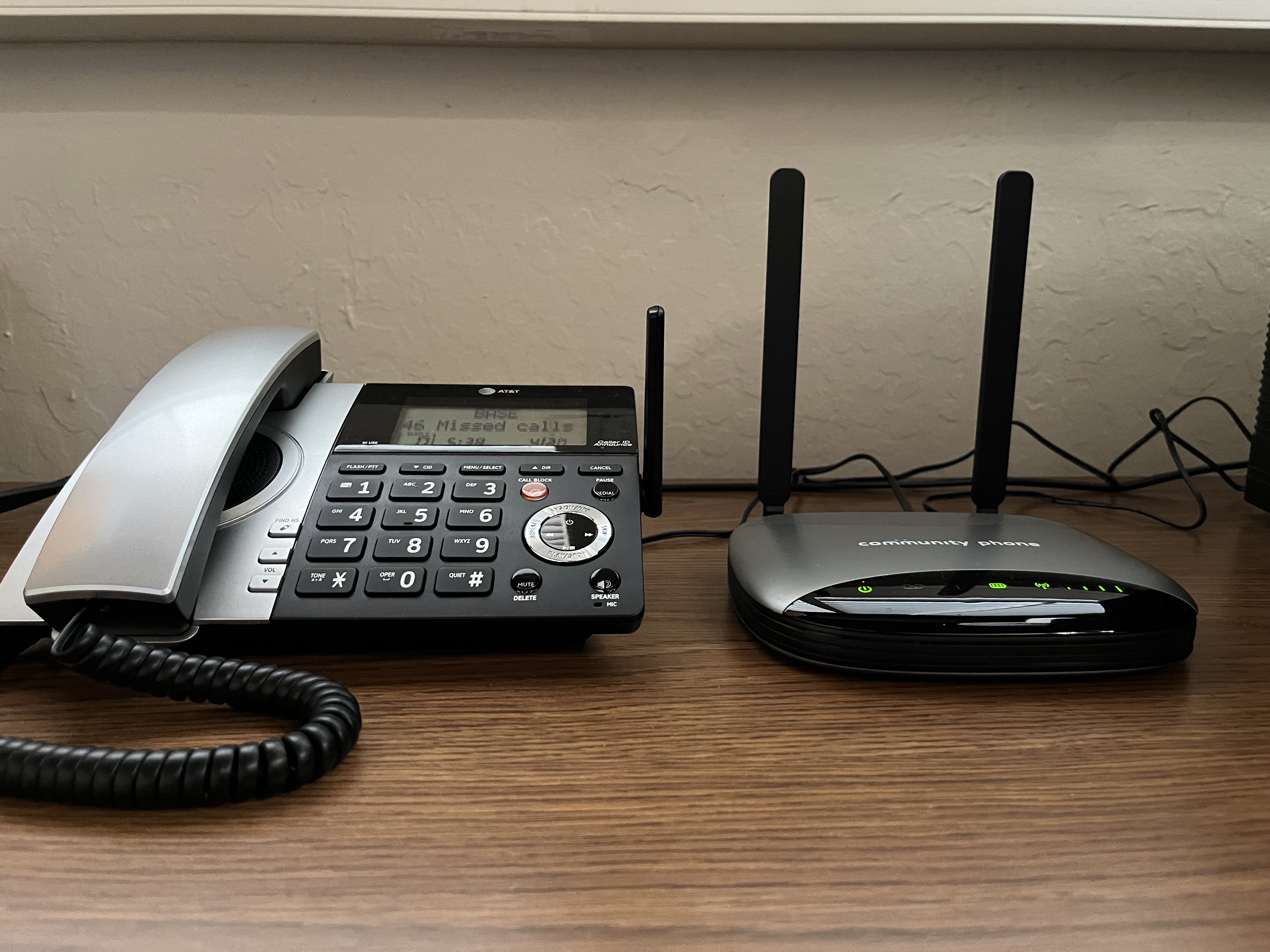
Community Phone was founded in 2018 and offers a service that’s somewhere between a cell phone and a traditional landline. They use cellular technology through two major nationwide carriers to not only have hot cutover capability, but to offer customers connectivity in case of a power outage. Their base unit serves as a cellular receiver that plugs into a regular electrical outlet and has a battery backup that according to specifications can serve on standby for up to 26 hours with 3.5 hours of talk time during a power outage. Customers plug their Community Phone base into an electrical outlet, preferably near a window, and plug their regular landline phone into the base. There are two phone jacks on the base unit, so a user can plug in two wired phones or a phone and an answering machine.
Community Phone also offers their system voicemail if users wish to set that up. Since this service isn’t through the phone jacks on the wall, if a customer has a need for extensions in other rooms, they would need to use a cordless phone system plugging the cordless phone’s base into the Community Phone base unit and then placing the cordless extension units throughout the dwelling.
I switched my service from AT&T to Community Phone, and so far, it’s working well. It’s also better voice quality than my AT&T service had been. I had been using my own answering machine initially, but I switched to their system’s voicemail to allow an extra ring. Their voicemail picks up 30 seconds after the call connects. Community Phone has a mobile app that not only provides access to voicemail, but it also shows users their call log and allows texting from the landline number. The premium plan provides voicemail transcriptions for those who prefer to read their voicemails and sends an email containing the voicemail transcription and audio file.
Community Phone requires no contracts, although customers get a month for free if they pay annually rather than monthly. The base unit/number is tied to the address associated with the account which is used for 911 identification. Customer service is available by phone or email, and they are quite responsive and resourceful.
There are a few unsupported aspects of the service. It doesn’t currently support medical alert systems and is not available for those on probation or house arrest due to incompatibility with the necessary monitoring systems.
Community Phone also offers basic cell phone plans in addition to their landline replacement service. Their plans have unlimited talk and text and are economical, but they lack unlimited data. Their cell phone plans are also only available to their landline customers.
This new “landline” is not quite the same as my old landline, but it is close, better call clarity, and the fact that it doesn’t require an internet connection like VoIP (despite the fact that I’m generally online a lot) is a plus.
Editor’s Note: An update to this article was written after several months of service with Community Phone. See: https://agoodreedreview.com/2024/09/26/update-to-a-landline-alternative/
Reference:
Community Phone – www.communityphone.org
A Good Reed Review also gratefully accepts donations via PayPal to help defray the costs of maintaining this site without creating paywalls.

 A Good Reed Review
Do you have call blocking for the spam phone numbers we receive calls from. How does your caller id work? Please print options and costs please along with senior discounts.
LikeLike
I’m just a Community Phone customer not an employee or representative of the company, and I’m not aware of any senior discounts. As to how the rest of what you’re asking works, the Community Phone website has all of that information readily available. You just have to enter your service address to see the pricing. In a nutshell, there are two levels of service, their standard “landline” plan and their premium plan. From what I’ve seen, the premium plan is about $10 more per month than the standard plan, and you get 12 months for the price of 11 if you pay annually instead of monthly.
Standard landline plans includes:
Landline service with unlimited nationwide calling Voicemail
3-way calling
Outgoing caller-ID
Access to our user portal and mobile app
Access to discounted cell plans
No contract
Premium landline plans includes:
Includes everything on the standard plan
Spam call protection
SimRing – Calls to your landline can ring on other phones
Voicemail transcriptions visible in your email or in the mobile app
No contract
LikeLike
Thank you so much for taking the time to inform me and answer my questions. You’re very kind. I will look into the site you provided and be able to consider all options. Again, bless you.
LikeLike
I read the review by Ande Jacobson and was seriously considering switching from AT&T to Community Phone. I checked the Better Business website for complaints and found a lot from this month. I’d like to know if Ande Jacobsen would still give a good review or if the review has changed. It is so hard to decide when there are so many good and bad reviews. I really don’t want my phone connected to my internet provider. Thank you.
LikeLike
Thank you for your inquiry. I’ve had Community Phone since early April 2024 and overall, the call quality has been excellent, much better than my AT&T service had been prior to that. The service is also just over half the price of my previous AT&T service. I have their premium service which is outlined in a previous comment. There have been a few brief issues from time to time due to some backend software updates to their premium services. To their credit, the Community Phone technical support is very responsive when issues are encountered and are resolved quickly. It appears that their standard service is more stable than their advanced system that adds the premium features, but certain features such as robo-blocking and emailed voicemail transcriptions aren’t available with the standard service.
The service is effectively a type of cell service, but it’s also much clearer than my standard cell phone service due to the base receiver they provide, and in my area at least happens to be through a different provider network than what I have on my cell phone which provides a bit more redundancy in case of outages. It is not VoIP, and from my experience is much clearer than any VoIP services I’ve encountered.
LikeLike
I read the review by Ande Jacobson and was seriously considering switching from AT&T to Community Phone. I checked the Better Business website for complaints and found a lot from this month. I’d like to know if Ande Jacobsen would still give a good review or if the review has changed. It is so hard to decide when there are so many good and bad reviews. I really don’t want my phone connected to my internet provider. Thank you.
LikeLike
See the response to your previous comment.
LikeLike
do they accept CA Lifeline program?
LikeLike
Not to my knowledge.
LikeLike
[…] late April, I wrote a piece about Community Phone talking about its benefits as a landline alternative. In short, Community Phone provides a […]
LikeLike
I am inquiring about this service as I got rid of AT & T some months back for the high price of their landline. I am with my internet company now, who told me the landland would not be connected to the internet and it is. everytime it rains or the wind is bad my internet is out and now so is my landline. I have calls dropping just about every time i am on it, and everyonne i am talking with cant hear me or they said my voice is wavy or sounds like a robot.
LikeLike
I’ve had Community Phone service for a little over a year and half now, and overall it’s a good service though not without a few hiccups. It’s not a traditional landline as they use cellular networks for their services though it’s a little more robust than a mobile phone. Their base equipment provides a more stable service to the home than a mobile phone tends to have. They use either the AT&T cellular network or T-Mobile’s network depending on which is available and stronger in your area. They provide a base unit that you can connect to a traditional landline phone or a cordless phone network if you wish to have multiple extensions in the home, and the unit has a battery backup that will keep phone service active even during power outages assuming the cellular signal is still active.
It costs significantly less than AT&T’s landline service which was the primary reason I switched. And yes, I took my landline number with me to Community Phone. They easily handled the transfer.
Their customer service is robust, and their technicians are very diligent and professional. They respond quickly to any issues and do all they can to resolve them quickly. I have found that their lower tiered service is more robust and reliable than their advanced platform which for me at least was somewhat buggy. The advanced platform has more features, but I have found that the standard service gives me more than my former landline service did.
LikeLike