 By Ande Jacobson
Although I am a Californian through and through, over the course of about 10 years, I spent a lot of time in the Washington, D.C. area, first for two vacation trips, then later for work. All of these trips, save the last one, took place before massive changes were enacted, and I got to do and see some things that are no longer easily accessible to the public.
My first trip to this historic city was in June 1991. Although my boyfriend and I were staying in Old Town Alexandria, we didn’t spend any significant time there choosing instead to spend the better part of the week seeing everything we could in Washington, D.C. proper and nearby Arlington, VA.
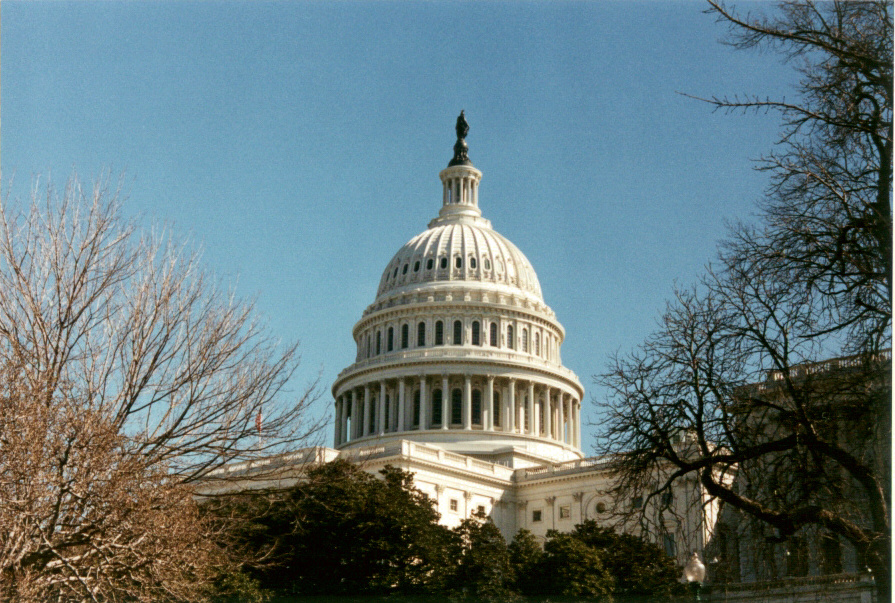
 During our stay, we walked several miles each day seeing many of the historic sites and three of the most popular Smithsonian museums – Air and Space (NASM), Natural History, and American History – although both being science nerds and working in the aerospace industry, we spent the most time in NASM. I took my first of many US Capitol photographs that started me on a multiyear journey to get what I considered the almost perfect shot. I wrote about that photographic hunt in an essay from 2021 entitled Photo journey: My quest for the perfect capitol shot.
I returned to D.C. a little over a year later in October 1992 with an old high school buddy. This was an exciting time to be in Washington, D.C. It was the month before the Bush v. Clinton presidential election, and the campaign was hot. There were several memorable aspects to that trip, but the most significant afternoon was the one we spent in the Senate gallery on the final day of the 102nd Congress’ Senate Session. It happened to be the day after then-President Bush had appeared on the Larry King Show, and the Senate was hopping. Senator Stevens from Alaska took the floor when we got there and tried to lambaste then-candidate Clinton with several flat out lies and accusations that had no basis in truth. He vehemently tried to paint Clinton as a criminal because as Stevens put it, he didn’t sit for his exams when he was a Rhodes Scholar. In other words, he didn’t finish his degree which last time I checked clearly wasn’t a crime.
Stevens was belligerent. Three senators tried to get him to yield the floor, but he wouldn’t. Finally, although I don’t recall exactly how this happened, then-Senator Joe Biden got him to yield. Once Biden took the floor, he concisely, precisely refuted every accusation Stevens had made with facts, and when he finished, he turned the discussion to something important – Bosnia. After a lively discussion about the issues facing Bosnia and how the U.S. should respond, the Senate then proceeded to honor three retiring senators – Cranston, Rudman, and Garne.
While Stevens was putting on his show, the thought that was going through my head at the time was that I couldn’t believe our tax dollars supported such drivel, but then when the Senate turned to real issues, and real work, it was truly fascinating to watch. That was also when I first became aware of just how sharp Joe Biden was and where his priorities were.
While the afternoon in the Senate gallery was the most memorable part of the trip, we also did quite a bit of site seeing as my friend had never been there before, and I had some favorite sites I needed to show her, NASM being at the top of the list. And it just so happened that the full Star Trek 25th Anniversary exhibit was there at the time. Both being ardent Trekkies, we had to see that.
The other big event that week was the traveling AIDS quilt that was unfurled along the Capitol Mall. Unfortunately the day we were supposed to go see it, there was a major rain storm pelting the area all day, so we instead spent the day inside some of the Smithsonian museums to get out of the torrent. Still, it was a fascinating trip.
After that second vacation to D.C., I changed companies, and I ended up on a project that sent me back to D.C. several times a year for extended stays just outside the beltway. Although I wasn’t working in D.C. proper, I was just a metro ride away, and I took advantage of that proximity to spend a lot of time continuing to peruse the sites the city had to offer, always making sure to stop by NASM at some point.
Over the years, I got to see some things that the public can no longer easily access. During one particularly grueling work trip, we decided to take a break on a Friday after completing a significant portion of our system upgrade and reaching a reasonable stopping point. We had all been working 16 hours days for some time, and after coming in particularly early that Friday, we hit our limit at about ten that morning. Four of us got permission from our management to take the rest of the day off, and we hopped on the metro to head down to the Pentagon to see if we could take a tour. We hadn’t made any arrangements, but in those days we didn’t have to. We just took the metro to the Pentagon station, disembarked, rode the longest escalator I’d ever seen, and ended up in what to the casual observer looked like a very well-stocked mall with all the conveniences. We found our way to the visitor’s center, and a half hour later, we were on a tour led by a young Army Specialist. Our guide couldn’t have been more than 21 at most, but this kid was knowledgeable and had a real ease about him giving us the history of the Pentagon as he almost ran backwards leading us along the approved route. There were museum quality exhibits all along the route we walked, and the artwork and architecture throughout the building were breathtaking.
On another trip to D.C., like many years, I was there over the July 4th holiday. That particular year, we had 3 July off as a company holiday, so I decided to head down to D.C. to see a few sites. I didn’t want to get anywhere near the tourist areas on 4 July as I have always been extremely crowd averse, but I thought that the day before wouldn’t be so bad. Since I had never seen it, I decided to take the tour of the FBI headquarters which is amongst the many government buildings in D.C. There was a bit of a line that ended up taking about two hours to get through, but once I got to the front, I was able to take the tour without having an appointment. This was in the mid-1990s, so the tour took the public on a guided walk through the facility viewing museum quality exhibits detailing the agency’s history, through a viewing area to see the FBI crime lab in operation, and ended with a shooting demonstration by current agents. That all changed after 11 September 2001 when the facility was closed to the public for several years due to the security concerns following the attack. I have not seen the current “FBI Experience” exhibit which has taken the place of the previous public tours, but the tour I took was fascinating.
On another trip before the week the world changed, I joined a colleague one Saturday to go see some of the monuments. Even though I had been to the area more than a dozen times by then, I had yet to see the Jefferson Memorial, so that was my goal for that day. We started at the end of the metro’s Red Line, changed trains at Metro Center, and took the Blue line to the Foggy Bottom station which is near the Lincoln Memorial. After a short stop there, we walked toward the Tidal Basin to see the Jefferson Memorial, but before we got very far, we got swept by the crowd up into a memorial I didn’t know was there at the time, the Korean War Veterans Memorial. There’s a path heading up onto a small hill that takes visitors through a series of sculptures of soldiers from the conflict. There was an eerie quality to the display as though these sculptures were depicting the ghosts of soldiers lost. The path takes visitors to the main exhibit at the top of the hill giving the history of U.S. involvement in the war along with a memorial listing all of the names of the fallen.
After we went through the exhibit, we continued on toward the Jefferson Memorial. When we got there, it was somewhat crowded, but there was some open space in the center of the rotunda near Jefferson’s statue. There are four columns separating the openings to the rotunda with inscriptions containing Jefferson quotes where most of the crowd gathered. I was backing up to get a better angle to view the inscriptions, and as I was backing into the open area, my colleague was desperately trying to get my attention. He stopped me just before I would have bumped into somebody behind me. He asked me if I knew who that was. I glanced over my shoulder and said no as I went back to reading the inscriptions. He told me that it was Charlton Heston. I glanced over my shoulder again, shrugged, and went back to reading the inscriptions. Although my colleague was awestruck, I am generally not impressed by celebrities, although this could have been far more than a chance encounter had my colleague not stopped me. Evidently, according to my colleague, Mr. Heston’s bodyguard was getting rather nervous as I backed up.
Beyond the famed historical sites and exhibits in Washington, D.C., I was there often enough that I had the opportunity to enjoy some of the local entertainment. One such event was an annual trek to see Hexagon Hilarity which at the time I was going there staged an annual fundraiser for the Duke Ellington School of the Arts during the month of March. Hexagon has been around for just over 70 years and has supported numerous charitable causes over that time. They stage an original musical political satirical revue with high-energy production numbers combined with a few smaller numbers (but still high-energy) lampooning a raft of political issues and situations. It’s all original content that is mostly nationally focused although there are a few more local issues in the mix. They do a new show every year with interesting subtitles such as Hexagon 2001: A Stateless Odd D.C. or Hexagon 1999: 20,000 Leaks Under D.C. While they seem to have scaled back a bit over the years, the organization is still active.
Another satirical political troupe I used to enjoy was The Capitol Steps. Their motto was “We put the MOCK in democracy!” Originally formed at a Senate Christmas party, most of the troupe was made up of former political speech writers, and they claimed to be equal opportunity in lampooning politicians of all stripes doing skits and musical numbers covering current events. Whatever was happening, they sliced and diced it into witty satire. They used to have a few teams of performers, one that was resident at Chelsea’s Cabaret in Georgetown, and a few others that toured the country. I never caught the tours, but I saw them at Chelsea’s several times over the years. If any Congress critters happened to be in the audience, they made sure to highlight them for all to see. They thrived from 1981-2020. Unfortunately, they disbanded due to the pandemic as they couldn’t survive when they were unable to perform live for a year or more. Still, 39 years is a pretty good run. As an aside, it seems that Chelsea’s Cabaret also closed at about the same time, no doubt for the same reason.
Another event I used to enjoy was one that occurred in September, generally the Sunday after Labor Day. The Kennedy Center Open House was a day-long festival when the center was open to the public to come and see various performances for free on every stage in the facility. The program was expansive and showcased performances large and small for audiences of all ages. It also featured an instrument petting zoo where the public could come and try out all kinds of musical instruments. I attended the event numerous times during my travels, and one of the most interesting presentations I got to see was a behind the scenes look at Phantom of the Opera which was running in the Kennedy Center Opera House at the time. A group of the show’s technical advisors and crew were on hand to show the public how various effects were done. In one segment, a crew member told the audience what his job was during each performance. He was the catcher. At the end of Act 1, the massive chandelier fell, and it was his job to stand in costume upstage center and catch the flying chandelier so that it didn’t swing back out into the house after being dropped. As part of the demonstration, he showed everyone what happened if his timing was off. He didn’t absorb the momentum sufficiently, and as a result, he went sailing out over the house holding onto the chandelier as it swung. He didn’t miss during performances, but for this demonstration, it took several people to catch him when he swung back onto the stage.
Sadly, the Washington, D.C. that I knew and loved changed forever on 11 September 2001, and although I wasn’t in the District that day, I was at work nearby all of that week. So many of the things that I got to do as a member of the public aren’t as easily accessible anymore, and some aren’t accessible to the public at all. We are supposed to be a nation with a “government of the people, by the people, for the people,” as President Lincoln said in his Gettysburg Address. The city that houses that government is all of ours. The institutions of that government are all of ours. There is a lot of history in Washington, D.C., and I have many fond memories of the time that I was fortunate to have spent there.


