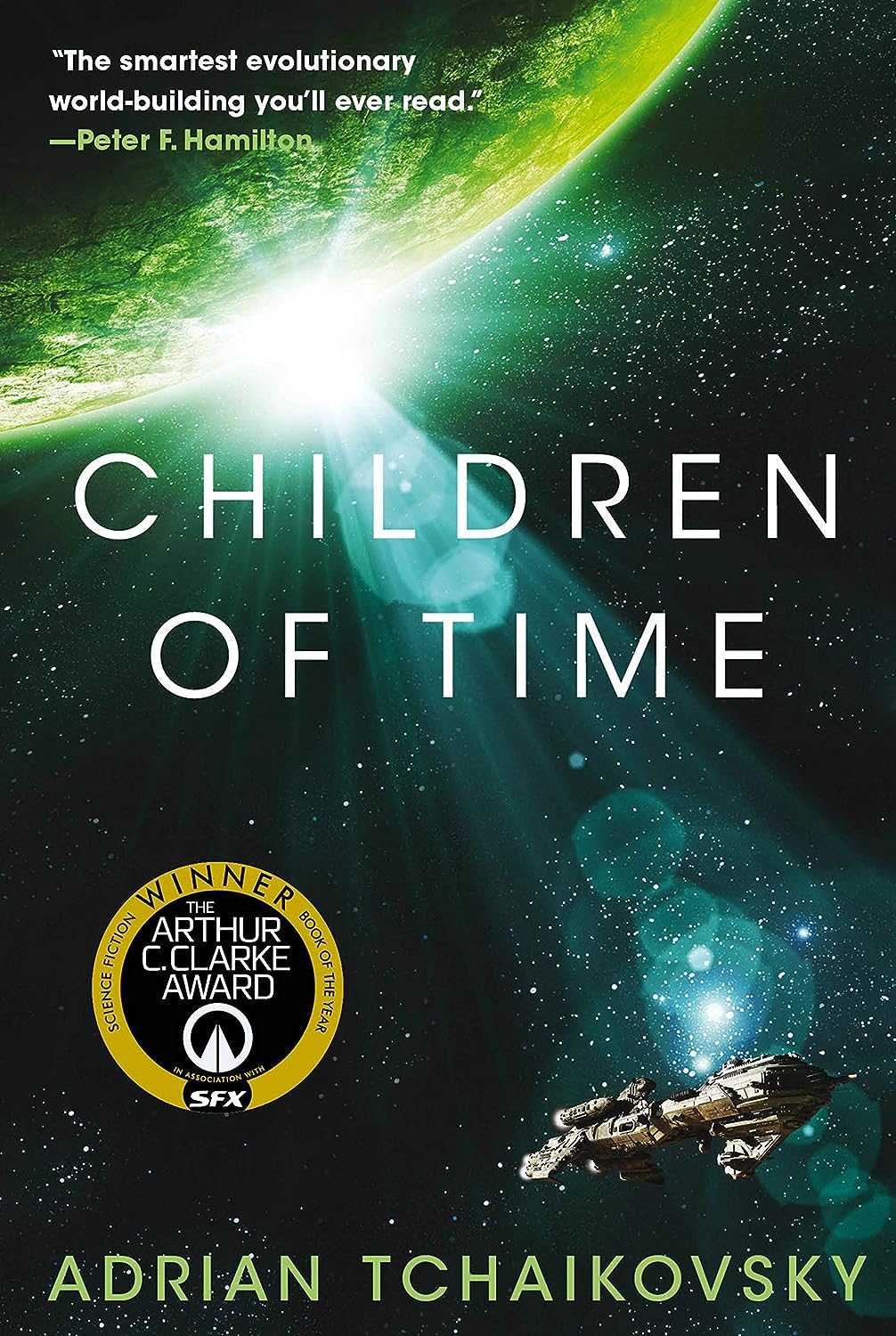
Adrian Tchaikovsky’s series that began with Children of Time, concludes with Children of Memory, released in November 2022. Again many of the characters (or their descendants from previous books) are back. This time, an instance of the AI known as Avrana Kern is built into yet another interstellar ship. She and all of her other instances are what remain of the ancient human terraformer/scientist who jump-started the advancement of numerous species on diverse worlds, though not all intelligent life was directly the result of her intervention. The ship this time is called the Skipper, and its crew is comprised of a Human (with a capital H), a few portiids (a type of intellectually advanced jumping spider), an enhanced octopus, an interlocutor or observer who has taken Human form but is in reality a colony of intelligent entities from the planet Nod, and two new arrivals. Continue reading
science fiction
‘Children of Ruin’ continues the journey
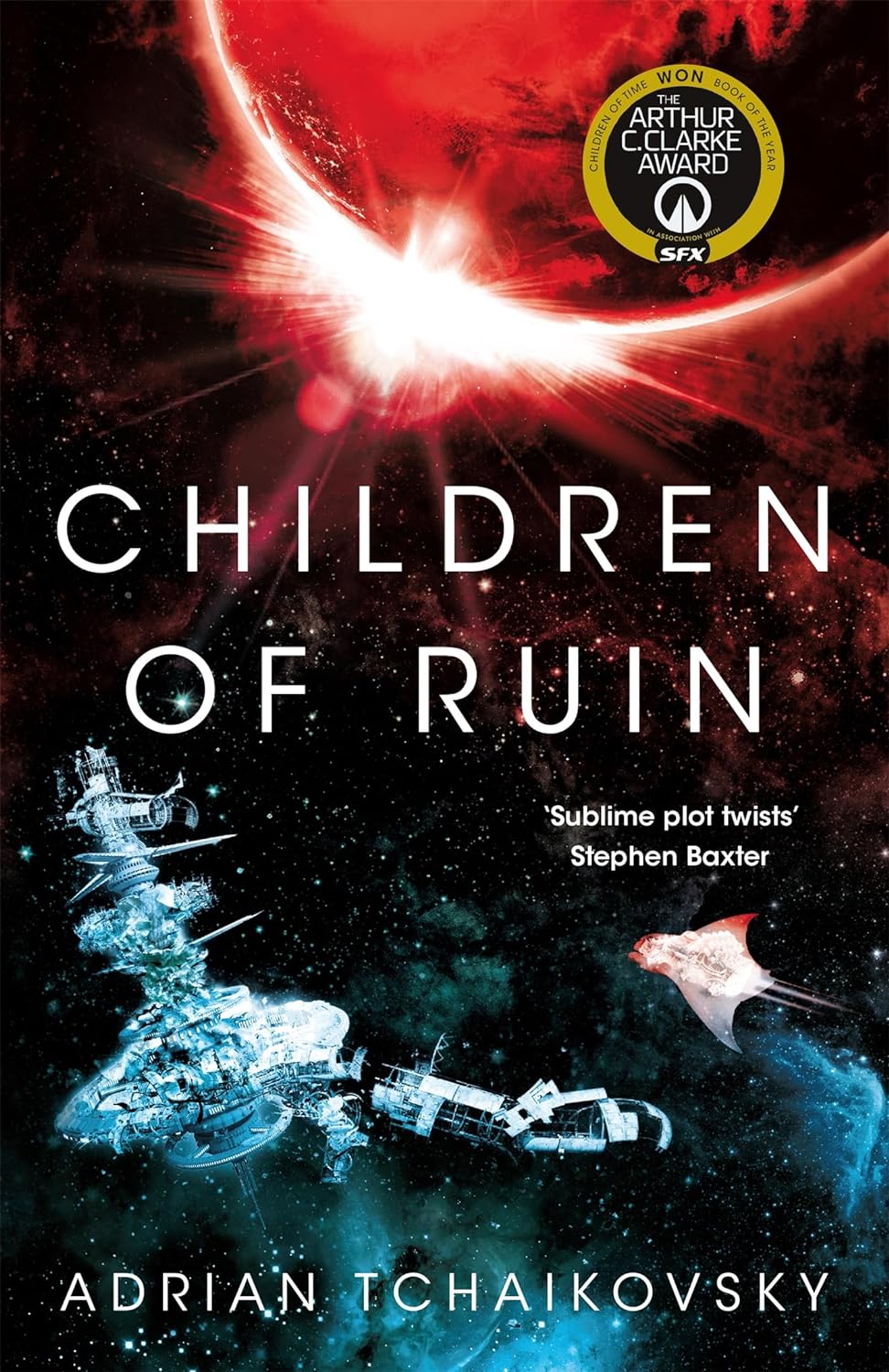
Adrian Tchaikovsky’s series that began with Children of Time, continues with Children of Ruin, originally released in May 2019. Many of the characters from the first book are back, at least in reference, and their descendants do them proud by continuing the adventure. The Humans (with a capital H) and the Portiids now have a strong working relationship on the planet known as Kern’s World, although direct communication is still a bit challenging given the differences in their thought and expressive processes. Capital H Humans are humans who have embraced a mutually beneficial relationship with the Portiids (i.e., large jumping spiders with an advanced intellect and civilization seeded and accelerated by humans of the distant past). Kern’s World from the first book is a planet that was terraformed and seeded with a virus to accelerate the intellectual development of monkeys. Alas, there were no monkeys, but a particular species of jumping spider evolved with the virus to establish a robust civilization on the planet. The planet was named Kern’s World after Avrana Kern, an ancient terraformer/scientist who over the centuries had uploaded her consciousness into an AI and enjoys a type of immortality. Initially, Kern was seen as some kind of god by the Portiids, but eventually when she made herself visible to the Portiids, she became something of an adviser. The first book is discussed in greater detail in ‘Children of Time’ expands minds.
In the second installment in the trilogy, Tchaikovsky runs a parallel storyline alternating sections between the distant past and what is now the present, along the way introducing some new life forms while evolving the existing ones. Continue reading
‘Children of Time’ expands minds
Adrian Tchaikovsky’s Children of Time trilogy begins with a bang. Or perhaps I should say the first book, Children of Time, originally released in June 2015 spins a mind expanding tale. The premise is one that draws deeply on Tchaikovsky’s roots as a zoologist (with a combination psychology/zoology pedigree). It is thought-provoking science fiction at its finest introducing a world where humans are not the dominant species. Although sparked by human interference, the green planet known as Kern’s World is home to a wide-ranging arachnid and insect population that has developed beyond the wildest human imagination. Marine life as well has surpassed what we know today on Earth. It wasn’t always this way, but humankind had run out of options. In the far future, humankind had finally destroyed the Earth. In their final days they sent out ark ships in hopes that the species could find a new home through advanced terraforming experiments intended to seed potential worlds with the ecosystems necessary to support human life. Alas, the best of the intentions are often usurped by unexpected events. Continue reading
How is living through the pandemic like space?
I have long loved the world of Star Trek and science fiction in general. I can remember imagining possibilities as a child while walking to school, wishing that it were possible to be beamed up to a starship to travel to new worlds and join with others in exploring the vastness of space. In the real world of my childhood, I got to watch, along with the rest of the world, as Neil Armstrong and Buzz Aldrin walked and jumped on the moon for the first time. Although very different from the pictures painted by my favorite television series, it was a breathtaking adventure that sparked many dreams. I later studied space travel and learned how manned space flight changed over time beginning with the U.S. Gemini and Apollo programs through the advent of Skylab, Mir, and the International Space Station. Various probes and telescopes continue to explore beyond the earth’s boundaries to give us crucial information about what’s really out there. We still haven’t achieved the level of development depicted in the Star Trek universe, nor have we discovered the kinds of life imagined by various science fiction writers, but we have grown outward and created stories, both real and imagined, related to what’s beyond our little blue planet. Continue reading
A Dinner Surprise
Since surviving the pandemic of 2020 Bea continued eating all of her meals at home. Even after the crisis had passed, although she ventured out for work and various activities, for Bea, one dinner was much like the next. Her meal consisted of a plate of rice or noodles covered in veggies, chicken, and cheese, and she zapped it in the microwave. She lived alone and loathed housework and cooking, so anything that kept those to a minimum was a plus. Continue reading