 By Ande Jacobson
While I have no plans to return to performance myself, I recently had the privilege of attending the first orchestra rehearsal for Sunnyvale Community Players’ (SCP) upcoming production of Sweeney Todd, not as a player, not as the music director, but as a very interested observer. I arrived early as the orchestra members trickled into the lobby of the theater to assemble the ensemble. Once everyone was in place, some of the players were noodling a bit or practicing some of the challenging sections of their parts while others were talking quietly. Eventually, the music director arrived carrying an amp for one of the keyboard players. He set up the amp, handed out a revised cut sheet, and then took his place in front of his orchestra to begin the rehearsal at the top of the score. Music director Val Zvinyatskovsky was the youngest person present at the tender age of 17, and yet he had the attention and command of the room. While it was the first time they had come together in this particular ensemble, everyone was ready to work.
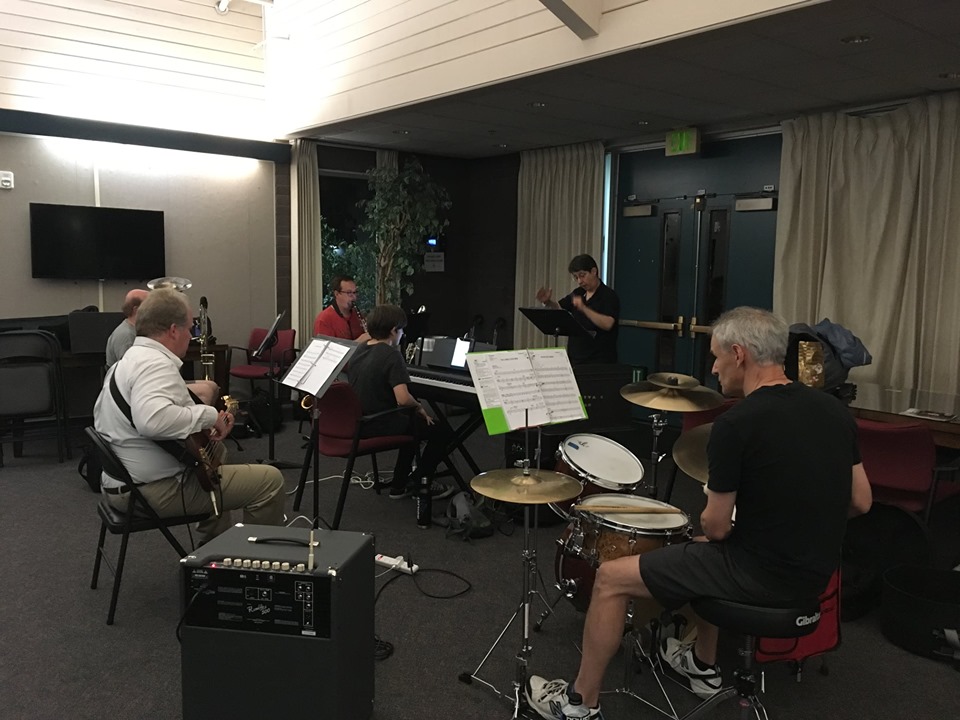
A hair over four years prior to this night, Val arrived in this very space for his first rehearsal as a pit musician playing the piano book for SCP’s production of Urinetown. Since then, he’s gained more experience in the pit, mostly as a music director, often directing from the keyboard.
This time, Val is leading his largest orchestra yet with a baton rather than a keyboard, and he’s ready. Interestingly, aside from me, everyone from that earlier Urinetown orchestra is on the roster. Val’s Sweeney Todd orchestra of 20 players per performance includes:
- Music Director/Conductor: Val Zvinyatskovsky
- Keyboard 1 (Organ/Celeste) – Ruiran Xun / Amanda Ku
- Keyboard 2 (Harp) – Greg Goebel
- Violin 1 – Jaime Yuen / Faye Yang
- Violin 2 – May Yoneyama / Karen Law
- Viola – Marilyn Anderson
- Cello – Zoe Lin / Karmen Peng
- Bass – Thomas Calamia
- Reed 1 (Flute/picc/recorder) – Asa Stern / Diana Tucker
- Reed 2 (Oboe/English horn) – Vicky Xiong
- Reed 3 (Flute/Bb, Eb, C Clarinet) – Mark Beyer
- Reed 4 (Bb/Bass Clarinet) – Jordan Selburn / Kathy Switky
- Reed 5 (Bassoon) – Gail Selburn / Noah Cort
- Horn – Jim DeLoach / Joe Kelly
- Trumpet 1 – Jose Sanchez
- Trumpet 2 – Ken Thomas
- Trombone 1 – Jason Loveman
- Trombone 2 – Ken Rydeen / Doug Brown
- Trombone 3 – Miguel Ledezma
- Percussion 1 (Mallets) – Martha Garcia
- Percussion 2 (Kit) – Peter Wallack
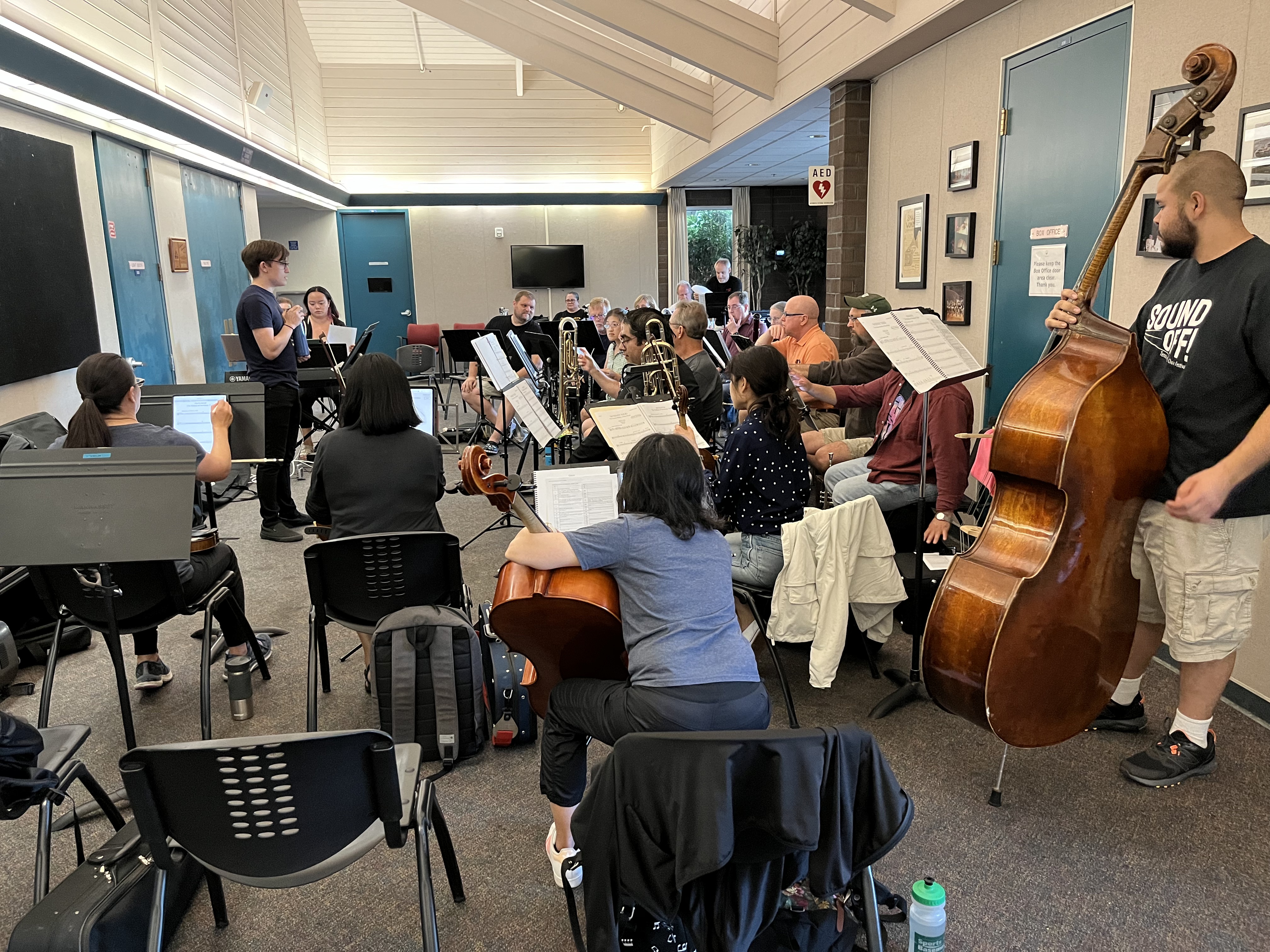 Several of the players had played previous runs of the show, but not necessarily on the parts they were playing that night. Several of the players had not previously worked with Val, and every music director is a little different. Besides getting used to a new director, rehearsals for a show can sometimes be a little chaotic on first read, but this one really wasn’t. It moved along without too many starts and stops. The music flowed well overall, albeit with just slightly more dissonance than written at times, but that will soon pass. The music is typical of Sondheim in that it’s complicated, dramatic, and requires focus.
Val had clearly done his homework and knew the score extremely well. Unlike the rest of the orchestra members who had been practicing on their own individually with varying degrees of rigor, Val had been working with the vocal director and the cast for weeks on this challenging music, and he brought all that with him to this rehearsal. His direction was smooth, clear, and precise. His tempos were solid show tempos, and the players watched him carefully as he led them through Act 1. He seemed comfortable and calm at the helm, and he was responsive to his players, listening and collaborating with them to clarify any points of confusion.
This orchestra is clearly going to gel very quickly and will add greatly to the stage action when they get to performance. Of course from my perspective as a musician this night’s rehearsal was a treat because the orchestra was the sole focus. With only the instrumental music, the musical lines emerge more distinctly. The crescendos are brighter. The lyrical sections soar more broadly without the human voice overlaying them. Occasionally throughout the rehearsal, various cast members would emerge from the auditorium to listen intently to the orchestra particularly to hear the instrumental accompaniment for their featured songs. Sweeney Todd is a dark show, and the music reflects that. Much of the music evokes a strong emotional response even without the singers. There’s a tension through much of it that was clearly there in this first rehearsal.
Because of the sizable instrumentation, not all of the players will fit into the pit for performance. As such, the reeds will be positioned in the wings using monitors to see Val while the rest of the orchestra will be down in the pit. Most of the reed players have played in this space in similar configurations for previous shows, although it will require a slight adjustment given the difference in what they’ll hear through monitors separated from the rest of the orchestra compared with their rehearsals before moving into the pit/wings.
So what did this rehearsal sound like? Here’s a short clip from the very beginning.
Here are a couple of clips from the end of the rehearsal. The first is a piece of the song, Johanna, and the second is some dramatic transition music from Act 1.
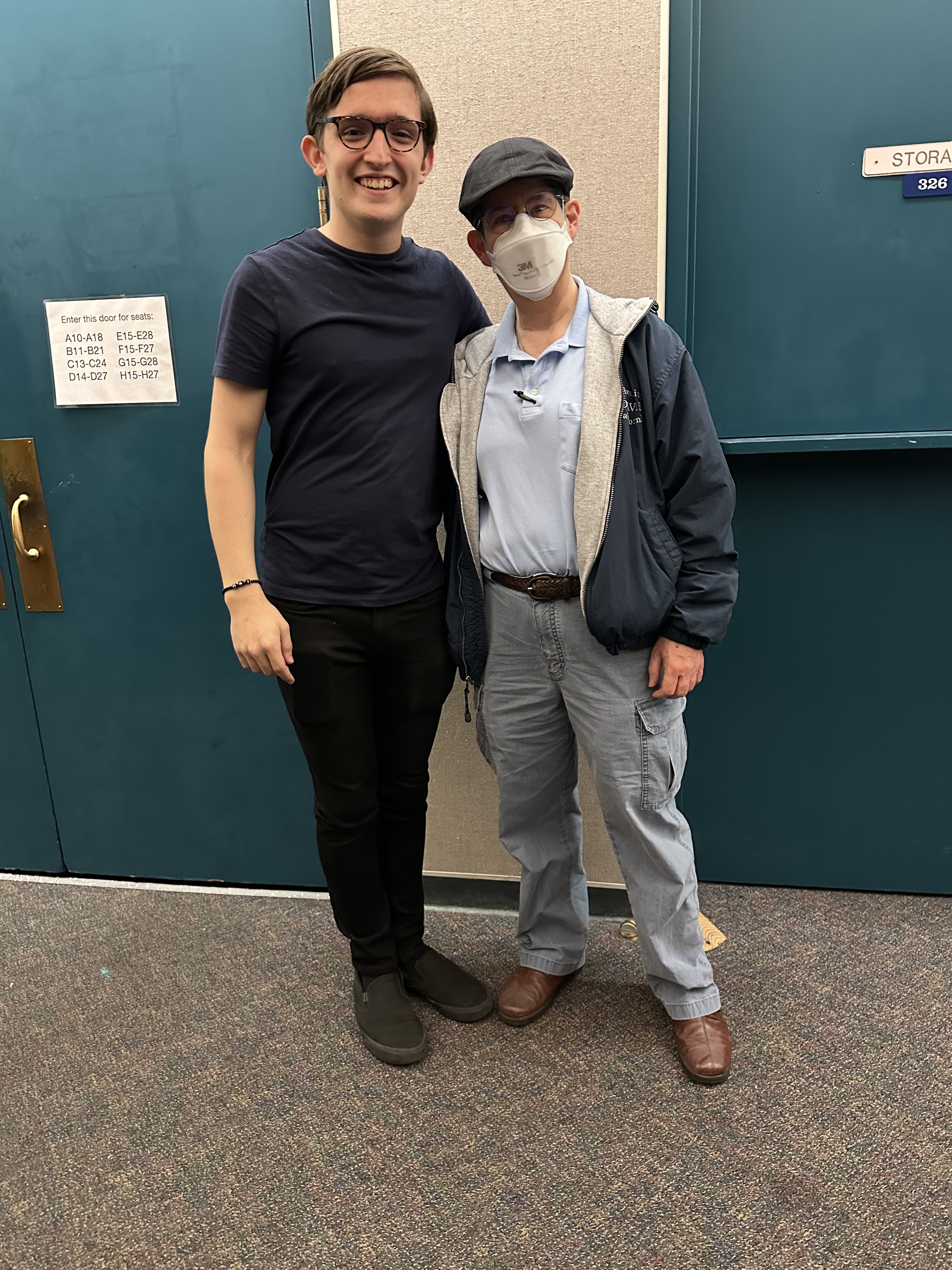 Much has changed over the last four years though the music plays on. To sit back and watch from the sidelines is a different perspective than I normally have to chronicle a piece of the pit journey, but the orchestra is in good hands. I have no doubt that they will shine even though they’ll be out of sight while the performances are running.
Too often in musical theater, orchestras are but a footnote while the cast gets all the attention. This production has an innovative creative team behind the scenes promising a visually spectacular show with a strong cast on stage. As noted in previous pit chronicles and my commentary on the role of the pit musician in musical theater, the orchestra has a very different path from the cast. Casts normally have weeks if not months of rehearsal time together honing their performance while the orchestras are required to do most of their learning on their own only coming together for very few rehearsals (often only one or two) to put their parts together before the most exciting rehearsal of the process when the cast and orchestra first come together during the sitzprobe (colloquially known as the sit-sing, although it’s usually more of a “stand-sing”).
Even so, this orchestra will be noticed in the best possible way as they will be heard and felt by all in the house, and their haunting melodies will linger long after the curtain comes down.
The show runs from 28 October – 12 November 2023 at the Sunnyvale Community Theater located at 550 East Remington Dr., Sunnyvale, CA 94087. For more information including a short description of the show, the full cast and creative staff lists, and to order tickets, see the SCP website.
Addendum after the second orchestra rehearsal:
This sample is music that many audiences may not notice as they are walking out of the theater, but the Exit Music is a treat. As a musician myself, I always stay for the Exit Music when attending a performance, but many theatergoers do not. Leaving immediately after the final bow, one misses the opportunity to hear the orchestra shine. In case you don’t get the chance, here’s the Exit Music from the first night the Sweeney Todd orchestra read through it together at their second and final orchestra-only rehearsal.
Note that while performances will have 20 players with one player per part, this rehearsal had a much fuller string section. Several string players are splitting the run, so with everyone there the violin and cello parts were doubled and able to take advantage of their divisi lines. There were also two French horns this one night only which was lovely to hear.
References:
https://agoodreedreview.com/2019/10/23/urinetown-is-it-satire-or-a-look-ahead/
https://agoodreedreview.com/2021/12/11/val-z-profile/
https://agoodreedreview.com/2022/03/11/promo-upstage-theater-falsettos/
https://agoodreedreview.com/2022/09/04/working-is-working-at-scp/
https://agoodreedreview.com/2023/04/21/next-to-normal-is-coming-to-scp/
http://www.valzvi.com/
https://agoodreedreview.com/2012/12/24/pit-musicians-commentary/
A Good Reed Review gratefully accepts direct donations via PayPal to help defray the costs of maintaining this site without creating paywalls.


[…] permission of course). That said, this is not a review. This is partially a continuation of my earlier orchestra chronicle expanded to the production […]
LikeLike