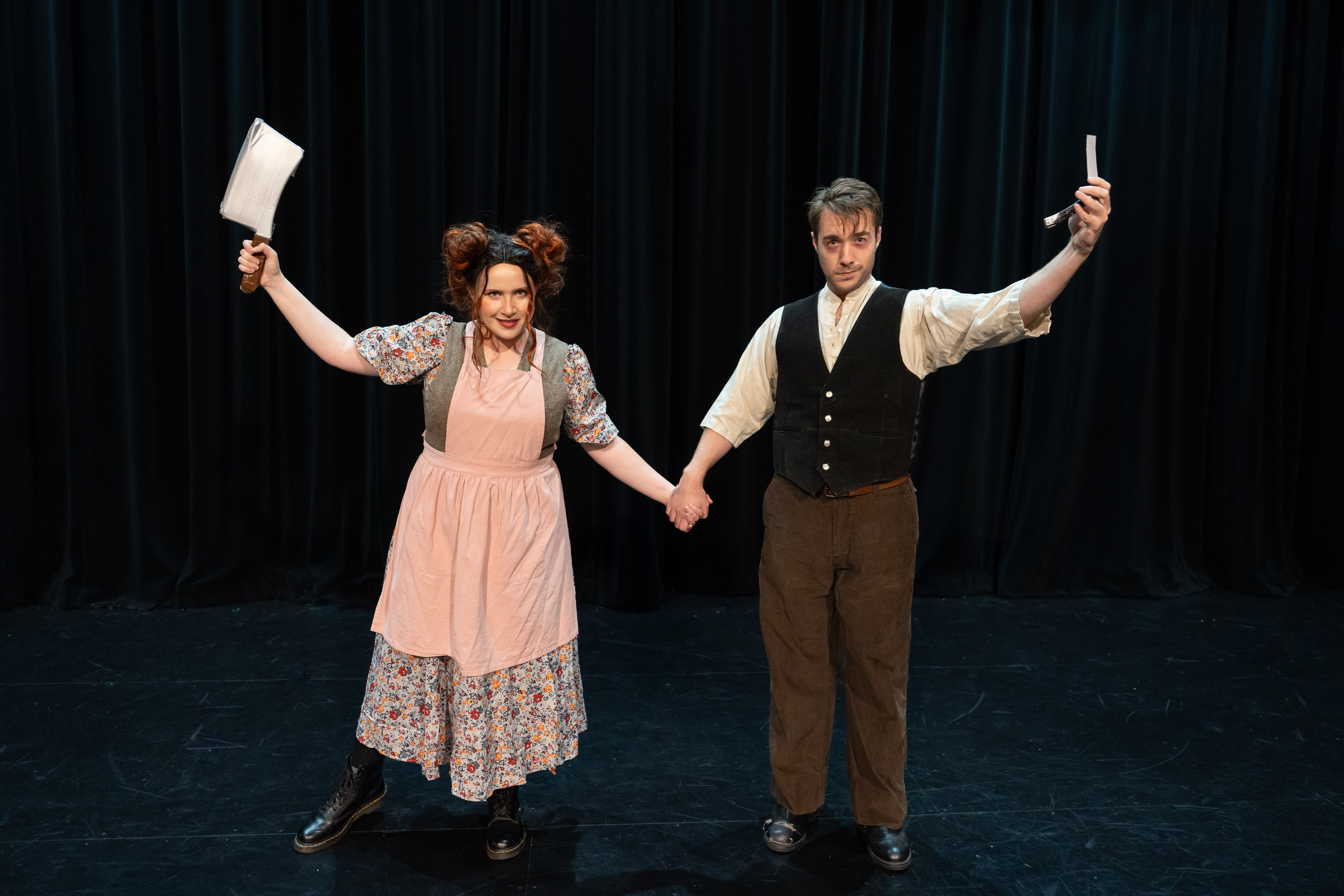
By Ande Jacobson
‘Appointments’ are going fast for Sunnyvale Community Player’s (SCP) production of Sweeney Todd: The Demon Barber of Fleet Street this fall. This is a show that should not be missed. I was fortunate to be granted an early appointment to catch a little more behind the scenes at the first full dress rehearsal with all of the elements in play. As a music director and player, it’s not often that I have been able to observe this part of the process from quite this vantage point, i.e., from the house without a musical score in front of me, though I had to take a quick peek backstage before the run-through started to see the pit setup (with permission of course). That said, this is not a review. This is partially a continuation of my earlier orchestra chronicle expanded to the production overall.
Sweeney Todd is a classic Steven Sondheim show that is different every production, yet the haunting score stays with you. It’s the story of Benjamin Barker, an innocent London barber who had been framed for a crime he didn’t commit. His family torn from him, he rotted in exile building a lust for vengeance against the judge who framed him and destroyed his family. He returns to London after 15 years to exact his revenge. While a precious few think they recognize him (with predictable consequences given the show’s theme), his new identity as Sweeney Todd gives him some cover. Along the way he makes a few friends, a few enemies, and a big impression on the people of London. His partner in crime, Mrs. Lovett, “cooks” up an ingenious way for him to exact his revenge. In the process, Mrs. Lovett’s pie shop receives the boost it needs leaving people “dying” for a taste of the best meat pies in all of London albeit unaware of the secret ingredient. Along the way, Todd is surprised and horrified when he discovers what has happened to his wife and daughter since he’s been gone.
This dark story is interspersed with some comic relief and its vibrant score can’t help but affect every theatergoer. It’s one of Sondheim’s most memorable works first hitting the stage in 1979, and it’s one that reveals new insights with every production and each viewing. SCP last presented this show during the fall of 2010, and this promises to be a very different production.
Director (and SCP Artistic Director) Thomas Times is always innovative in his approach to shows adding details that aren’t necessarily explicitly stated but inform the performance. For instance, when he directed Urinetown in 2019, he set the show in a near dystopian future in East Palo Alto. For Sweeney Todd, he includes some subtle undertones that his cast will embrace and exude in their performance. A big part of this is finding the humanity in every character, heroes and villains alike. The themes of the show are familiar to everyone in their own lives including love, loss, pain and suffering, and what it takes to achieve happiness. Yes, murder is also a significant theme (remember the full title is Sweeney Todd: The Demon Barber of Fleet Street), and while the actions taken are far more dramatic than most people personally encounter (hopefully), the feelings that the characters experience and express are relatable. Through it all, human connection is the goal.
This is a big show with multiple interweaving threads. There are romances, some explicit, some unrequited. The heroes and villains are bigger than life, but despite their extreme methods in some cases, they are still sympathetic, a credit to both Times’ vision for the show and the actors’ interpretation.
The presentation is fairly traditional. The set provides efficiency and dramatic flair with a simple turn (or three) allowing the action to move quickly between scenes. The central platform serves the show well with clean lines, drawing focus in just the right way.
Outside of the dark themes, audiences can let themselves be fully absorbed by the intricate music. The show is largely sung through, the lyrics clever and complex in typical Sondheim fashion.
Here’s a clip from the sitzprobe one week before opening:
A sitzprobe is technically a seated music rehearsal, although as can be seen in the clip, the singers are standing when singing. The sitzprobe is also the first meeting of the cast and orchestra before they settle into their arduous tech week (colloquially known as “hell week” because of the long hours and intense focus necessary to put all of the elements together before the show opens).
Since the sitzprobe, the cast, staff, orchestra, and crew have been busy. They did an initial sound check after moving into the theater to set a baseline for cast and orchestra balance before releasing the orchestra while the cast, tech designers, and crew started their cue-to-cue (or Q2Q for short). Q2Q is when they run the show’s technical transitions without orchestra going from one cue to the next to tune the lighting, sound, and set movement making necessary staging adjustments along the way. Given the complexity of the show and some technical challenges, there were still some aspects being sorted out at the start of rehearsal the night I attended.
Pre-pandemic, SCP used to run three, or sometimes even four dress rehearsals with full cast, orchestra, and crew before any audience got to see the show. Now, SCP has trimmed that down, so there are only two scheduled dress rehearsals before the preview. The preview is still technically a dress rehearsal, but it’s done in front of a small, invited audience the night before opening. The rehearsal I attended was the first of the two dress rehearsals running the entire show with all the elements together.

Before running the show that night, in addition to adjusting a few of the cues and some staging, Times also staged the bows which pushed the start of the run-through later than planned making for a very late night (note the “hell week” reference above). During the run-through, there were a few expected hiccups in the process when the orchestra was added to the mix including some sound balancing needs. There were also few issues that were unexpected. One unexpected challenge related to having a closed pit.
When the pit is open, i.e., some number of pit covers removed, the music director/conductor is visible to the cast stage downstage center. This allows the conductor to make eye contact with the actors and cue them directly. The conductor is also projected on the back wall of the house, in theory to allow the cast to catch a glimpse of him if they are far upstage or have an obstructed view of the downstage center area due to blocking. With the pit closed, the cast’s only view of the conductor is the projection on the back wall of the house. Unfortunately, with the stage lighting, particularly when the actors had spot lights on them, they couldn’t see into the house. Also, their conductor, Val Zvinyatskovsky, was not brightly lit to stand out over the stage lights at this first dress rehearsal. The projection was visible from inside the house if one looked at the back wall, but then the people in the house didn’t have lights shining in their eyes. There are a number of ways to address this, and I’m confident that it will be sorted before the preview. With the musical complexity in this show and the fact that the orchestral accompaniment and vocal lines form an intricate counterpoint, at times in different meters layered atop one another, complete synchronization is next to impossible without a visual cue. Despite a few timing issues, the musicality of the vocals came through, and it’s clear that this cast knows their parts well.
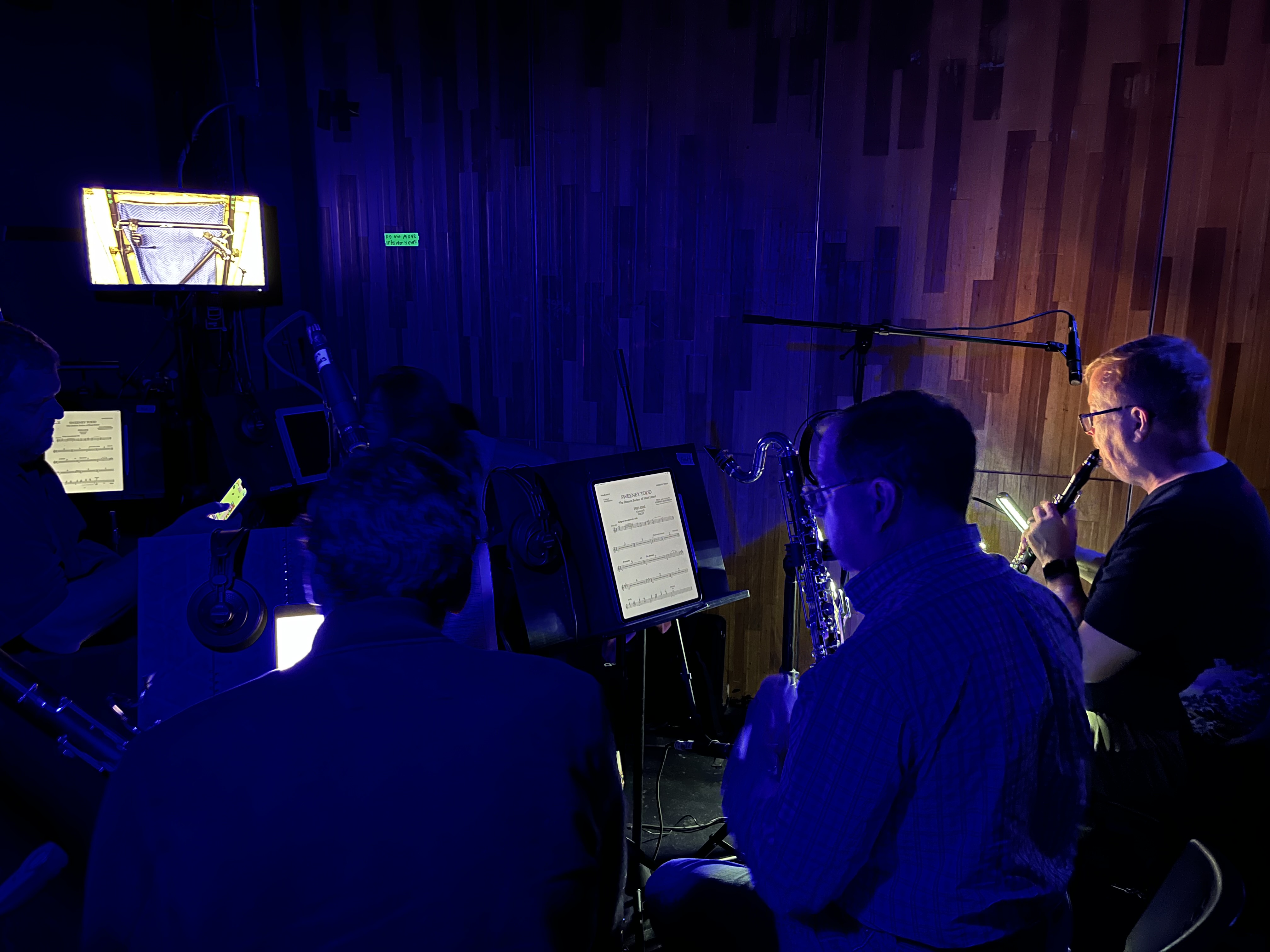
The overall orchestral balance was interesting from the house because the pit singers and the reeds in the wings could be heard acoustically and through the sound board mix fed into the house. The rest of the pit could only be heard through the sound system. Zvinyatskovsky and all of the musicians had headphones to hear the stage action as well as the orchestra mix, though that took some tuning through the rehearsal before everyone could hear what they needed.
This is a physical show, and with the various levels on stage along with some interesting “exits,” it was fascinating to see how smoothly the action ran despite this being the first full dress run. The staging works well, and the few changes made that night were incorporated surprisingly seamlessly.
This impressive cast includes:
Sweeney Todd: Steve Allhoff
Mrs. Lovett: Alea Selburn
Anthony: Ryan Liu
Johanna: Aishy Panwar
Judge Turpin: John Mannion
Beggar Woman: Susan Tonkin
Toby/Ensemble: Zanden Forbord
Toby/Ensemble: Monty Zinkevich
Pirelli: Joe Cloward
Beadle: Ray D’Ambrosio
Jonas Fogg/Ensemble: Dane Lentz
Bird Seller/Ensemble: Emma Blickenstaff
Ensemble: Collin Seaman, Nico Conrad, Meghna Mandava, Matt Regan, Daniel Gilmer, Gaby Pinto, Katie Lannin, Elizabeth Lawrence, Catherine Porter, Kim Seipel, Jessica Lubke
Pit Singers: Jessica Ganz, Lex Lindquist. Kenny Silberberg
The creative team includes:
Director: Thomas Times
Vocal Director: Stacy Levin
Stage Manager: Marte Synnøve Abrahamsen
Music Director: Val Zvinyatskovsky
Choreographer: Daelyn Cerruti
Set Designer: Scott Ludwig
Costume Designer: Lisa Claybaugh
Sound Designers: Angela Yueng, Curtis Murray
Lighting Designer: Ed Hunter
Props Master: Haiden Tomas Grushkin
Hair and Make Up Designer: Jazmine Morris
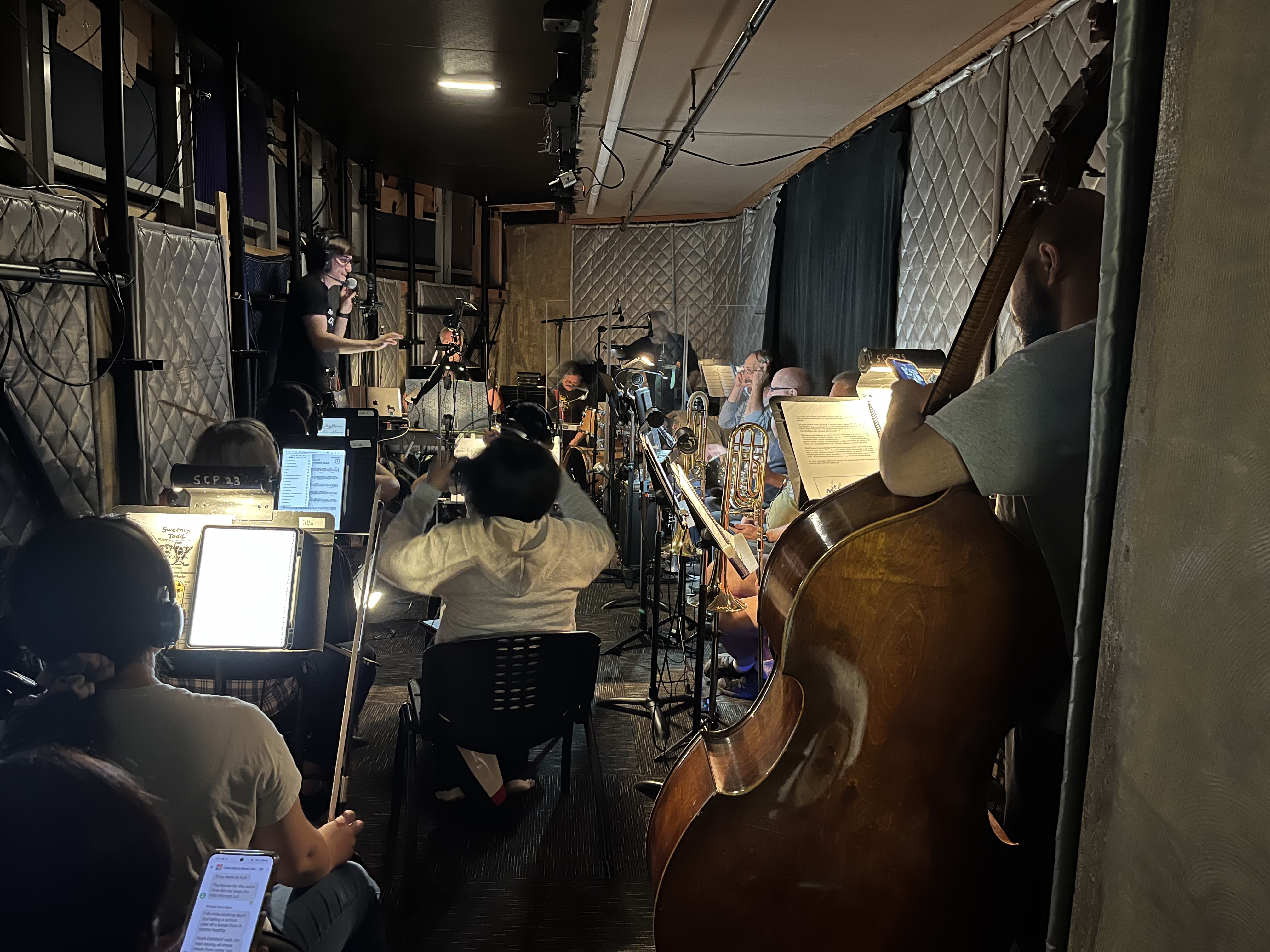 Zvinyatskovsky’s Sweeney Todd orchestra of 20 players per performance includes:
Music Director/Conductor: Val Zvinyatskovsky
Keyboard 1 (Organ/Celeste) – Ruiran Xun / Amanda Ku
Keyboard 2 (Harp) – Greg Goebel
Violin 1 – Jaime Yuen / Faye Yang
Violin 2 – May Yoneyama / Karen Law
Viola – Marilyn Anderson
Cello – Zoe Lin / Karmen Peng
Bass – Thomas Calamia
Reed 1 (Flute/picc/recorder) – Asa Stern / Diana Tucker
Reed 2 (Oboe/English horn) – Vicky Xiong
Reed 3 (Flute/Bb, Eb, C Clarinet) – Mark Beyer
Reed 4 (Bb/Bass Clarinet) – Jordan Selburn / Kathy Switky
Reed 5 (Bassoon) – Gail Selburn / Noah Cort
Horn – Jim DeLoach / Joe Kelly
Trumpet 1 – Jose Sanchez
Trumpet 2 – Ken Thomas
Trombone 1 – Jason Loveman
Trombone 2 – Ken Rydeen / Doug Brown
Trombone 3 – Miguel Ledezma
Percussion 1 (Mallets) – Martha Garcia
Percussion 2 (Kit) – Peter Wallack
 The show runs from 28 October – 12 November at the Sunnyvale Community Theater located at 550 East Remington Dr., Sunnyvale, CA 94087. To order tickets, see the SCP website.
Due to the mature themes and language, it’s suggested for audiences aged 13 and above. The show runs about 2:45 with one intermission.
With respect to COVID-19 safety policies, SCP strives to make their theater a safe environment for the public and requires patrons to wear masks while inside the theater during performances, but proof of vaccination is not required. While the policy could change, ticket purchases confer an agreement that patrons will adhere to the masking requirements in effect at SCP at the time of the performance for the safety of all attendees. Even if the masking requirement is rescinded at some point, masks would be strongly encouraged when inside the theater. The actors and most of the musicians will not be masked while performing, but they are regularly tested.
References:
https://agoodreedreview.com/2023/10/10/the-sweeney-todd-orchestra-adventure/
https://agoodreedreview.com/2019/10/23/urinetown-is-it-satire-or-a-look-ahead/
Sweeney Todd Video
A Good Reed Review gratefully accepts direct donations via PayPal to help defray the costs of maintaining this site without creating paywalls.

 A Good Reed Review