 By Ande Jacobson
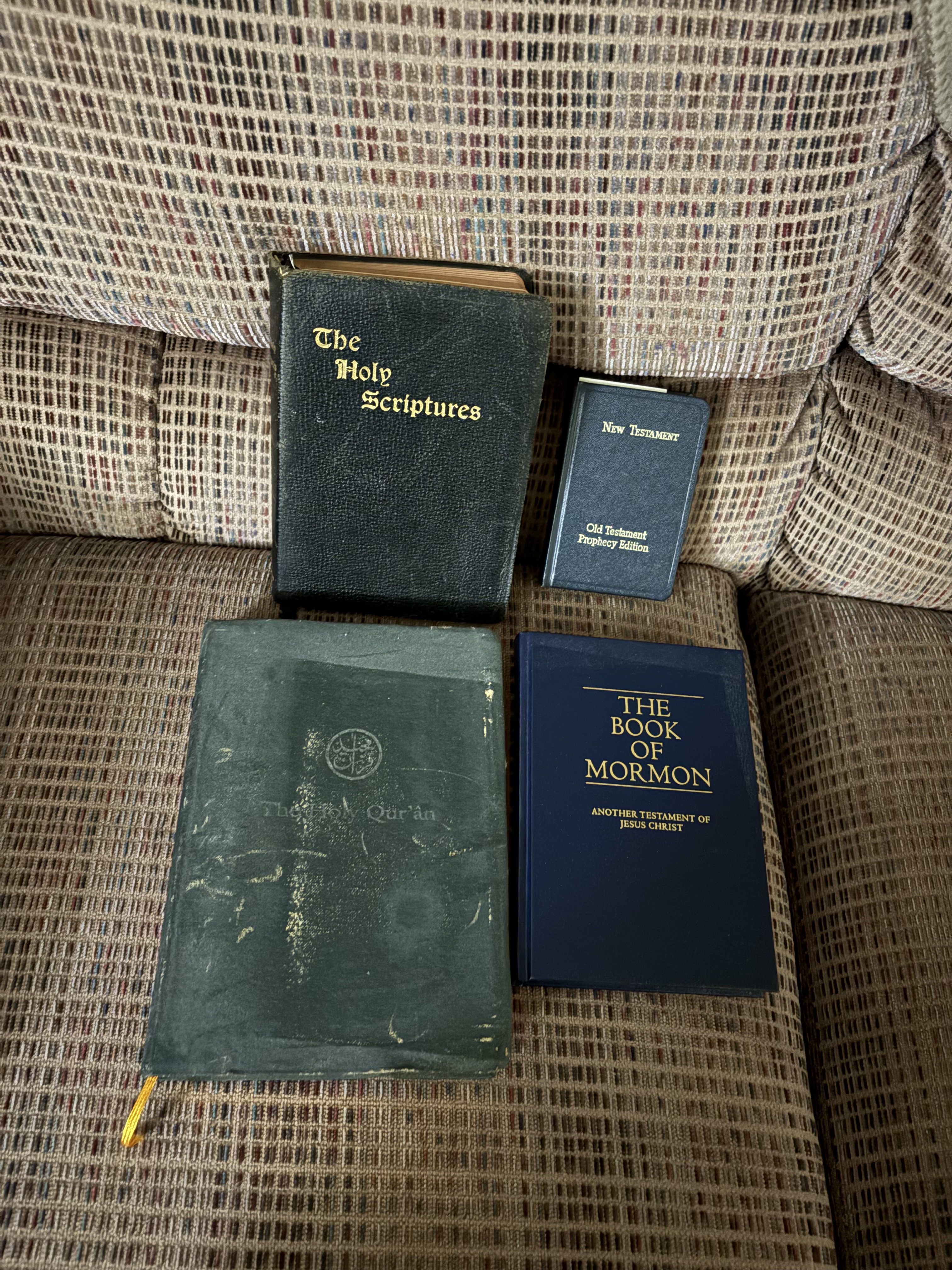
I don’t have any faith in any supernatural being(s) based on everything I’ve learned throughout my life, although based on observation, I came to that conclusion in childhood. I have studied science and rely on the scientific method in my exploration of the world around me. I have also studied religion growing up, not just the faith in which I was raised, but others as well. I have copies of numerous religious texts including an Old Testament (from which the Torah is drawn), a New Testament, a Qur’ân, a Book of Mormon, a Haggadah, and a Union Prayer book. I view them as literature written by men reflective of the times in which they were written. I do not view them as supernatural or divinely inspired. They are books, and as such, they are food for thought as are all books.
That said, I don’t care what others follow with respect to religion so long as they don’t force it on me. As my mother used to say, “Your free space ends where my nose begins.” In other words, with regard to religion anyway, I have tried very hard to hold to a live and let live philosophy. I may not agree with somebody’s view of the world, but I can accept that they see things differently than I do so long as they reciprocate that level of tolerance. Where my tolerance ends is with intolerance.
In the US, our First Amendment rights include the freedom of religion meaning that the government cannot force any religion on anybody. As such, freedom of religion can also mean freedom from religion if that is one’s choice, and that has always been my preference.
I have a few extended family members and some good friends who are very religious representing various faiths. For the most part, they respect my boundaries, and I respect theirs where religion is concerned. We still have philosophical discussions from time to time that veer into religious territory, but they aren’t for the purpose of trying to convert each other. They are merely the exchange of ideas in a more academic sense.
When I was in university, my freshman year college roommate was very religious. She was a Baptist, and she was very comfortable with her own beliefs. She didn’t feel the need to threaten, proselytize, or otherwise force her beliefs on others. Like some of my friends later in life, she was happy to discuss matters of faith in a friendly manner if somebody was interested, but she didn’t generally bring it up. Spring quarter that year, she was taking a bible as literature class as one of her humanities electives (she was a physiology major destined for medical school). We had several deep, philosophical discussions based on her class that quarter, generally at around two or three in the morning. I’m not sure why those discussions needed to happen at that time, but that’s when they occurred. This roommate was the exception unfortunately.
Outside of these friends and family who are not oppressive in their religious fervor, I’ve experienced a great deal of negative pressure from religious individuals at various times in my life. As an undergraduate, I ran into several obnoxious religious folks who were extremely obtrusive in foisting their beliefs on anybody they could corner. I had a few friends like that in high school as well, but it got much worse overall in college, except for my freshman year roommate.
Later in graduate school I saw a further escalation of religious fervor. One day, I was taking a walk by myself in my neighborhood near my apartment. A man several years older than I was at the time came up to me while I was walking and offered me some Christian pamphlets and a bible. I politely told him that I wasn’t interested and continued walking. He paced me and continued trying to get me to accept his literature. I quickened my pace. He matched my stride, and then he started yelling at me and calling me several profane names, a few of which I hadn’t heard before. I quickened my pace some more. He quickened his. This went on for 10-15 minutes. Finally, I got to a grocery store and ducked inside. Fortunately he didn’t follow me into the store. I wandered the aisles for several minutes hoping he’d lose interest and go away. By the time I ventured outside, he was gone, but that was unnerving. This was in the mid-1980s, so there weren’t any cell phones to document the encounter or to call for help. Oddly, while I should have thought about his possibly being dangerous, I was mostly annoyed that he wouldn’t leave me alone. Were that to happen today, I would whip out my cell phone, snap a picture, bolt, and call 911 because it really could have been a dangerous situation.
All that said, from my personal experience I’ve seen a very dark side of religion used as a cudgel to try to force others into complying with a narrow lifestyle that excludes any variation. This is the direction the Christian nationalists are trying to force the US toward. Their goal is to make the country into a Christian theocracy where everyone has to comply with their interpretation of how people should live. Anyone not following their strict rules would be punished. One of my very devout friends was surprised by my experience. She assured me that her experience was far different and that it didn’t represent the Christianity that she practiced. Still, as I noted in a recent essay, her version of Christianity isn’t quite as accepting or benign as she proclaims. Whenever a religious follower or organization tries to force others outside of their faith to comply with their restrictions, that’s when things can spiral negatively. In that form, it limits thinking. It denies exploration of the world around us. More importantly, it ostracizes those who are different, and it allows extreme cruelty to enforce compliance. That is dangerous.
It is one thing to follow a strict set of religious teachings personally. That is a person’s right. If that gives them purpose and solace, great. If that makes them a more caring person, even better. What nobody should have the right to do is to force others into complying with their religious practices. In the US, our laws are based on the Constitution, not religious texts.
One thing that has always bothered me about various types of Christianity in particular is that many of the practitioners I’ve encountered often are driven to proselytize relentlessly which shows a complete lack of respect for others. It is one thing to have a religious discussion with someone who has asked for one or is receptive to that encounter. It’s quite another to force such an encounter. Numerous religious warriors have come to my home uninvited over the years. When that has happened, I generally tell them up front that I’m not interested, and I ask them to please leave. If they simply turn and go, that’s the end of it. Generally that doesn’t happen, and instead they try to argue with me. That’s when I can be less than nice. Since grad school, this brings back memories of that disturbed fellow who tried to accost me with his religion while I was out walking and minding my own business. In the case of the religious door knocking, it’s even more intrusive than a random encounter on a public street. They’ve intruded on my private space and tried to force something on me that I do not want.
In cases when someone’s (or some group’s) belief reaches a radicalized fundamentalism where only their view matters and all others are to be expunged, that’s dangerous. The sad thing is that it can happen with any faith if the beliefs are not just adhered to but projected outward such that no other belief is tolerated not just within their community but in general. We see it among various theocracies worldwide where non-believers are often tortured or even killed, and we see it among a number of extremists in the US who are trying diligently to turn the country into a Christian theocracy that resembles their particular brand of religion, one that oppresses all but straight white Christian men. As Richard Dawkins points out in his book, The God Delusion, even mild or moderate religion creates an environment where absolutism (or religious extremism) can flourish. That’s not to say that there aren’t some religious organizations doing good work that helps vast numbers of people. That is to say that once religious tenets are taken to the extreme, the danger of oppression and worse often follows.


