With all of the turmoil in today’s world between the vile political battles between the forces of democracy and authoritarianism, the constant stream of crises in the news on an hourly basis, and the displacement of millions of people due to crime, war, and the ravages of climate change, it’s sometimes instructive to think of times when the immediate future didn’t seem so dire. We have made tremendous progress over the last century, but with that progress comes some extreme pushback by those not ready or able to accept change. When I get overwhelmed by the bad news that just doesn’t stop, I think back to my childhood. I wouldn’t want to go back to that time again or live under the restrictions of childhood, but I am comforted by pleasant childhood memories and the love that my family shared. Continue reading →
After hearing about the Tabard era coming to an end, I thought back on some of the community theaters that used to thrive in years past. One such community group was The Shoestring Theatre Company, later renamed Shoestring Family Theatre. Shoestring was a little different than most theaters. It hearkened back to what community theater was in a bygone era. The Andrews family was the driving force behind Shoestring, and they got the whole community involved.
Shoestring spent most of its tenure affiliated with the Presbyterian Church of Los Gatos (PCLG) serving not only their congregation, but the local community in the area. Unlike so many groups, Shoestring took all comers. Everyone came to audition, and the Andrews family (who served as producers, directors, and choreographers in addition to being in the shows) would then cast the productions based on those auditions. They used to double cast their shows for a good part of their history giving as many people a chance to shine as possible. Their productions were all family friendly and infinitely expandable to allow for large ensembles and audiences of all ages. Their shows included Seussical, Cinderella, Annie, The Wizard of Oz, and whole host of others that were equally applicable. They ended up with performers with a wide range of talents and experience, and every year, they made it all work. The other truly unique aspect of their shows was that their casts were intergenerational with children and adults working together on every show.
Everyone could participate, and for most of their tenure, there was no cost barrier to attend or perform in Shoestring shows. In fact, for most of their existence, Shoestring didn’t even have tickets. People could just show up for performances, and there was also no participation fee for the performers. There was an expectation that the performers (or their families) would provide some sweat equity in their productions by pitching in with things like set building, painting, child wrangling, providing goodies for the green room and/or the snack tables during intermission at performances, etc., but the group thrived on donations and grants from a very appreciative community.
While Shoestring was at PCLG, they performed on a small stage in the social hall. They also used live orchestras, including musicians from the church’s congregation and others from around the community. I had a connection to Shoestring early on, not through the church, but as a music director for a few summers, and for that, I owe them a debt of gratitude. As I wrote in Part 5 of my Magical Musical Journey my first time as the director for a pit orchestra was a production of Seussical that came about because of a fluke of timing. A musical director for whom I’d played numerous times got himself in a bit of a scheduling pickle and ended up handing me the baton and his orchestra in which I was supposed to play. My first action was replacing myself in that orchestra, and then learning everything I needed to know about directing as quickly as possible. I talked a bit about the uniqueness of the theater group in that earlier essay, but what I left out was that the group was The Shoestring Theatre Company of PCLG.
After Seussical, I continued serving as their orchestral music director for three subsequent shows including Cinderella, Children of Eden, and Once Upon a Mattress, all of which turned out well and played to very appreciative full houses. That church social hall wasn’t a luxurious theater setting. It was more a multipurpose room, but in the midst of the shows with theater lighting and music in the air, audiences were swept into the stories unfolding on stage.
Shoestring eventually had to move out of their church location and spent two years affiliated with the Addison-Penzak Jewish Community Center (JCC) where a number of their performers were affiliated. Finally, they moved out into the commercial world and performed for four summers before the pandemic lockdowns at the Historic Hoover Theater in San Jose. They reopened with a production of SpongeBob in the summer of 2022, but for the last stretch without sponsorship from either PCLG or the JCC, they had to start charging a small participation fee for minors along with nominal ticket prices to help cover their facility fees and show licensing, but they still kept those costs far lower than most other local community theater groups to ensure that cost wasn’t a barrier either for their participants or for their audiences.
Unfortunately in the current pandemic, AB5 environment in California, Shoestring had to close their doors this month. They resisted raising either their ticket prices or their participation fees to equal many of the other groups that have stayed afloat because they strongly believed that the arts should be available to everyone, no matter their economic status. They had been focused on the arts through community volunteer efforts as a labor of love. Even just paying their musicians had become more costly because of AB5 forcing performing arts groups to treat them as employees rather than paying small stipends in appreciation. Many other community theater companies have increased their ticket prices significantly. Audiences have been smaller as many patrons have been slow to return to crowded venues due to the pandemic, and at the same time, material and facility costs have increased.
Shoestring will be missed, but they spent over a quarter of a century serving the local community in a way few groups do in today’s challenging economic environment. With their take all comers policy, their performing artists ranged from professional performers to those who had never seen a stage before they started rehearsals. Shoestring served to introduce a lot of people to all sides of theater who might not otherwise have had that opportunity in the past. Several of their alumni have gone on to careers in the arts all because one or more of those gentle summer shows captured their hearts and minds and gave them a taste of the magic of theater early on.
A Good Reed Review also gratefully accepts donations via PayPal to help defray the costs of maintaining this site without creating paywalls.
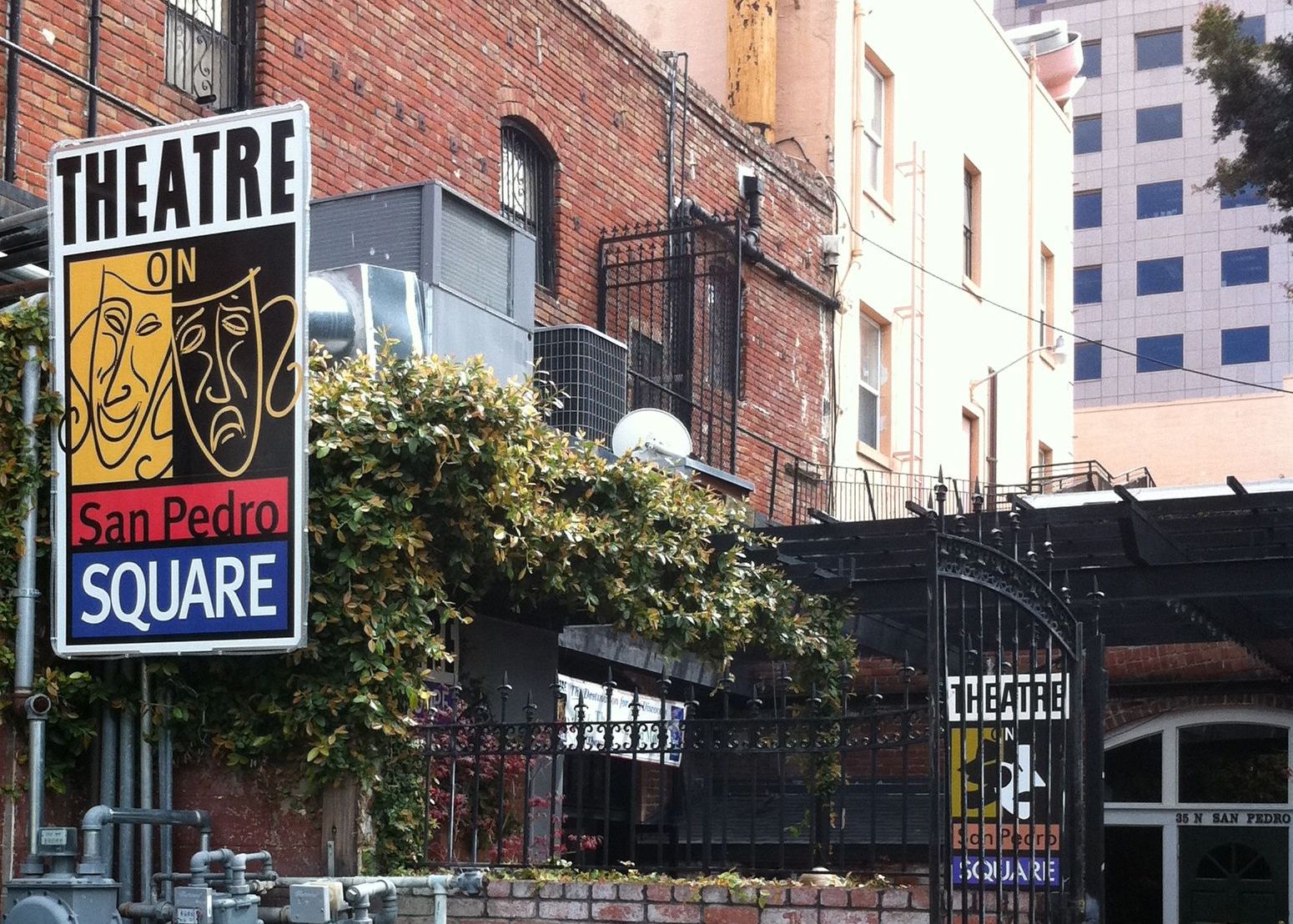
The Tabard Theatre Company has often been known as the little theatre that could. For its first seven years, it was a vagabond company, performing in various spaces and growing a dedicated patron base. Under the guidance of founding artistic director Cathy Spielberger Cassetta, the little company took on a wide variety of projects, often doing shows that weren’t available elsewhere. It was a wholesome company seeking to bring a different kind of theater to the community compared to the hundreds of other theater groups in the area. Eventually, the company settled into a unique space in San Jose known as Theatre on San Pedro Square. Tabard was the managing and resident theater company in the space although they didn’t officially change the name of the venue to Tabard Theatre until 2018. As the managing company, they not only put on their own productions, they hosted numerous guest concerts and shows in that space as well as various private events. Tabard also ran a summer youth theater program each year.
A unique aspect of Tabard Theatre is that for each of its productions, it partnered with a non-profit that shared in the revenue. The non-profit partners were generally chosen based on some thematic connection to the particular show, and these partnerships served the greater community beyond just bringing the arts forward.
In 2020, there were many changes for Tabard. After founding the company and serving as its executive artistic director for the first 19 years of Tabard’s existence, Cathy Spielberger Cassetta handed the reins to Jonathan Rhys Williams for its 20th season which began in July 2020, and we all know what else happened that year. Williams brought innovative ideas to Tabard to help the company continue to bring the arts to its audiences, albeit remotely for some time due to the pandemic restrictions. The 2020-2021 season held a full slate of productions, continuing Tabard’s history of tackling high-quality, thought provoking theater. In 2021 when the company could return to more traditional live audiences, they didn’t abandon their remote broadcasts, they often incorporated both options to give their audiences greater flexibility. I reviewed their production of Shylock remotely that summer and was pleased not only with the show itself, but with the quality of the remote presentation even though their live audience had returned, albeit in smaller numbers than before the pandemic.
The last three years have been especially challenging, not just because of the pandemic, but also because of the challenges from California’s legislative changes. One piece of legislation has been the bane of community based arts groups since January 2020 when AB5 took effect. Although that bill was aimed at the gig economy and employers like Uber and Lyft, one side effect was that community arts groups that used to provide small stipends to their mostly volunteer support had to pay at least minimum wage to every paid person, and they had to treat them as employees of the companies. This added a huge amount of overhead to arts groups that were already struggling to survive in a very high cost area.
The combination of AB5, the pandemic reducing the patron base for all live performances, and the rising rates of pretty much everything finally was too much for the little theater that could, and Tabard announced that they will be closing their doors on 2 April 2023.
A few concerts and their production of the Tony Award winning musical, Once remain on the calendar which comes to an abrupt end when Once closes and strikes its set. The show runs 10 March – 2 April 2023 and will be Tabard’s swan song presented at 29 N. San Pedro St, Ste 200, San Jose, CA 95110. For tickets, see: https://tabardtheatre.org/, call 408-679-2330, or email: boxoffice@tabardtheatre.org.
It’s sad to see the company go after so many vibrant years. I had the good fortune to play in the instrumental ensembles for four Tabard productions including The Story of My Life in 2011, The Tin Pan Alley Rag in 2012, Love, Laughter, and Linguini in 2014, and finally Sherlock Holmes and the Mystery of the Crown Jewel in 2019. All of the orchestras or bands for these productions were small combos or chamber groups that were much more intimate and integral to the shows than a more typical pit orchestra.
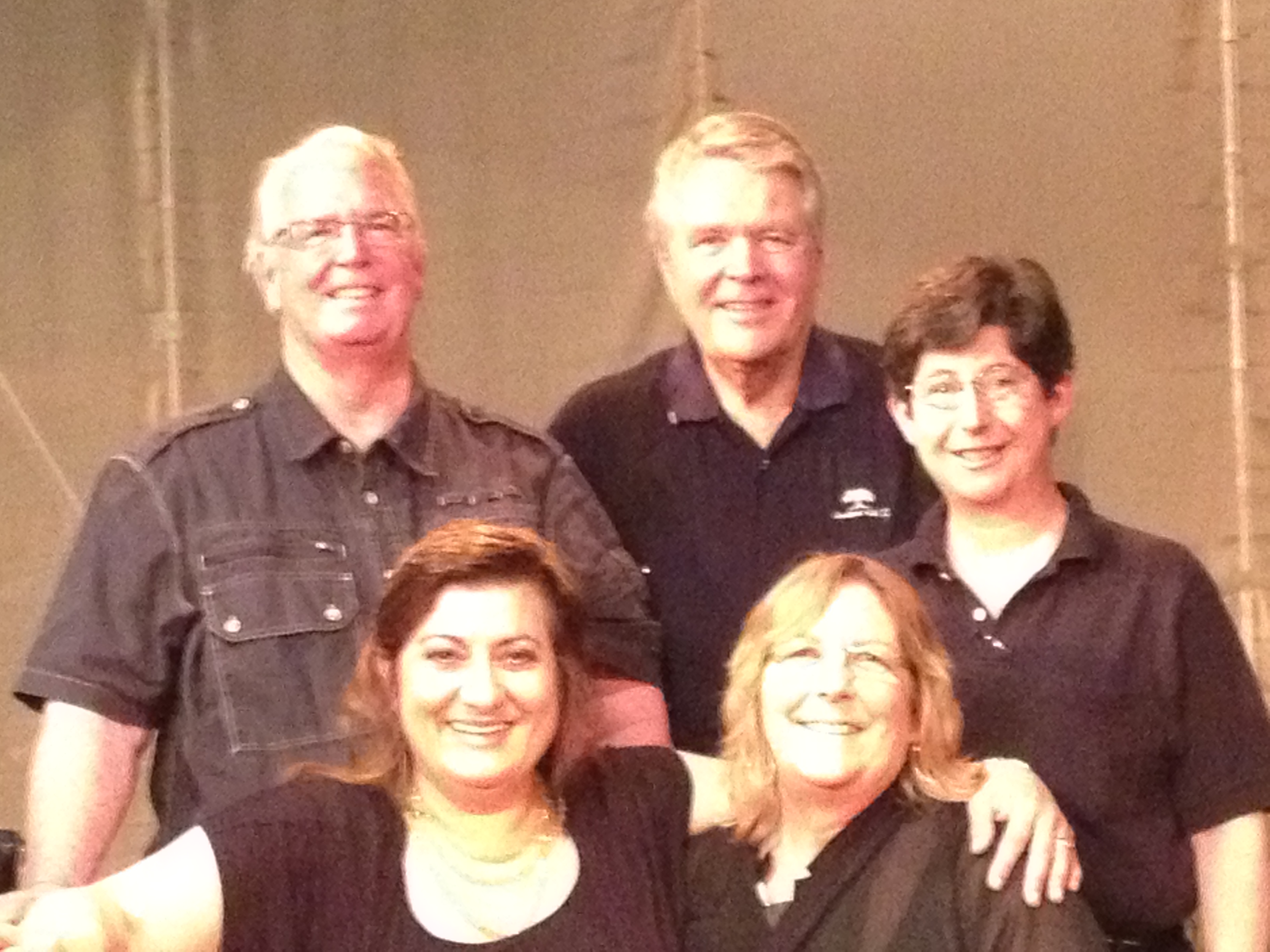
Cast and chamber trio from “Story of My Life” – photo credit: Nicolas Sancen
In The Story of My Life, the cast and orchestra together numbered five including two actors and the three piece chamber trio. For that show, the trio was often described as the third character in the story, and we were visible on stage behind a mostly transparent, beige scrim.
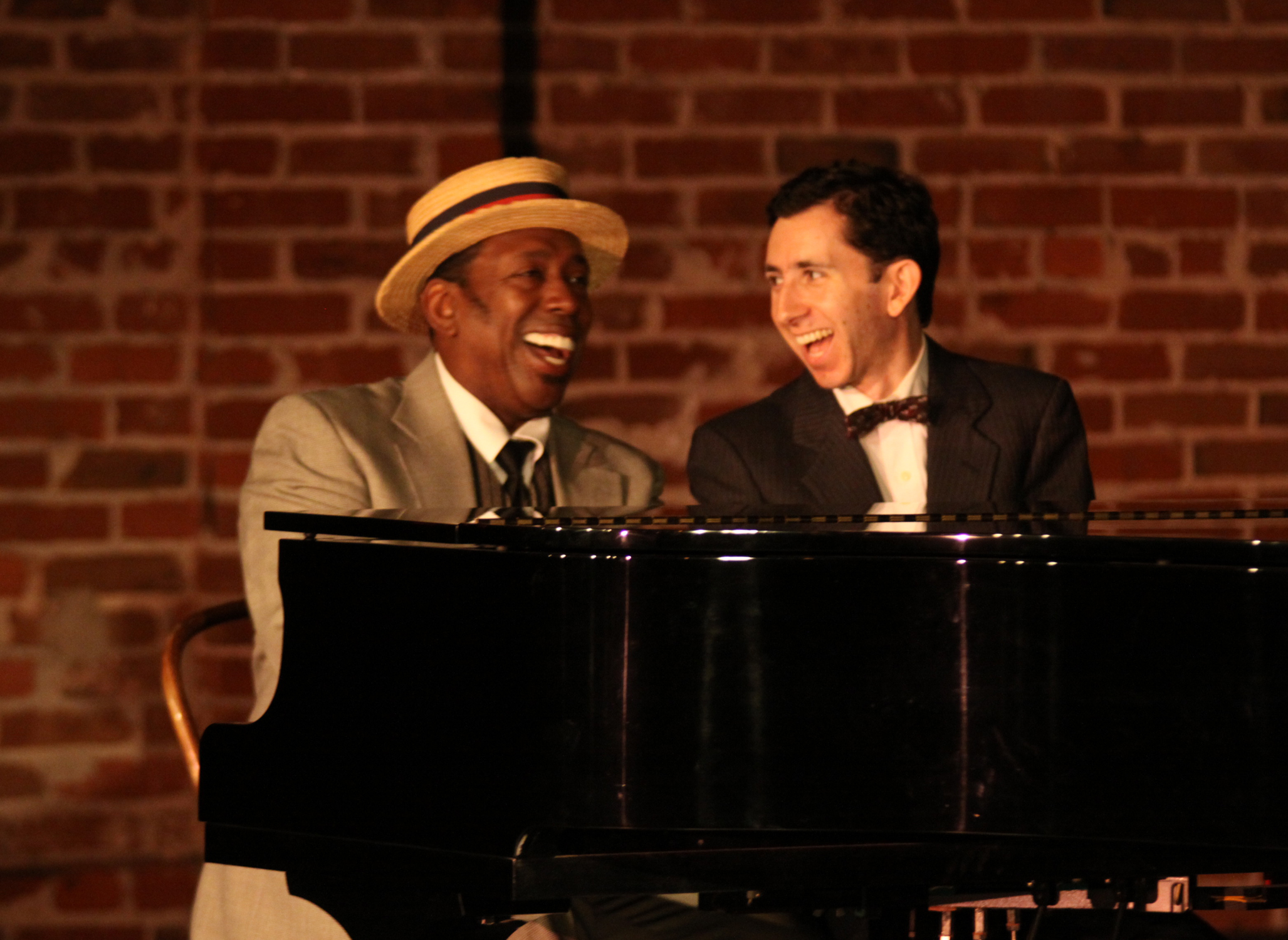
The Tin Pan Alley Rag had a relatively large cast, along with three actors who also had to play some very challenging piano music on stage. One of my favorite memories from this show was the big production number late in the second act when two of the actors and our instrumental quartet were all playing together in a lively spectacle.
James Creer and Ben D’Angelo as Scott Joplin and Irving Berlin; Photo Credit: Edmond Kwong
Our little quartet wasn’t visible to the audience as we were sequestered in a tight upstage space behind a dark scrim, but the cast knew we were there, and the audience certainly heard us.
The third show was a little different. Our ensemble was again a quartet, but this time we were part of the show and fully visible upstage of the action. The music was fun to play, and the story was a bit quirky.
The Sherlock Pit
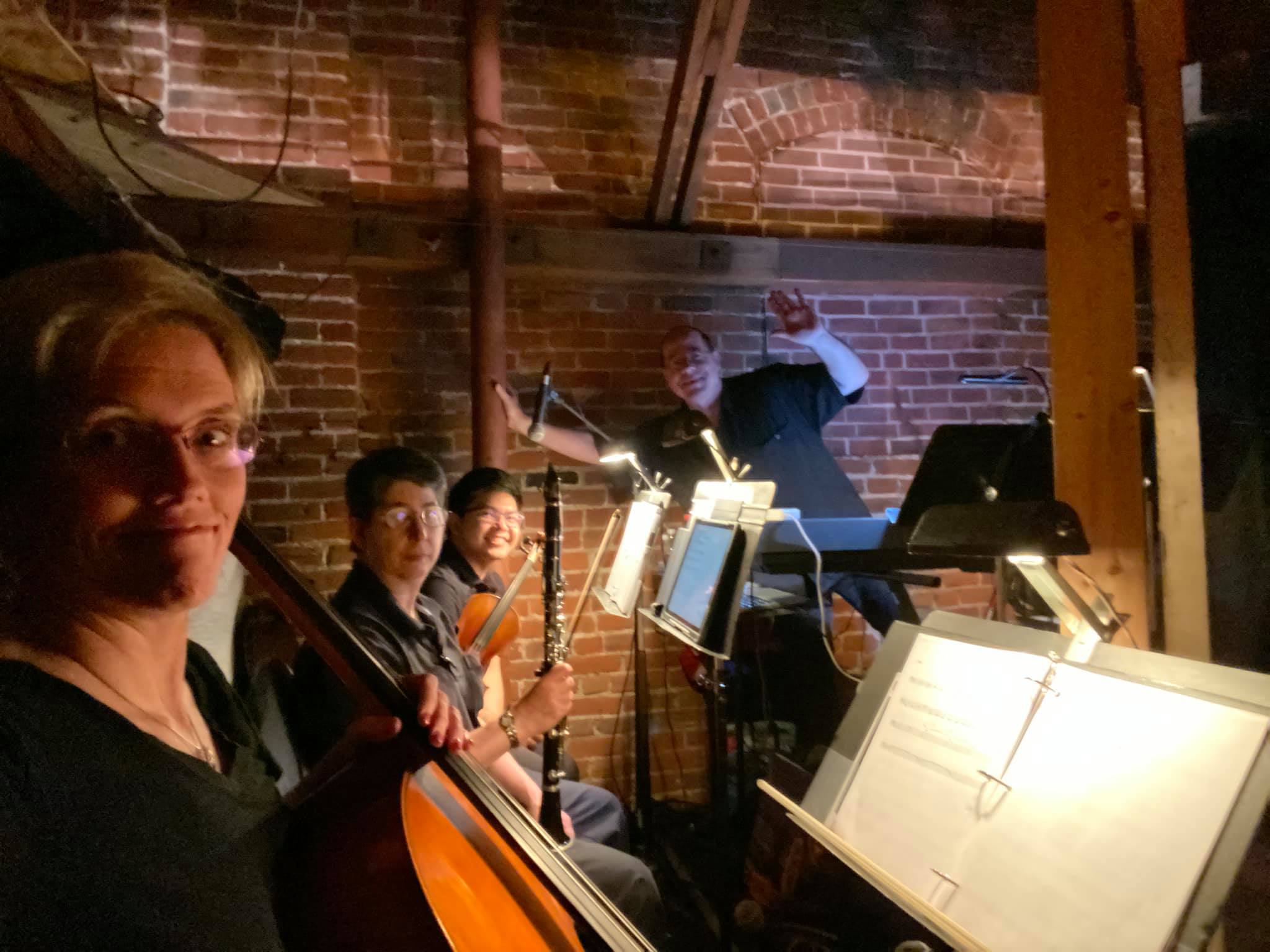
For Sherlock Holmes, we were another chamber quartet, very classical this time with piano, violin (of course they had to have a violin for Sherlock Holmes), clarinet, and cello. We were stashed in the apex of the upstage corner behind the set. We were completely invisible to the audience, but this time there was a path in front us, and a few chairs facing us where various cast members would often congregate between scenes as they awaited their next entrance. As such, we had a built-in audience backstage for that one.
Beyond playing in these shows, A Good Reed Review reviewed numerous Tabard productions over the years.
One other thing that was unique about the Tabard performance space was that the dressing rooms were two floors below the stage in the basement of the building. There was no green room as there is in most other theaters. Because of that, once an act began, the performers couldn’t leave. They’d be visible to the audience if they did, so they had to find little cubby holes behind the set when they weren’t on stage.
The Tabard Theatre Company will be missed by audiences, artists, and the community at large, but those of us who have been touched by this company over the years will cherish our memories of those special experiences.
A Good Reed Review also gratefully accepts donations via PayPal to help defray the costs of maintaining this site without creating paywalls.
Over time I have learned a few things about social media posts.
First, a surprising number of people consume the stuff I write for which I am appreciative.
Second, even something I consider innocuous or even trivial can become controversial depending on the consumer’s interpretation.
Third, it’s important to take a step back and not necessarily engage at face value. A person’s response may not necessarily be directly related to what I wrote or intended but could be a response to something my writing triggered in them or to an unstated connection they made. They experienced what they experienced. They could be reacting to that with my writing acting as a catalyst for them. No matter the reason, discussion is fine, but attacks are not.
Fourth, the way language is used today, meanings seem somewhat fluid despite what the dictionary may have recorded. This unfortunately goes back to an experiment I ran at work several years ago regarding that elusive concept of “common knowledge.” Common knowledge in this case extends to the meaning of various words or terms which may not be as universal as I thought. This makes communication much more challenging and sometimes frustrating. Continue reading →
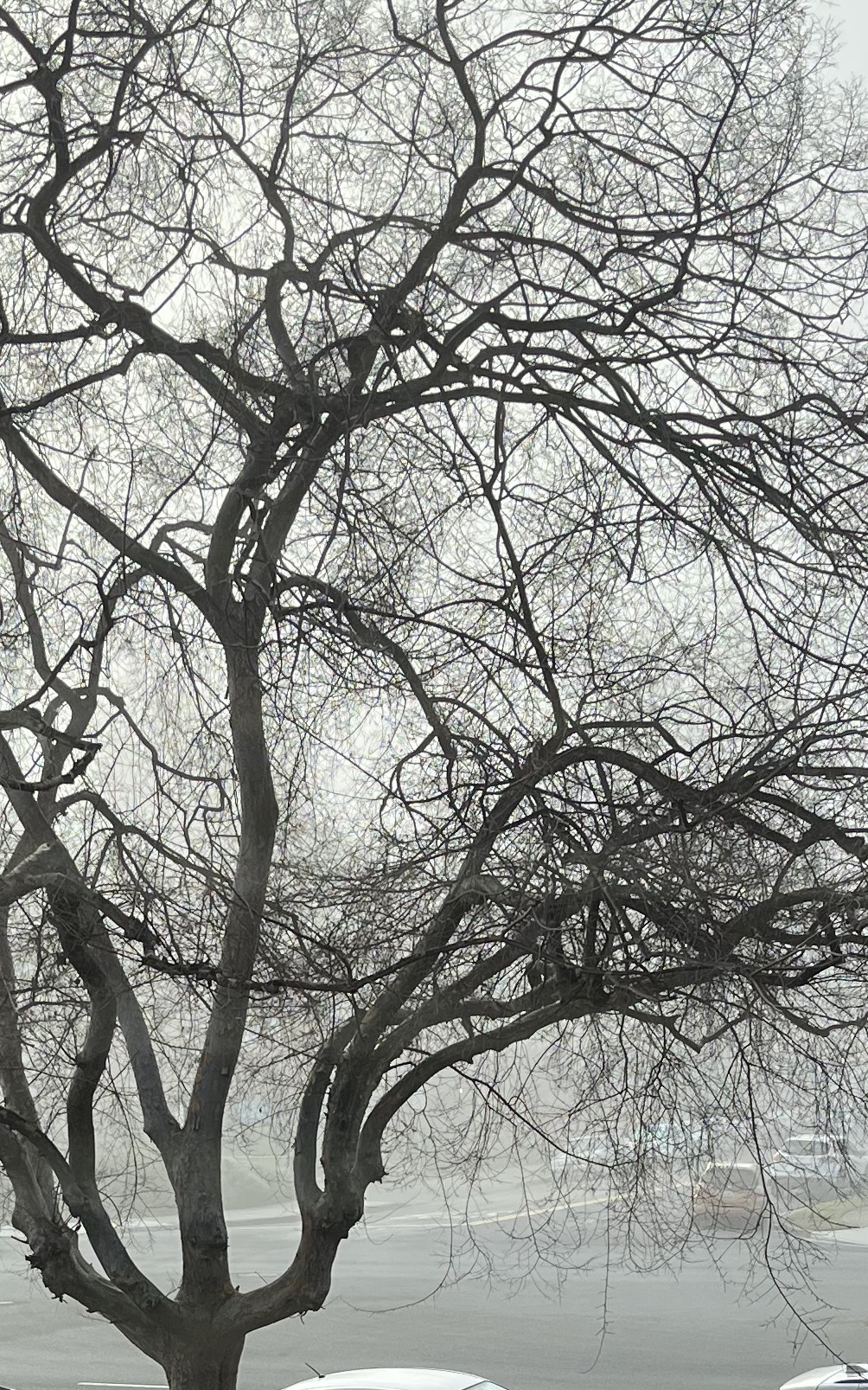
One recent morning, things seemed a little foggy. Literally foggy. Though not a common occurrence, a thick ground fog engulfed the region. While it burned off by late morning, the early daylight hours were murky. On a morning like that it was easy to get somewhat philosophical and also a little nostalgic. I thought back to my college days in California’s central valley where the tule fog season runs from 1 November – 31 March effectively encompassing the greater winter season along with a smattering of late fall and early spring. Though this recent Silicon Valley version wasn’t as dramatic as those in my bygone days, it reminded me of the times I used to enjoy walking in the mist in the early mornings. Continue reading →
Robert was restless. He looked around quickly and then took off running through the lab, climbing over various apparatus, leaping from landing to landing, until finally stopping atop a bookcase in the corner. It was late, the lights were dimmed, and he wanted to play. This was not an unusual occurrence after the scientists left for the day. Continue reading →
To welcome the New Year, 60 Minutes presented a sobering look at the negative impact humankind has had on our planet. Humankind has been too successful as a species. The objective measure of that “success” is that we have grown beyond the bounds of what the earth can support. There are too many people, and according to Dr. Paul Ehrlich, the problem was well in sight many decades ago. In his 1968 book The Population Bomb he put the crisis on food, forecasting that humanity would be unable to feed itself. Instead of working to control our population, we found ways to substantially increase the food supply. Now, while we may be able to produce enough food to feed our ever increasing world population, we cannot create space that doesn’t exist or provide enough fresh water. Through our exponential population growth we’ve encroached on natural habitats worldwide and exacerbated climate change. This combination has created the sixth mass extinction crisis where species the world over are disappearing destroying the ecological balance needed to sustain life, all wrought by too many humans roaming the planet. Continue reading →
At the beginning of a new year I sometimes think about years past, especially when a year starts off with as much chaos as 2023. Between watching the antics in the U.S. House of Representatives and the series of once-in-a-century storms in California, events can be a little overwhelming sometimes. Rather than dwelling on things that I cannot control or change, I instead ponder where I’ve been, and where I’m going. Sometimes I look a long way back. While I’m not sure what triggered the memory, I recently thought about a few oddly connected occurrences from many years ago stemming from my undergraduate years. Continue reading →
2023 completed its first week. We passed the second anniversary of an insurrection ending the U.S. tradition of the peaceful transition of power for the first time in our history, and we watched the U.S. House of Representatives put on a chaotic spectacle taking just over four days and 15 votes before finally electing Rep. Kevin McCarthy Speaker of the House. To get there, McCarthy made several concessions to the extremist faction that has taken over his party, a faction that supported the insurrection and the insurrectionists. Those concessions have been covered extensively in the media and could have dire consequences for the country as the year progresses if they come to pass. Continue reading →
King and Maxwell is the sixth and final book in David Baldacci’s King & Maxwell series, and it doesn’t disappoint. The last three books of the series, First Family, The Sixth Man, and King and Maxwell are closely coupled, each picking up where the last one leaves off. Sean King and Michelle Maxwell are looking to get back to a more normal, less life-threatening routine when they come upon a teenager running through the woods with a gun in a vicious storm. The boy, Tyler Wingo, is frantic. He’s been informed that his father, Sam Wingo, was killed in combat in Afghanistan. The trouble is that Sam Wingo is very much alive, and he’s a hunted man though it takes a while to determine that this is the case. After some negotiation and being threatened by various government and government adjacent thugs, King, Maxwell, their client Tyler Wingo, his father Sam, and a couple of innocent bystanders are in grave danger. No matter the risks, they aren’t deterred from their quest to clear Sam’s name and get him and Tyler to safety. Continue reading →
 By Ande Jacobson








 A Good Reed Review