Thinking about holidays

By Ande Jacobson

There is so much going on these days. We’re just about ready to start a third year dealing with a worldwide pandemic as we face yet another new variant in the midst of a holiday period. While that’s weighing heavily on my mind, in my solitude I think about what constitutes a national holiday. Some are obvious like the 4th of July, the day marking our nation’s independence. That one makes sense. It’s a celebration commemorating the birth of our new nation, founded on the principles of democracy where we the people voice our opinions through free and fair elections determining who serves in our representative government. This one is a truly patriotic, American holiday. Memorial Day and Veterans Day are also American holidays in honor of those who have served our country to help keep it free. Presidents Day and MLK Day honor some of our national heroes which also makes sense as far as patriotic American holidays go. Continue reading

Val is making the world a better place through the arts

By Ande Jacobson

Every so often we are fortunate to cross paths with somebody with that intangible spark that makes them stand out in a really good way. They bring enthusiasm to all they do, and they inspire others to reach far beyond what seems possible. I ran into such a person some years ago, and I’ve been amazed by what this young fellow has done and continues to do.

I first worked with Val Zvinyatskovsky when he was but 10-years-old. He played the role of Jojo, one of the leads in a youth production of Seussical that I was music directing. This particular group used live orchestras drawn from the greater musician community to give their young actors the privilege and thrill of performing in musicals in a way that would prepare them for potential careers in professional theater. Through the rehearsal process, this young actor stood out as one of the most skilled, prepared, and polished young thespians I’d seen. He not only had all of his lines and blocking down pat long before the cast needed to be off book, but his musical timing was impeccable. He never missed. Even so, it wasn’t until we got into the run of the show that I realized just how accomplished and curious this young man was. Continue reading

SJ SaxMas is back for the 27th time!

By Ande Jacobson

SJ SaxMas is returning to San Jose this December! 2019 was the last time sax players from all over the area (and beyond) gathered in San Jose to serenade audiences with wonderful saxophone holiday music. The pandemic prevented last year’s event, but this year SJ SaxMas is returning albeit a little bit smaller and more carefully. All of the players and volunteers will have to provide proof that they are fully vaccinated or a negative COVID test to participate – no exceptions. They are excited to return to make music together after such a long and unexpected hiatus. For those who want to play, the ensemble is limited to a maximum of 150 players to accommodate the COVID safety protocols in the rehearsal space and performance venues. For more information on that, see sjsaxmas.com. Continue reading

Thinking about history 80 years ago

US Navy Photo of Pearl Harbor

By Ande Jacobson

“December 7, 1941 – a date which will live in infamy….” That happened 80 years ago today. I’m way too young to have heard that speech live the day after the attack, but my parents lived through it. I was pretty young when my father died, so I don’t know much about his personal experiences growing up, but my mother told me many stories from her childhood including her recollections of their lives during the war. Although she was pretty young, she remembers the terror it created around her. She talked about the measures that the country took to support the war effort and how everyone pulled together in a way that seemed impossible even half a century later, although even as a young child she was also painfully aware of the limits of who was considered American even then. My grandfather worked for the U.S. Postal Service and was considered a critical worker. He was also just a hair too old to join the military and worked two jobs during the war to support the many dependents of the multigenerational extended family living under their roof. It was a difficult time and success wasn’t guaranteed, but they survived. Sometime later when my mother and my aunt were a little bit older, my grandmother also started working for the post office. Continue reading

Thinking about things

By Ande Jacobson

When I take my car out for a drive to keep it running, it gives me time away from my computer. These drives give me some “outside” time to think. I notice the people outside of my automotive bubble passing by on foot, on bicycles, and in other cars. Many are masked, but not all. I think about friends and family and how things have changed for all of them over the years. I think about my theater community. Before we became aware of the pandemic in early 2020, music and theater had been a primary focus in my life, much more so since I retired from my engineering career several years ago. While many in that community are now back in productions, collaborating freely and enjoying the comradery they missed for so many months, others like myself are not. There are still huge risks because of the ever looming pandemic that weren’t there before. Continue reading

Choice is important

By Ande Jacobson

The choices we make are important. We each make choices about all kinds of things every day. Some are small things such as what to eat for breakfast. Some have longer range effects such as deciding on a career path or whether to accept a particular job offer. Others are even more life changing such as choosing if or when to have a child, or more immediately, whether to carry a given pregnancy to term based on one’s own circumstances. All are personal choices, yet that last one is currently under its greatest threat since the passage of Roe v. Wade. Continue reading

Breaking the code

By Ande Jacobson

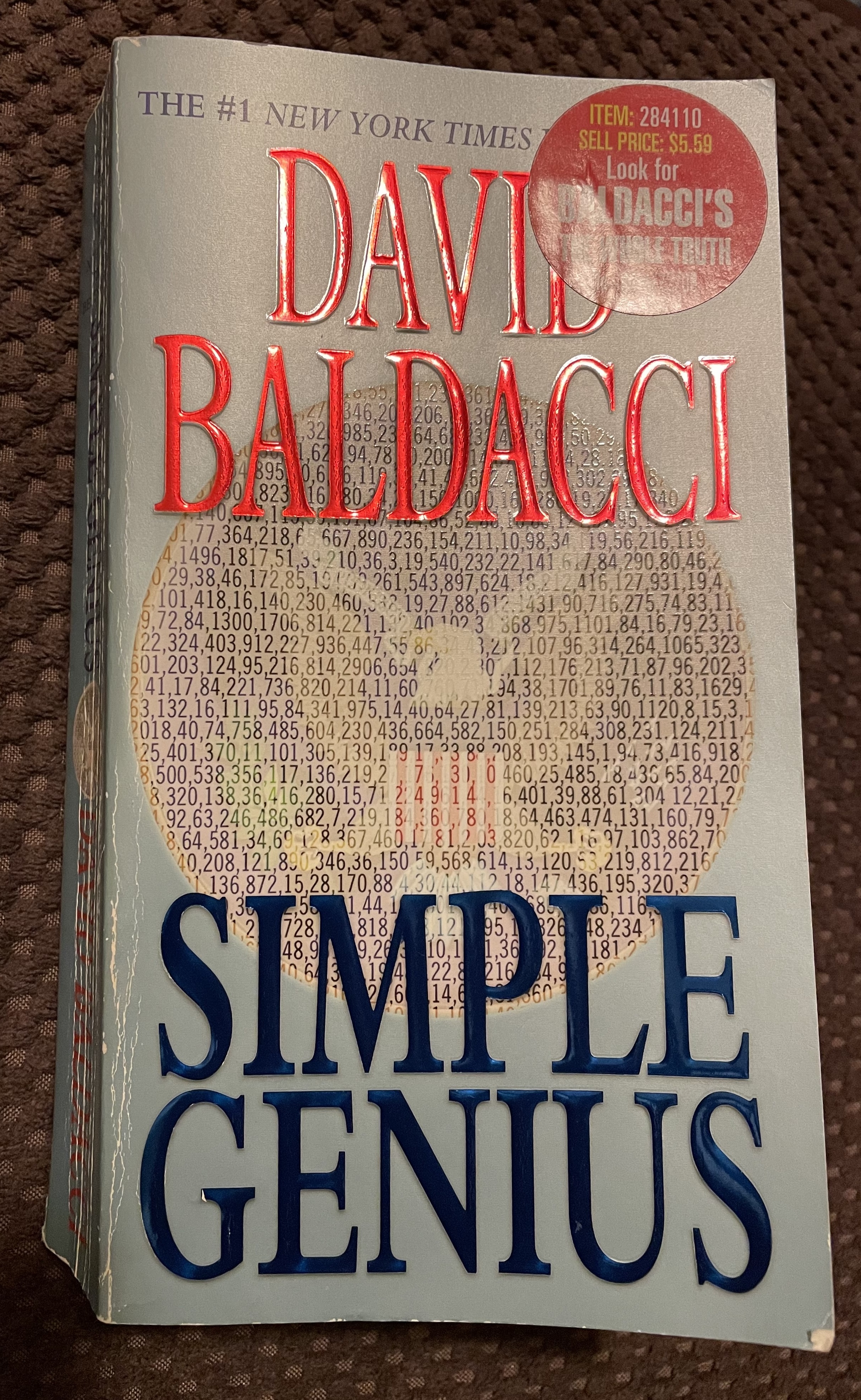
I recently read and reviewed Kate Quinn’s The Rose Code for an upcoming book club Zoom, and at the same time, I was reading David Baldacci’s Simple Genius. I had started Baldacci’s book first, but as I decided to get a jump on my book club reading, I discovered an unexpected connection. Both books feature the mystique of codebreaking and of Bletchley Park, albeit at different times in history. As mentioned in my previous review, The Rose Code takes place at the time that Bletchley Park was active during WWII and its immediate aftermath and provides the reader with riveting historical fiction. Simple Genius doesn’t qualify as historical fiction and is instead a political thriller/murder mystery, the third in Baldacci’s King and Maxwell series. Continue reading

Fog to clear – a new window to the world

By Ande Jacobson

Almost a quarter century ago, I made the decision to upgrade our townhouse. I ditched the old, mid-1970s windows and upgraded to double panes that were supposed to be a vast improvement. After all the contracts were signed, it took the installers about six weeks to complete the job (far too long in my opinion). Beyond the attractive aesthetic improvement, these new windows were supposed to provide insulation from unwanted sounds and help with heating and cooling. The claims were true to an extent. They muffled some of the outside sounds, and they also helped the furnace and air conditioning function more efficiently, although they didn’t obviate the need for either heating or cooling overall. The new windows were clean and felt a lot more substantial than the old single pane windows they replaced.

Over the years, two of the windows in the warmest room in the house eventually failed. These particular windows faced south and daily endured hours upon hours of sun beating down on them and heating them up. After a couple of decades the spacers between the panes along the bottom cracked, and the windows fogged up. Out of all of the windows in the house only these two failed, but I hadn’t realized the difference that foggy view made on my overall outlook. Continue reading

‘The Rose Code’ puzzles reach beyond the walls of Bletchley Park

By Ande Jacobson

Kate Quinn’s The Rose Code is a masterwork of historical fiction. It’s a long book at 656 pages that reads quickly as the tension builds. Published by William Morrow in March 2021, this gripping story brings Bletchley Park, the famed hub of the British effort to break the German Enigma code during WWII, and the unique personalities who worked there to life. Quinn’s fascination with history and her deft storytelling add new twists to events past as she mixes historical figures together with her vibrant fictional characters, although her fictional characters are themselves composites of real people. Her history is not names and dates but is instead about how historical events changed and complicated people’s lives.

Three women meet through Bletchley Park where they each play a part in the monumental task at hand. They come from very different backgrounds from one another and from their fellow codebreakers. Osla Kendall is a debutant originally from Canada who had been helping the war effort bending metal building Hurricanes while dating a dashing prince. Mab Churt is a self-made London shop girl with a long held secret. Beth Finch is a shy young woman in her mid-20s with no confidence in her own abilities having been beaten down by her overbearing mother.

Osla and Mab are summoned to Bletchley Park. They meet on the train on their way to report and encounter one of the more interesting characters upon their arrival. He introduces them to the colloquial name for the place – GC & CS – which he explains stands for “Golf, Cheese, and Chess Society.” They later find out that GC & CS actually stands for “Government Code & Cypher School” which makes them wonder if they are being trained to be spies.

After reporting in and being assigned to different sections of the codebreaking effort, the two women are billeted close by at the Finch house which is a short walk from Bletchley Park. While there, they start to forge a friendship with Beth and take note of her wicked-sharp crossword puzzle skills. Much to Mrs. Finch’s chagrin, Osla manages to get Beth into Bletchley Park, and unbeknownst to either Osla or Mab at the time, Beth, assigned to “Dilly’s Fillies,” becomes one of Bletchley’s top cryptanalysts. Dilly Knox, it’s later revealed, prefers to hire brainy women because they take the job more seriously without their egos getting in the way. None of them can tell the others what their specific roles are at Bletchley which infuriates Mrs. Finch.

As the story develops, the three become quite close sharing the details of their private lives and loves as well as stories of some of the mishaps and odd personalities at work while always being careful to steer clear of divulging any work secrets. When each started at Bletchley Park, they signed a draconian oath that laid out severe or even life threatening penalties for breaking secrecy. Along the way, they start a Bletchley book club, affectionately known as the Mad Hatters after reading Louis Carroll’s Through the Looking Glass. Their meetings bring together disparate personalities from their different sections of Bletchley Park for some much needed recreation. Eventually the secrecy sparks a traumatic incident that ends in a massive falling out before the war ends, but the story doesn’t end there.

The novel flips between two timelines, one through the course of WWII, and the other a few years after the war ends surrounding a royal wedding. Quinn’s attention to detail brings forward fascinating aspects of the different sections at Bletchley Park showing how the various groups’ work fits together even though none of the workers knows the full story by design. Quinn reveals the machinery used and critical skills required of the elite workforce at Bletchley. They all know they are involved in work that not everyone is capable of doing, and in their own ways take pride in their contributions to the war effort. Some of the habits they pick up through their efforts stay with them long after the war ends which comes in handy when a new puzzle presents itself and threatens one of their own.

Quinn is careful to maintain accuracy surrounding historical locations as well as the tone and urgency of the events shaping the war torn world of the early 1940s. She shows how the war wears everyone down. Despite being relatively safe in the confines of their secluded little hamlet, those at Bletchley Park fear for their friends and families who are not so fortunately located. They also suffer a bit of survivor’s guilt at times from the knowledge that although their efforts are what give the fighting forces the information they need, the warfighters are putting their lives on the line daily to carry out their missions while the codebreakers sit in their safe hamlet away from the physical dangers of the war.

What is later discovered is that spies are everywhere, and the secrecy oaths while well-intentioned are not full proof in combating all disclosure. The heart-pounding adventure continues long after the Armistice, and their codebreaking skills come in handy well after they leave Bletchley Park. Along the way, despite their wartime grudges, Osla, Mab, and Beth discover that some bonds turn out to be thicker than blood and stronger than even the worst falling out, and families can be found in many unexpected forms.


References:
The Rose Code by Kate Quinn
Kate Quinn Author


A Good Reed Review also gratefully accepts donations via PayPal to help defray the costs of maintaining this site without creating paywalls.
Donate with PayPal

The good side of Facebook

By Ande Jacobson

Growing up, we wrote letters. We also talked on the telephone, but if people lived more than just a few miles away those phone calls could quickly get expensive, much more so than the cost of a stamp. I remember when I was in eighth grade, I had a friend who was a high school junior who lived past our local calling zone, so we would write long letters back and forth. After we had been doing this for some time, I accompanied her to school one day when I had a holiday and she didn’t. Throughout the day I went to all of her classes and met a bunch of her friends, all of whom were avid Star Trek fans. She and I originally met at a Star Trek convention, so it stands to reason that many of her friends would be trekkies. After that day, her letters became a compilation of letters from all of these friends, so mine got very long in response. Even mailing these thick letters back and forth was far cheaper than it would have been to call in those days. There was no email or social media back then, at least not for the general public, but computers were beginning to be more accessible in schools and workplaces albeit in mainframe form. In fact my letter associates were all in a computer class at their school and tried to get their teacher to find a way to let me join them. He was game, but we just couldn’t work out the logistics given I was too young to drive at the time. Two of the students in that class who were part of our letter writing group had coded one of the best Star Trek games I’d ever seen, though they took it with them when they graduated. Continue reading