Cleaning House

By Ande Jacobson

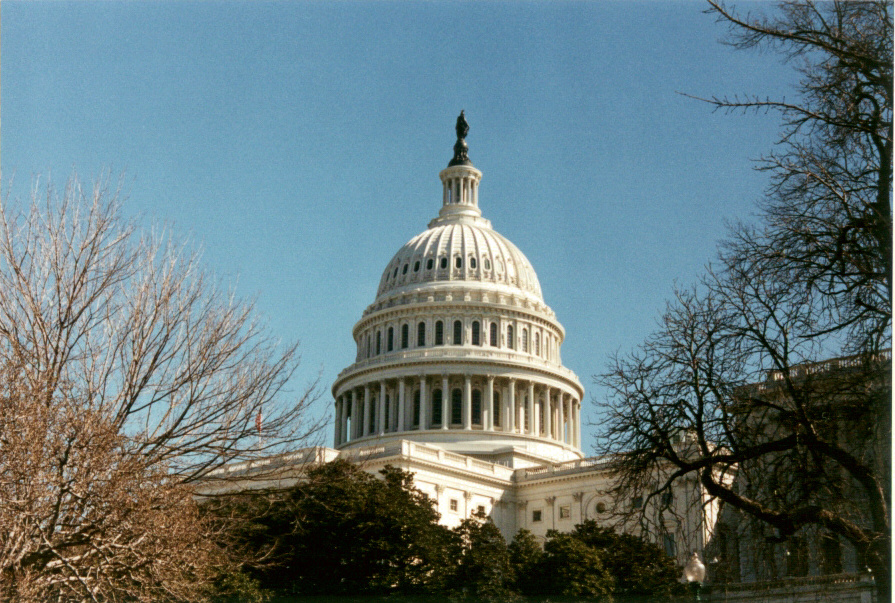
2023 completed its first week. We passed the second anniversary of an insurrection ending the U.S. tradition of the peaceful transition of power for the first time in our history, and we watched the U.S. House of Representatives put on a chaotic spectacle taking just over four days and 15 votes before finally electing Rep. Kevin McCarthy Speaker of the House. To get there, McCarthy made several concessions to the extremist faction that has taken over his party, a faction that supported the insurrection and the insurrectionists. Those concessions have been covered extensively in the media and could have dire consequences for the country as the year progresses if they come to pass. Continue reading

2022 is almost over

By Ande Jacobson

Every night (or first thing in the morning) I read Heather Cox Richardson’s latest Letter from an American. She writes her observations of the day’s events from the perspective of an historian focused on what she thinks will be important 100 years from now. Her letters often pull together disparate threads to provide a read on current events that might not always be obvious to someone not-so-well-versed in history and in which events seemingly have historical significance. One thing that she’s said many times in her various live sessions is that as an historian, she often focuses on what people say and do. This includes reading newspapers, and in her deep dives into the past, those news reports provide a fascinating view into the important events of the day. Continue reading

The 28th Annual San Jose SaxMas happened

By Ande Jacobson

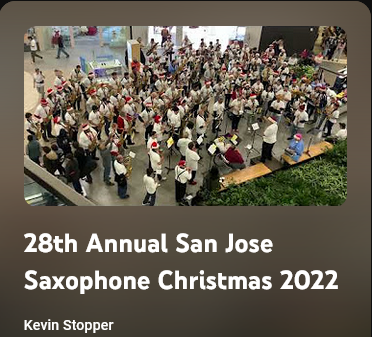
The 28th Annual San Jose Saxophone Christmas (or SaxMas to the initiated) took place on 17 December 2022. It was a tad smaller than it had been a few years ago, but it was energetic and festive nonetheless. There’s something special about so many saxophone enthusiasts coming together to make holiday music just for the fun of it.

The players came together in the morning to run through the charts, and then they gave two concerts in the afternoon. The first one was held at San Jose’s Christmas in the Park. The second concert was held at San Jose’s Eastridge Mall. Continue reading

Is Mastodon the solution?

By Ande Jacobson

I’ve written about social media before, most recently as the Twitter turmoil was ramping up. I originally joined Twitter back in 2011 mostly to help bolster my fledgling A Good Reed Review website. Originally, that’s all I used it for. Every time I’d publish a piece on the site, I’d have it appear on the site’s Facebook page and on what I considered its Twitter account. Then I got involved in politics in a more substantial way in 2020 volunteering for the Biden text team during the general election. At that point, I started using my Twitter account for more than just the music and theater related content on my website, and I started to recognize much of the good that Twitter could do. News agencies had long used it to get important information out quickly, particularly in times of crisis. The same was true for various public figures. Continue reading

Sometimes you just have to do a little Pink Panthering

By Ande Jacobson

On a gray November day when the country’s future is in the balance, it can be a little stressful. Instead of obsessively watching all the midterm returns which can’t be finalized tonight, I decided instead to put this out there in case folks wanted a break.

During the first year of the pandemic, I played with an app that many of my musician friends recommended. As a result, I created a number of collaborations with myself and added them to my Appearances page. In May of 2020, I really just needed to do a little Pink Panthering, and these were the result. Both are based on a slight modification of an arrangement from my old Sax Quartet, Peninsula Saxophonica. I like the second one best with two clarinets and a tenor sax, but three clarinets have a certain appeal, and today just seemed like a day that needed a little Pink Panthering.

Enjoy!

If you’re curious what our quartet sounded like, have a listen:


A Good Reed Review gratefully accepts direct donations via PayPal to help defray the costs of maintaining this site without creating paywalls.
Donate with PayPal

Social media again

By Ande Jacobson

With all the hype about Elon Musk buying Twitter and taking it private to avoid oversight as a private company, it seems like a good time to revisit the world of social media. I wrote a piece about a year ago talking about the good side of Facebook (yes, it can be used for good). All of the social media platforms have one thing in common, how one uses them determines one’s user experience. Every platform can be used for good or ill, but a user can avoid most of the effects of the algorithms and advertising by using them deliberately. In this case, deliberate means not “doom scrolling” and leaving what they see to the manipulative algorithms but instead consciously choosing what content to view.

On most social media platforms, a user makes connections or follows various people and pages. To use social media platforms deliberately, one can search for or bookmark their favorite pages and go directly to those. Alternatively, one can start with their own profile and pick from there. Hiding ads also reduces the number of ads one sees pretty effectively. Continue reading

Cultural shifts and quirks

By Ande Jacobson

In a recent live session, Heather Cox Richardson talked about the evolution of the “Dark Brandon” meme that’s been taking over various social media sites in the last few weeks. It’s got a curious history that will very likely be dropped by future historians because it is tied to a potentially transitory cultural moment that originated through a vulgar verbal attack, shifted to a positive superhero context by co-opting the original intent, and may shift again before it disappears into the ether forever. The details of this meme/cultural reference while curious aren’t unique. She illustrated the point further by recalling various sayings or items such as the meaning of red telephone on a desk that anybody over about age 55 or 60 would know immediately, but somebody under 40 probably wouldn’t. What was once known as “common knowledge” has become increasingly less widespread as our diversity increases, but thinking about the whole concept of common knowledge as it applies to cultural familiarity, I am reminded of an entertaining incident and subsequent informal study I conducted many years ago. Continue reading

What is an expert?

By Ande Jacobson

With the advent of the internet, and more recently the widespread availability and influence of social media, what constitutes an expert has been challenged in the media and in the public sphere. The online dictionary, dictionary.com, defines expert as follows:

noun

  1. a person who has special skill or knowledge in some particular field; specialist; authority: a language expert.
  2. Military.
    1. the highest rating in rifle marksmanship, above that of marksman and sharpshooter.
    2. a person who has achieved such a rating.

adjective

  1. possessing special skill or knowledge; trained by practice; skillful or skilled (often followed by in or at): an expert driver; to be expert at driving a car.
  2. pertaining to, coming from, or characteristic of an expert: expert work; expert advice.

verb (used with object)

  1. to act as an expert for.

That definition is in keeping with other more traditional dictionaries, but in practice why does it matter?

In this information age, anybody with a connection to the internet can search for answers to any question imaginable or pontificate their own claims on myriad publicly visible platforms.

Just because somebody writes or speaks with assurance doesn’t automatically mean they are an expert or even that they necessarily know what they are talking about. Possessing academic credentials alone doesn’t guarantee that the speaker or writer is an expert either. Further, having purely academic credentials isn’t always necessary for somebody to gain proficiency or even expert level knowledge in a discipline. Mentoring and apprenticeships can be effective ways to learn and hone expert level skills in areas as varied as the performing arts to vocational trades or even some more academically oriented pursuits such various types of engineering. It depends on the quality of the mentor, the aptitude and dedication of the mentee or apprentice, and the educational requirements of the discipline.

Licensing can provide an additional level of oversight to help ensure that practitioners follow approved ethical standards and demonstrate competency in disciplines where public health or safety are concerned, but those standards are only valuable if they are enforced. Numerous fields require extensive formal training and licensing such as those in medicine, law, the financial industry, and various engineering disciplines, but there are also abuses which have become far more publicly visible in the current data jungle.

Reputation matters as long as it is built on actual accomplishments and facts. On this I’m reminded of one of my mentors from early in my career as a software/systems engineer. I had more than entry level academic credentials having received baccalaureate and master’s degrees from the University of California at Davis and San Jose State University respectively. What I lacked was program-specific domain knowledge which wasn’t taught in school. My mentor was 16 years my senior, and while his academic background stopped at the baccalaureate level, he had extensive domain knowledge. He was also looked upon as one of the system gurus in our corner of the world having designed numerous complex systems and having solved some of the most challenging problems along the way. He was the guy everyone sought out when they needed help, and I was fortunate to have been assigned to work with him.

He was going to leave big shoes to fill. In our work together, I had an intimidating amount of material to internalize and master before he left leaving our area of responsibility to me alone. I was acutely aware of how much I didn’t know as I tried to learn as much as I could as quickly as possible while often feeling like Sisyphus. Unlike many others in our field, my mentor didn’t hide information to elevate his position. He shared freely helping others to understand the technical details to whatever level they were comfortable. After working together for a few years, he left our program and moved back home on the opposite side of the country, but we stayed in contact.

One night when I was on an extended trip to his location on his old program, we met for dinner. I commented that while I had very much enjoyed working with him, I never felt like I really understood enough about our system. I knew that I still had so much to learn which of course was much more challenging now that he was on another program. He looked at me dumbfounded. While he was more than willing to share and help anybody however he could, he wasn’t one who handed out compliments very often. This made his response all the more stunning. He told me that when we were working together, I learned so fast that it was scary. I could see so much that I didn’t know, I hadn’t understood how much I truly had mastered until that conversation.

Part of the reason I was on this particular trip was to staff a tiger team to tackle a massive multidisciplinary technical issue. I had carte blanche to tap whoever we needed, and my mentor introduced me to all the heavy hitters in our division no matter their program at that time. It took us a few months, but we ultimately solved the problem. As an added benefit, the connections I made from that team were invaluable on many other endeavors down the line.

My mentor was an expert in his field as were the other experienced engineers we pulled onto our tiger team. Their expertise stemmed from their training, their work experience, and their proven unique abilities to adapt and extend the system in ever new and ambitious ways. I learned a lot from them. While I was good, they were great, yet they treated me as one of their own.

In my engineering work, experts were recognized as such over a period of time based on empirical data. In today’s ever more intrusive information ecosystem including traditional media, social media, and personal platforms, expert claims across all manner of disciplines abound. The problem of course is deciphering the factual claims from the fantasies. To make matters worse, bad actors often attack those on public forums whose claims counter their fictitious ones with facts.

Even if we accept everyone’s credentials as valid, that still doesn’t automatically mean their “expert claims” are deserving of any note. We have to look beyond the surface of the claim at their motivation for making it and at factual data supporting it. As always, the facts matter. There is no such thing as “alternative facts.” If a self-proclaimed expert makes a claim that is not supported by reputable, fact-based sources, then that claim should become suspect as should the person making such a claim.

My personal experience in dealing with experts runs across multiple fields including engineering, music, and even writing. I’ve written about some of my other mentoring experiences from the mentee side in Part 5 of My Magical Musical Journey and from the mentor’s side in this profile piece.

Through my personal experiences, I’ve noticed a couple of interesting things about the experts I’ve encountered. They all seem to be willing to share their expertise to help others, and they don’t belittle people. While I’m sure that’s not any kind of absolute characteristic required to be an expert, it seems like it might be a good prerequisite.


Additional Reading:
https://psycnet.apa.org/record/1993-40718-001
https://www.bbc.com/news/magazine-26384712
https://www.ncbi.nlm.nih.gov/pmc/articles/PMC3925425/
https://twitter.com/i/broadcasts/1OdKrBXwlYXKX
https://agoodreedreview.com/2021/03/13/my-magical-musical-journey-part-5-practice-performance-and-repeat/
https://agoodreedreview.com/2021/12/11/val-z-profile/


A Good Reed Review gratefully accepts direct donations via PayPal to help defray the costs of maintaining this site without creating paywalls.
Donate with PayPal

The world I want to live in

By Ande Jacobson

With so much predation going on these days, I often think about a different place where humankind has evolved beyond its constant quests for power and control. The U.S. is in the throes of a struggle for its future. It’s possible that in 2023, the country could be completely unrecognizable, although many of us already find it so, but not in a direction that we want to be going.

So what would I like to see? I would like to live in a world where humans have stopped being a predatory species preying upon one another whether through physical violence, economic exploitation, or supremacist goals. In this world, humans will have realized that while we may have some superficial differences in customs, preferences, or even physical attributes, we really are all the same, and nobody is any better than anyone else. Humans will have come to realize that it helps us all if nobody has to suffer. Continue reading

Hypocrites R Us

By Ande Jacobson

This month has shown us the full range of hypocrisy in our nation’s highest court. The court’s majority claims to be “originalists” beholden to the Constitution, yet their rulings belie this claim instead showing them to be radically reactionary basing decisions on ideological or religious goals.

  • Carson v. Makin (6-3): The SCOTUS majority completely disregarded the separation of church and state in their decision allocating public funding to religious schools in Maine. This goes counter to the First Amendment and allows the government to directly fund religious teaching with taxpayer dollars.
  • New York State Rifle & Pistol Assn., Inc v. Bruen (6-3): The SCOTUS majority took away state’s rights to enact restrictions based on common sense gun control measures such as limiting who can carry a concealed weapon. Restrictions on gun ownership are well within the framework of the Constitution’s Second Amendment which is mute on private gun ownership or where one can carry a gun. As a result, this court majority imposed a federal mandate which will undoubtedly increase gun violence not based on any Constitutional rights.
  • Vega v. Tekoh (6-3): The SCOTUS majority determined that people arrested by police have no recourse if they are not read their Miranda Rights upon arrest. This pushes us further toward turning the U.S. into a police state.
  • Dobbs v. Jackson Women’s Health Organization (6-3): The SCOTUS majority took away federal protections on a woman’s right to choose when or if to carry a pregnancy to term throwing that legal authority to the states. That means that a woman’s most personal decisions related to their own reproductive freedom will depend upon their state of residence.

These recent decisions show these wildly unpopular majority opinions are not based on precedent or the Constitution but instead are based on an ideological agenda that goes counter to our legal foundation. These decisions will target women, racial minorities, and people of limited financial means most dramatically, unfairly putting their lives at unnecessary and often preventable risk. Continue reading