TheatreWorks presents the cure for holiday hype – ‘The Santaland Diaries’

By Ande Jacobson

During the holidays, the hype and family togetherness can sometimes be just a little overwhelming. It seems that it’s all about the kids, and the presents, and the singing, and the egg nog. Instead of drowning in that last one to escape, there is another remedy for someone seeking something that’s just a little less saccharine – The Santaland Diaries. What started in 1992 as a NPR holiday tradition that catapulted memoirist David Sedaris to international fame, has reached the TheatreWorks stage in their “alternate” holiday production this year. Joe Mantello adapted Sedaris’ essay into a full one-act, one-man play in 1996, and it has enjoyed seasonal success in regional, college, and in some cases even high school theatre ever since. In short, this little gem details Sedaris’ experiences as Crumpet the elf, navigating the treacherous landscape of Macy’s in Manhattan during the holiday season.

The play runs just 70 minutes without an intermission, and while it’s not appropriate for the youngsters who still believe in Santa, it will have their parents at least chuckling if not fully guffawing at poor David’s predicament as a misplaced and somewhat “low key” elf.

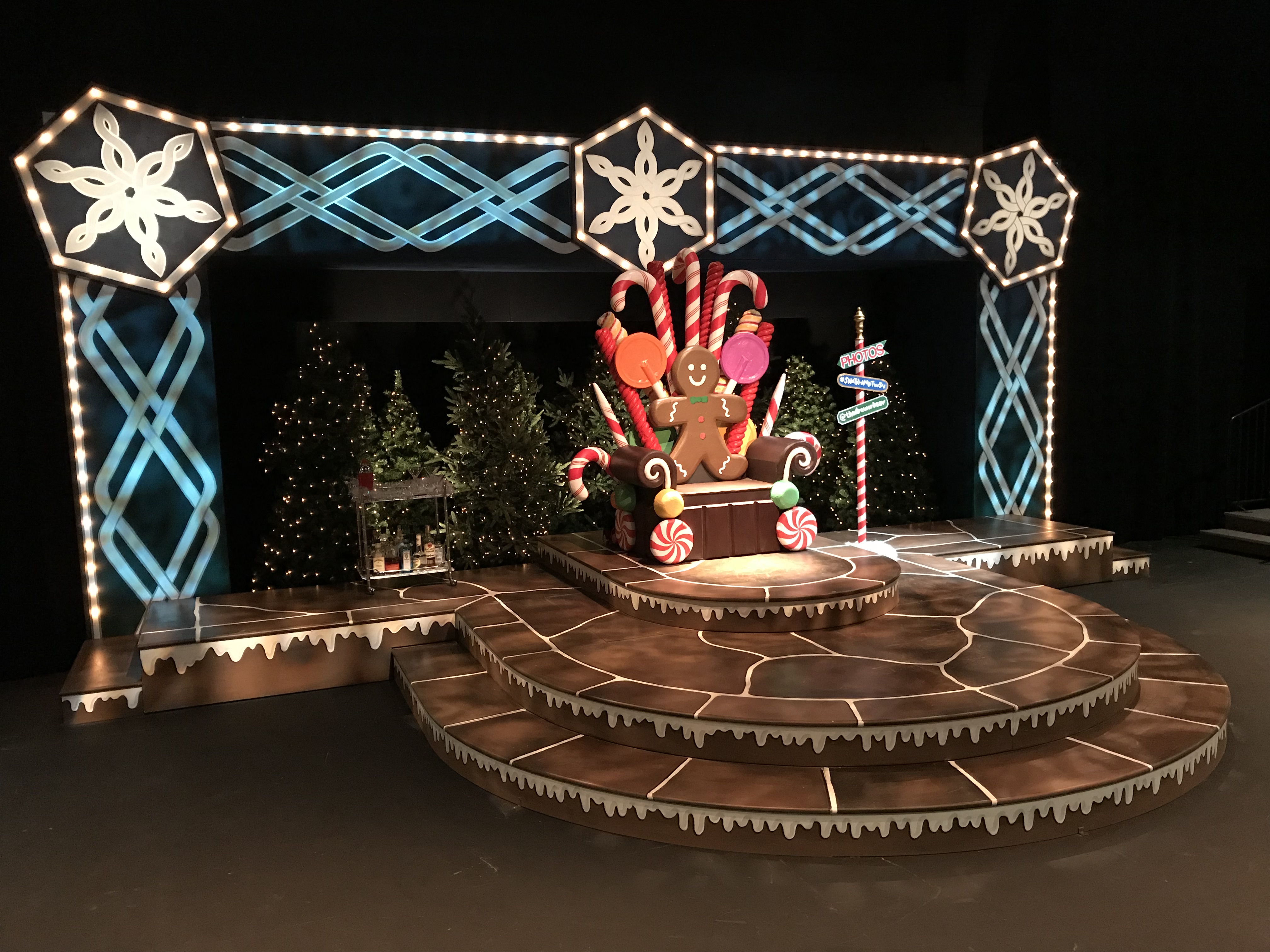
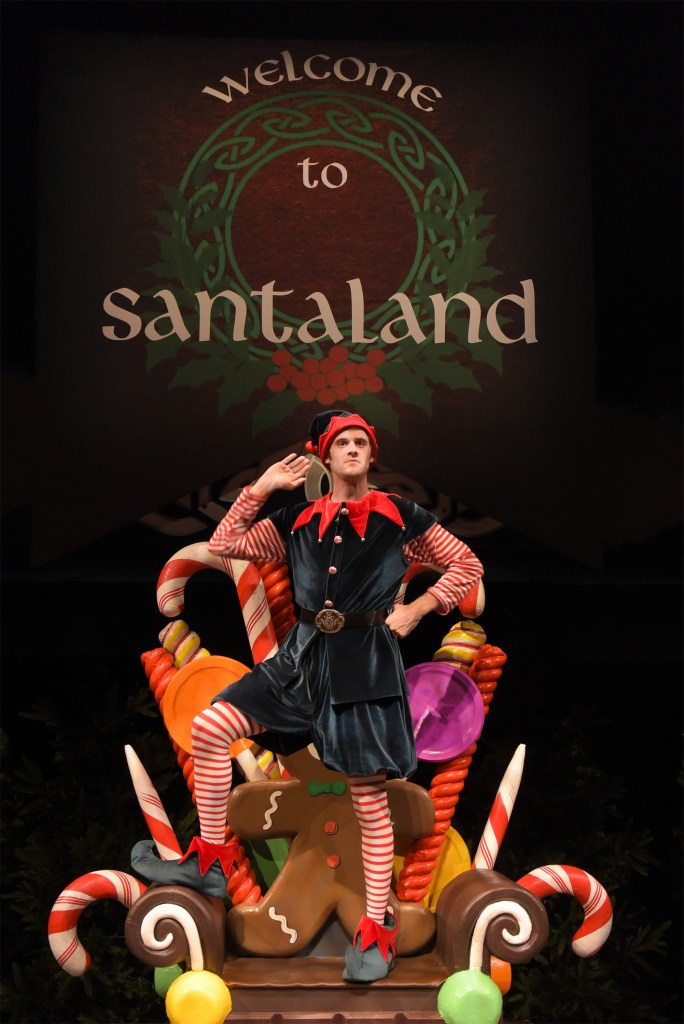
Jeffrey Lo directs Max Tachis in this TheatreWorks production at the Lohman Theatre on the Foothill College campus. Scenic designer, Christopher Fitzer captures the feel of the Macy’s Santaland setup with a nicely framed Santa throne in front of a small, but tastefully lighted pine forest. There’s no snow, except when momentarily provided by Mia Kumamoto’s lighting design toward the end of the piece.

Tachis is wonderful in this show. It’s not an easy task to be an engaging solo performer for an unbroken 70 minute stretch, but Tachis is up to the challenge. Before he enters the stage, the set stands open for patrons to take turns sitting in the big chair and taking pictures. Yours truly decided to take that opportunity to shoot the accompanying shot of the colorful set, signpost (next to the big chair) and all.

When Tachis first enters, he hams it up posing with the signpost for a few last photos before he instructs patrons to put their phones away for the duration of the performance. His curtain speech is a bit different than the standard recordings. It both does the job and sets the tone for much of what is to come.

Howard Ho’s sound design could almost be considered “counter-Christmas” with some rock, some eerie haunted-sounding holiday arrangements, and a bit of burlesque thrown in at just the right moment. In addition, as Tachis portrays David / Crumpet the elf introducing the audience to the different regions of Santaland, sudden horn blasts accompany the unfurling of the appropriate banners, sounding like attacks to the poor elf on stage.

Tachis, for his part, starts out as himself. Once he takes care of the pre-show business and delivers his unique announcement, he reemerges as David Sedaris, job hunter in NYC during the holiday season. As David, he recounts to the audience a conversation he had with his roommate sneering at the ads for seasonal help. He then shares that he applied to become a store elf on a whim after this discussion. Despite his having shared in some mockery with his roommate over such a position, he’s unemployed and down to his last $300 before he’d have to resort to becoming a dog walker to be able to eat and figures how hard could it be? Little did he know.
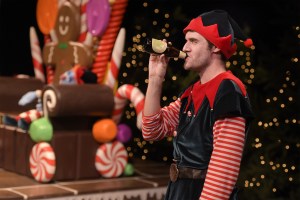
Tachis’ easy manner, sardonic delivery, and facial expressions convey volumes. Through his monologue, we come to understand that in many ways, becoming a store elf is much like any other job. The duties, however, are a bit specialized. As he recounts the interview, onboarding, and training phases, he clearly points out the unique aspects of his position. It’s evident that David really doesn’t belong in this job, but he’s going to make it work somehow.

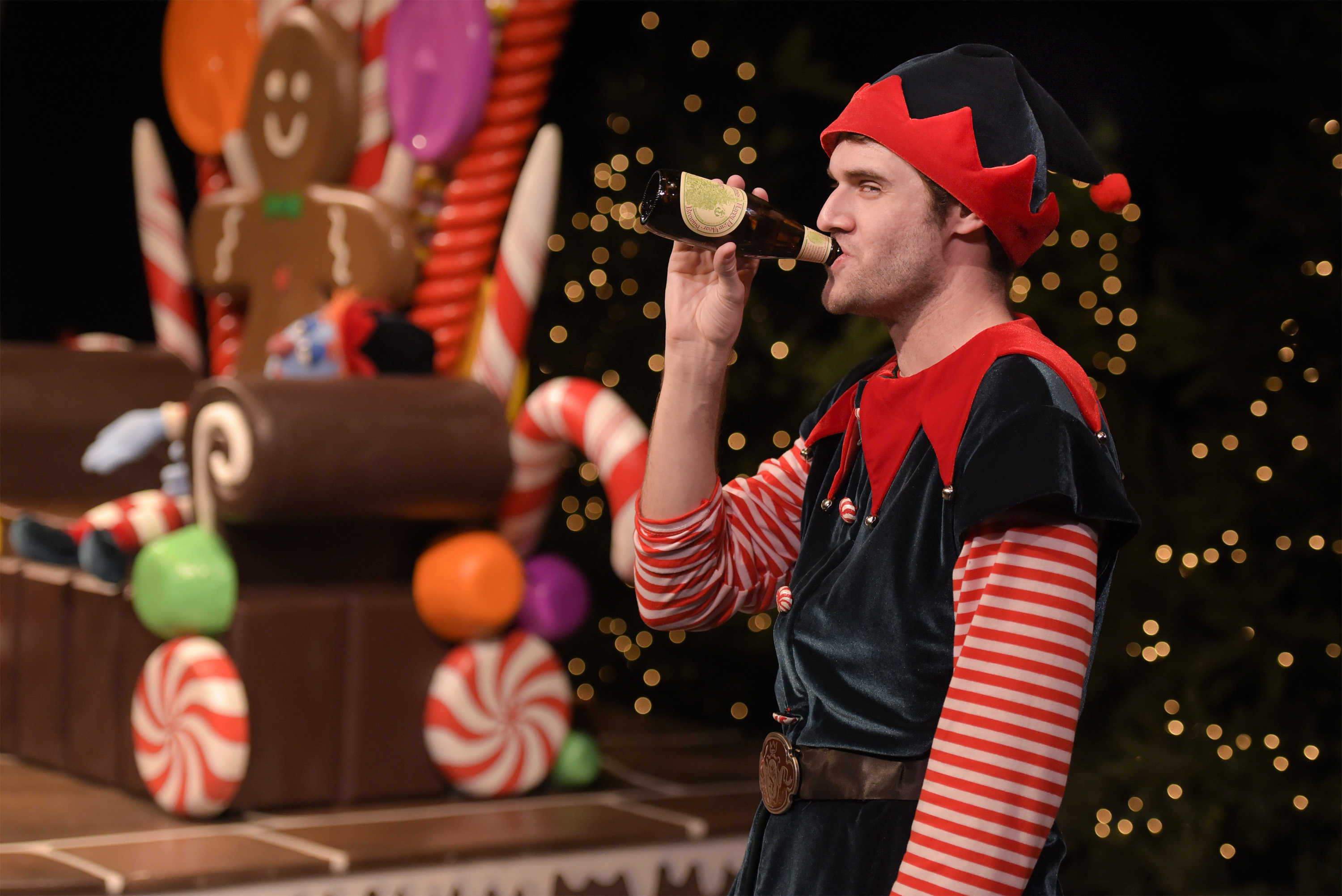
Then David gets to the final training session when his work uniform is required. He changes on stage with appropriate snide comments about his elven wear, and a chorus of “Santa Baby” plays on as he applies the velvet costume pieces. Costume designer Jill C. Bowers hits the perfect combination of colors and textures to make his outfit memorable and authentic.

Much of what Tachis relays sounds extremely familiar to anyone who has worked in the service industry dealing with the general public up close and personal. Whether it’s the impatient or insipid customers, or his zany colleagues, audience members can picture the people he describes and, in many cases, correlate them to acquaintances from their past.

The standout scenes though are when Tachis brings out his alter ego, designed by Mark Stys. His mini-me elf puppet is adorable, and the interactions Tachis has with him are priceless. Whole conversations ensue, some involving members of the audience, some further upstage, but all with wonderful expressions and mannerisms. Tachis is quite an adept puppeteer for this production, seamlessly manipulating the mini-elf and frequently exchanging glances as they “share” the jokes together.

Being live theatre, there are moments where slight malfunctions might occur, and on opening night did occur at least once. At one critical moment, a set piece didn’t entirely cooperate when it was deployed, but Tachis adroitly delivered a situational ad-lib and didn’t miss a step. He has internalized this material to the point where it flows easily and naturally, no matter what happens.

This production won’t appeal to everyone, but if you’re looking for a fun escape from the normal holiday happiness, this is definitely the show for you. It’s a little edgy, but not overly so. It’s a got a wee bit of off-color language and content, but there too, not excessively so. It gives audiences an entertaining appreciation for a seasonal job that they’ve certainly at least seen if not lived themselves. It’s clever, and the time flies by before sending folks back to their normal holiday hubbub.

What:  The Santaland Diaries, by David Sedaris, adapted by Joe Mantello

Where:  Lohman Theatre, Foothill College, Los Altos Hills, CA

When:  Continues through 23 December 2017

See http://theatreworks.org/201718-season/201718-season/santaland-diaries/, email boxoffice@theatreworks.org, or call (650)463-1960 for more information or to order tickets.

(Photo credits: Kevin Berne for all but the preshow set shot; A Good Reed Review preshow set shot)

Background References:
The Santaland Diaries / Season’s Greetings: 2 Plays
NPR: A Holiday Tradition: David Sedaris Reads ‘Santaland Diaries’
TheatreWorks packs 80 days into a fun-filled, 2-hour trip around the world

By Ande Jacobson

TheatreWorks presents Mark Brown’s adaptation of the 1872 Jules Verne classic novel, Around the World in 80 Days, and has audiences whooping at the antics on this whirlwind, 80-day adventure compressed into 120 hilarious minutes (including intermission). Although the show is billed as a holiday adventure, the only holiday aspects are the festive adornments throughout the house at the Lucie Stern Theatre, a bit of snow along the journey, and the timing of the target arrival home from the adventure. It’s good, clean, family-friendly entertainment that will have even the “grinchiest” audience member smiling. The adventure intertwines technology and romance across the globe in that bygone era of the late 19th century. Continue reading

BBB mounts a dancing spectacular that glistens in the rain

By Ande Jacobson

Singin’ in the Rain started life as an MGM film in 1952 showcasing the talents of Gene Kelly, Donald O’Connor, and Debbie Reynolds. It later became a classic film legend, even though it originally only enjoyed modest success. It tells the memorable story from the 1920s about the transition of the film industry from silent films to talkies, and humorously details the challenges felt by those unfortunate silent film stars whose voices were better left unheard. In the mid-1980s, the film was faithfully adapted for the stage keeping the story and all of the songs and memorable dances intact. It’s actually a little surprising that it took until the mid-80s to reach the stage given that its story fits the traditional musical mold so well. It’s an uplifting tale of boy meets girl, boy loses girl, and boy gets girl back in the end after a few interesting twists and complications. Then again, this show requires three true triple threats along with a well-synchronized dance ensemble, masters of tap one and all. And it requires on-stage rain, so it’s not a trivial matter to mount a successful production. Continue reading

The prescience of Henrik Ibsen’s ‘An Enemy of the People’ – who knew?

By Ande Jacobson

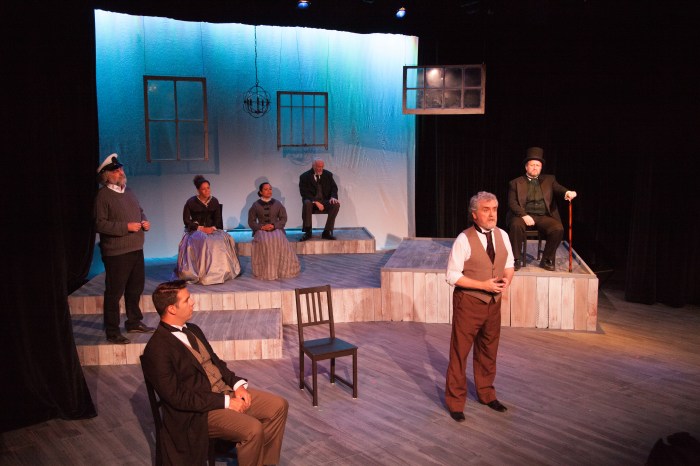
The Pear never backs away from edgy theatre, a tradition that’s alive and well in their current production – An Enemy of the People. Rebecca Lenkiewicz’s adaptation of Henrik Ibsen’s 1882 political masterpiece premiered in London in 2008 and made its Broadway debut in 2012. Though this version of Ibsen’s story is 90 minutes shorter than the original (the Pear’s production runs approximately 120 minutes including the intermission) and includes updated (and translated) language, the integrity of Ibsen’s material remains intact. The surprising aspect of this work is that although it depicts a situation in 1880s Norway, its themes and issues are just as pertinent to U.S. society today and include altruism and whistleblowing vs. profit and venal self-interest; media manipulation vs. the truth; free speech; and the educated elite vs. the working class. Continue reading

TheatreWorks’ ‘The Prince of Egypt’ brings a big story to life in a spectacular way

By Ande Jacobson

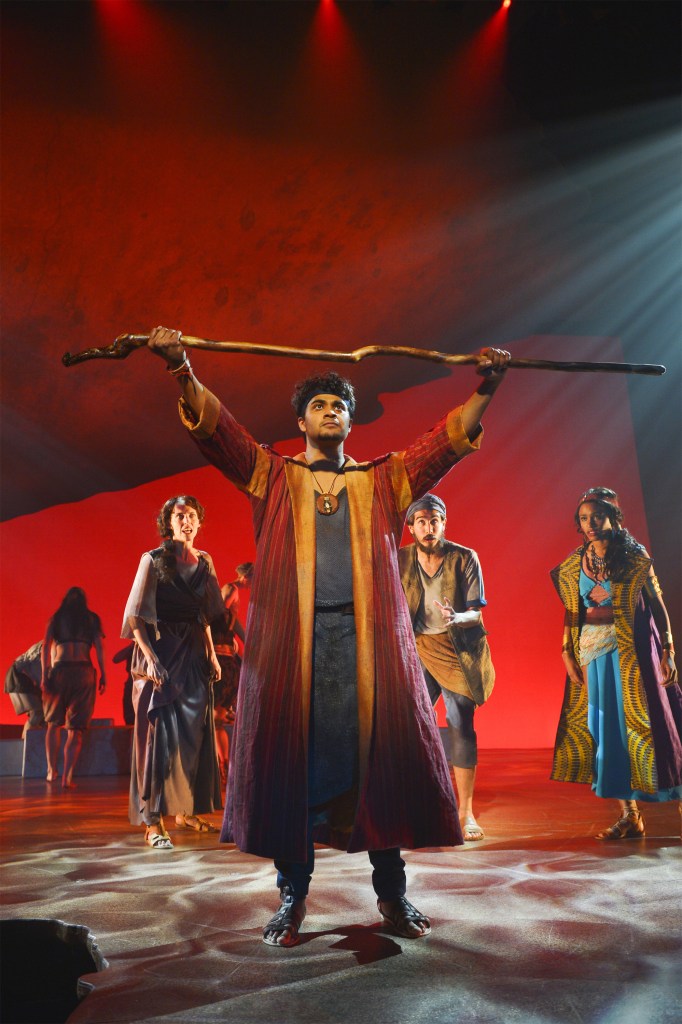
TheatreWorks is no stranger to world premieres, or even to working with the powerful father-son artistic duo of Stephen and Scott Schwartz. Lest audiences think that the current TheatreWorks production of The Prince of Egypt is routine in any way, they can rest assured that it is not. The show is adapted and expanded from the 1998 DreamWorks film of the same name, and conveys its story of biblical proportions in an immensely creative and captivating way while providing some breathtaking theatre. The Prince of Egypt tells the story chronicling the early life of Moses up through his awakening as one of the Hebrews on his quest to “let his people go.” The production is a world premiere that Mountain View audiences will savor for reasons that will be described shortly. What will be seen on stage; however, stems from a collaboration that breaks new ground for TheatreWorks. The stage adaptation by Stephen Schwartz and Philip LaZebnik is being mounted in collaboration with the acclaimed Fredericia Teater in Denmark. Once the Mountain View run completes, Diluckshan Jeyaratnam (Moses) will head back to his homeland to star in the European portion of this co-world premiere in both Fredericia and Copenhagen, telling the story in both Danish and English beginning in April 2018.

What makes this production so spectacular? It’s all in the storytelling. The cast is a talented, diverse, international troupe that explodes with the grandeur and precision this story demands. The grand scale, with empires and monumental physical elements from the Egyptian pyramids, to the river Nile, the expansive desert, and the Red Sea are well-known, and generally not seen on stage. In a film, these can be included directly, but on stage, while they could be projected, a far more creative approach can also be applied. Per director Scott Schwartz:

“We call on cloth, light, and dance to represent water, fire, plagues, and more.”

Continue reading

‘Fiddler’ 2017 breaks all SCP records – L’Chaim!

By Ande Jacobson

This run just keeps surpassing itself. The Sunnyvale Community Players production of Fiddler on the Roof continues to receive not one, but two standing ovations every performance, and as of 29 September 2017 (one quarter of the way through its penultimate weekend), the run completely sold out. As written in the background pieces – promising cheers and tears, tech week chronicles from the pit, and why his run – this production means a great deal to everyone involved with the show. Rather than rehashing the background already discussed at length, this article attempts to provide some more video insights into this heartfelt journey. Continue reading

SCP’s ‘Fiddler’ 2017 Tech Week Chronicles from the pit

By Ande Jacobson

Starting at the end of this story, on opening night, this Sunnyvale Community Players production of Fiddler on the Roof received not one, but two standing ovations! Needless to say, all the hard work over the many months, and especially this final week, Tech Week, paid off. This last week was a doozy, but we not only survived, we thrived, and the show runs at the Sunnyvale Theater Thursdays – Sundays through 8 October 2017. Now on to the focus of this article, the path through our final week of rehearsals from the pit.

Tech Week, or more colloquially, Hell Week, is always an adventure in the theatre, particularly for musical theatre. Tech Week is that last week leading up to opening night when all the elements are combined, both technical and artistic, which in the case of a musical also includes the music itself. Everything that can go wrong often does, but somehow, magically, it all works by the time the last element is added – the audience. Fiddler on the Roof is a big show, and this Sunnyvale Community Players production includes a cast of 38 (with around 20 of them wearing individual mics) and a full 25-piece orchestra (with every instrument on its own mic) covering every part in the licensed orchestration. By the time we arrived at the first day of tech, the cast had been rehearsing for two months, and two sitzprobes with cast and orchestra together had been conducted.

The video below is a sample from early in the week. The pictures in the video are still shots of the stage action from scenes throughout the show, and the audio is from our recording session of the John Williams mini-symphony on the second night of tech. Note that this Williams piece was originally written for the 1971 film version of Fiddler on the Roof covering the opening credits, the Entr’acte, and the end credits. We will be performing this work in its entirety each show as intermission entertainment, featuring Eric Sun playing the iconic Isaac Stern solo violin part:

Continue reading

Paroxysms, circa 1880s, abound at the Pear

By Ande Jacobson

According to a handy, modern medical dictionary, a paroxysm is defined as:

  1. a sudden violent attack, especially a spasm or convulsion, or
  2. the abrupt worsening of symptoms or recurrence of disease.

In a broad sense, the first definition fits the 1880s meaning in terms of all outward appearances, but that’s not exactly what they meant by the word in those days – at least as it’s used in Sarah Ruhl’s play, In the Next Room or the vibrator play, currently on stage at the Pear Theatre. This work was inspired by Rachel P. Maines‘ research. Maines specializes in the history of technology and accidently discovered an odd connection between medical practice of late 19th century and technological advances in the use of electricity based on ads from numerous American women’s magazines from the era. The new gadget of the time was the precursor to the modern vibrator, and it was used to treat the nebulous, mostly female malady known as “hysteria” through “manipulation of the uterus” resulting in “paroxysms” that were supposed to fix the imbalance. Looking back from the present, it seems far more likely that the symptoms this 19th century device was supposed to treat resulted from taboos surrounding intimacy, ignorance, fiendish fashion norms, gender discrimination, and an extremely patriarchal society. Continue reading

SCP’s ‘Fiddler on the Roof’ promises cheers and tears – opens 16 September 2017

By Ande Jacobson

Sunnyvale Community Players’ production of Fiddler on the Roof is going to delight audiences in ways that no previous Fiddler production has. The well-known story is based on the works of Sholom Aleichem, often called the Jewish Mark Twain. Playwright Joseph Stein collaborated with composer Jerry Bock and lyricist Sheldon Harnick to create a captivating presentation of the lives of the people of Anatevka, a little village in Czarist Russia in the early 20th Century. Its themes of tradition vs. change, family, and community are timeless, and given the current state of the world today, they are especially timely. This Broadway favorite first hit the stage in 1964, became a highly acclaimed feature film in 1971, and is beloved the world over. Continue reading

‘The Student Conductor’ masterfully merges politics, history, fiction, and musical reality

By Ande Jacobson

Robert Ford isn’t exactly a household name, and it’s been over a decade since he published his first (and seemingly only) novel. He went on to write several award-winning one-act and full-length plays that have been produced both in the U.S. and in Europe, but his novel remains a unique work. The Student Conductor was first published in the U.S. in 2003 with subsequent editions in Europe and Australia. It gives readers a look into Ford’s imagination as he conjures up plenty of intrigue and heart. He also guides readers deep into the magical world of classical music giving them an idea of just what it takes to become a professional symphony conductor. Continue reading